International shipping is complex—and hidden costs can hurt your bottom line
Expanding into international markets offers exciting opportunities, but it also introduces complexity. Many businesses underestimate the true cost of getting a product across borders, only to discover too late that unexpected fees are eating into their margins.
Beyond the base price of goods and shipping, cross-border transactions often come with a host of additional charges: duties, taxes, brokerage fees and handling costs. These hidden expenses can quickly turn what looked like a profitable sale into a loss.
Worse, they don’t just affect your bottom line, they affect your customer experience. Surprise charges at delivery, customs delays or refused shipments can frustrate buyers, damage brand trust and lead to higher return rates.
That’s where landed cost comes in. It’s a clear, comprehensive way to calculate the total cost of delivering goods from origin to destination, including every fee along the way. By understanding and planning for landed cost, businesses can protect margins, avoid surprises and deliver a smoother, more transparent experience for their international customers.
- In 2023, the global online shopping cart abandonment rate reached 70% for the first time since 2013 (Statistica)
- In the U.S. in 2025, nearly 40% of consumers cited additional costs (shipping, taxes or fees) as the reason they abandoned purchases during checkout (Statista)
Key takeaways
- What is landed cost—and why does it matter?
- Key components of landed cost
- How does landed cost affect your pricing, margins and customer experience?
- How to calculate landed cost accurately
- How landed cost transparency supports faster, smoother customs clearance
- How supply chain shifts impact landed cost
- Purolator’s North American and international shipping expertise
- Navigating global tariffs: How trade policies affect your landed cost
- Five business benefits of mastering landed cost
- How to integrate landed cost into your e-commerce shipping strategy
- Why choose Purolator as your cross-border shipping partner?
- Unlock global growth without hidden costs
What is landed cost—and why does it matter?
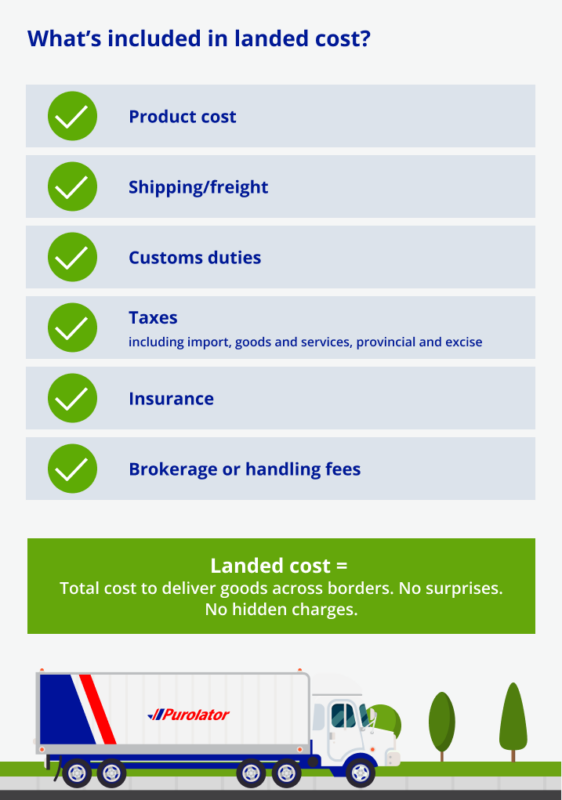
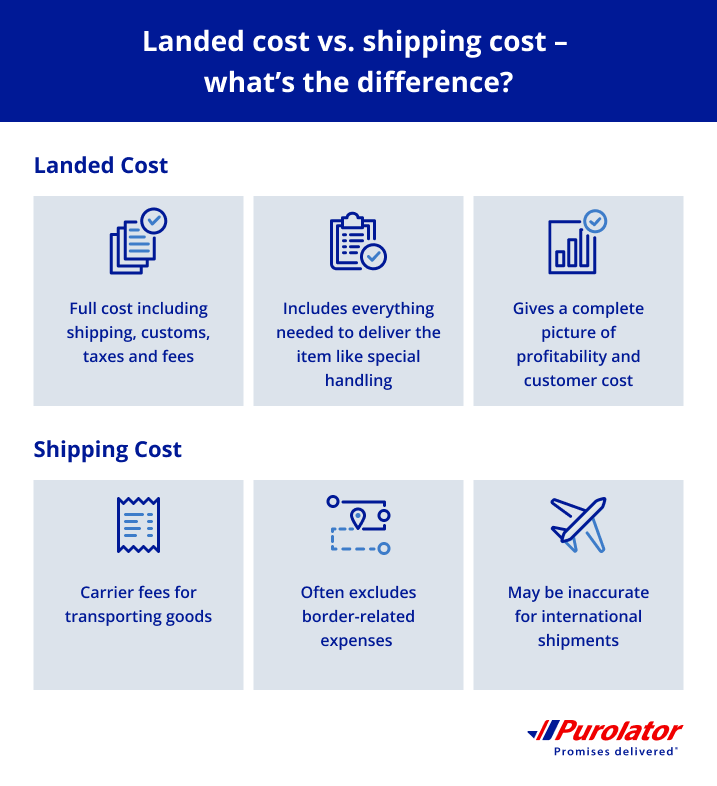
At its core, landed cost is the total cost of getting a product across borders, through customs and into the buyer’s hands. It includes international shipping costs, customs duties, import taxes, insurance, brokerage fees and any additional handling charges incurred along the way.
In short, it’s not just what you pay to ship the goods—it’s everything you pay to deliver them successfully.
Why is landed cost important in international shipping?
When businesses overlook the components of landed cost, they risk underestimating the true cost of selling internationally. This can lead to inaccurate pricing, reduced margins and surprise charges for the end customer.
Getting landed cost right matters because it helps businesses:
- Enable accurate pricing: By including all cross-border expenses, businesses can set prices that reflect the real cost of international delivery, avoiding underpricing that cuts into profits or overpricing that drives customers away.
- Maintain healthy profit margins: Unaccounted fees can erode profitability fast. A clear landed cost calculation ensures that each sale supports your bottom line, not just your top line.
- Build customer trust: Nobody likes unexpected charges at checkout—or worse, on delivery. Offering landed cost transparency reduces friction, improves the buying experience and keeps customers coming back.
As cross-border e-commerce continues to grow, so does the need for businesses to understand their full international logistics picture. Landed cost is a key part of that puzzle, one that can make or break your success in global markets.
Key components of landed cost
Understanding the components of landed cost is essential for any business involved in international logistics. These aren’t just optional add-ons, they’re core to calculating your total shipping cost accurately and avoiding margin erosion or customer dissatisfaction.
Let’s break down the key elements that make up landed cost:
Duties and tariffs
Import duties are government-imposed fees based on the type of goods/commodity, the value of goods and the country of manufacture in cross-border shipments. These are calculated using Harmonized System (HS) codes, which classify products into categories for customs purposes.
Duties can vary widely depending on the product and destination country,and they’re often impacted by changing trade agreements or political shifts. Businesses that don’t stay current risk paying more than necessary or facing costly delays at the border.
To minimize risk, it’s important to:
- Classify products correctly using HS codes
- Stay up to date with tariff changes
- Plan for duty costs in your landed cost calculation
Optimize your cross-border shipping with Purolator
Taxes (e.g., VAT, GST, HST)
Taxes such as Value-Added Tax (VAT), Goods and Services Tax (GST) and Harmonized Sales Tax (HST) are applied at the point of import or sale, depending on the destination country or province.
These taxes:
- Vary by region and product category
- Must be calculated accurately
- Should be disclosed to customers at checkout to avoid surprise charges
Including taxes in your landed cost helps maintain transparency and ensures you remain compliant with local tax regulations.
Freight surcharges
Shipping isn’t just about moving goods—it’s about protecting them, too. Your international shipping costs will likely include:
- Base freight charges
- Fuel surcharges
- Additional fees for special handling or oversized packages
- Cargo insurance to protect against loss or damage in transit
These costs often fluctuate based on destination, mode of transport and carrier surcharges, making them important variables in any landed cost calculation.
Customs brokerage and handling fees
Clearing goods through customs involves paperwork, compliance and coordination with multiple government agencies. Many businesses rely on customs brokers or logistics providers to handle this process.
Brokers typically charge fees for:
- Preparing and submitting customs declarations for clearance
- Coordinating inspections
- Managing duties and taxes on your behalf
These handling fees may also include warehouse transfers, repackaging or last-mile coordination. They’re essential to factor in when estimating the total cost of delivering goods internationally.
How does landed cost affect your pricing, margins and customer experience?
When businesses underestimate landed cost, they put their margins and customer relationships at risk. Failing to account for duties, taxes and handling fees can quickly turn a profitable sale into a loss—especially in cross-border e-commerce.
Pricing becomes a guessing game. Set prices too low, and you absorb unexpected costs. Set them too high, and you lose your competitive edge. Either way, poor landed cost calculation makes it harder to maintain healthy margins. It also impacts the customer experience. Shoppers don’t like surprises—especially at checkout or delivery. Unexpected customs fees often lead to cart abandonment, refused deliveries or negative reviews.
On the other hand, getting international shipping costs right improves both transparency and trust. When customers know exactly what they’re paying upfront, they’re more likely to complete the purchase and come back again.
How to calculate landed cost accurately
Getting landed cost right starts with having a clear, consistent method. Whether you’re managing a few cross-border shipments or scaling a global operation, choosing the right approach depends on your volume, complexity and available tools.
Manual method: Add up all known costs
- Best for low-volume shippers or simple supply chains
- Risk of human error and missed fees
- How to calculate landed cost for imports/exports
For smaller businesses or low-volume shippers, calculating landed cost manually for imports/exports is possible, but it comes with risks.
You’ll need to add up:
- Product cost
- Shipping and insurance fees
- Customs duties (based on HS codes)
- Import taxes (like VAT, GST or HST)
- Brokerage or handling charges
This method can work for simple supply chains, but it requires constant attention to regulations, fee changes and country-specific tax rules. Even a small oversight—like an outdated tariff or misclassified product—can lead to costly mistakes.
Use a landed cost calculator
Landed cost calculators are tools—often built into e-commerce or shipping platforms—that automate the process by factoring in current tariffs, taxes, shipping rates and destination regulations.
They help you:
- Save time
- Minimize manual errors
- Adjust pricing dynamically based on destination
- Improve the accuracy of your international shipping cost estimates
For growing businesses, calculators offer a scalable way to build landed cost transparency into the customer journey, especially at checkout.
Make the process easier with Purolator Trade Assistant
For Canadian brands shipping to the U.S. and beyond, Purolator Trade Assistant simplifies every step of the landed cost calculation process.
You can:
- Estimate duty rates and identify the correct HS codes
- Generate customs documentation to ensure compliance and reduce clearance delays
- Streamline imports and exports, making it easier to manage cross-border costs and avoid surprise fees
By automating key steps and ensuring your shipments are compliant from the start, Purolator helps reduce border friction and improve both efficiency and customer satisfaction.
Want to reduce landed costs and simplify your U.S. and international shipping? Talk to a Purolator expert today.
Want faster border clearance and fewer delays? Learn how Purolator’s customs optimization strategies can help improve international delivery performance. Read whitepaper.
How landed cost transparency supports faster, smoother customs clearance
Even with the best logistics plan, international shipping can be delayed by one common issue: customs clearance. When the duties, taxes or documentation don’t line up, your shipment can be held at the border, causing delays, extra fees and unhappy customers.
Many of these issues stem from incomplete or inaccurate landed cost calculations. Missing tax details, incorrect product classification or unaccounted fees can trigger compliance checks, shipment holds or unexpected charges.
By clearly itemizing duties, taxes and fees upfront, businesses can move goods across borders with fewer disruptions.
Purolator’s customs expertise
As a trusted logistics partner, Purolator brings more than fast delivery to the table, we bring customs know-how, too. Our customs clearance solutions help businesses:
- Classify goods accurately using correct HS codes
- Generate compliant documentation for both imports and exports
- Avoid costly errors that can lead to clearance issues or surprise fees
With Purolator’s customs support, you gain the confidence to ship across the Canada–U.S. border and beyond
Livingston International
With Purolator’s acquisition of Livingston International—North America’s leading international customs broker—we’ve expanded our customs capabilities even further. This integration enhances our ability to offer end-to-end solutions, from landed cost calculation to smooth customs clearance, helping your shipments arrive on time, every time.
Learn more about Livingston International
How supply chain shifts impact landed cost
In today’s global trade environment, many companies are rethinking where they manufacture and source goods. Supply chain disruptions, rising international shipping costs and geopolitical tensions have made traditional offshore models less reliable and more expensive. Strategies like nearshoring, reshoring and friendshoring are gaining traction—and all three have a direct impact on your landed cost.
Nearshoring involves moving production closer to your target market—like relocating manufacturing from Asia to Mexico or Central America. This shortens transit times, reduces shipping complexity and can lower tariffs.
Reshoring brings production back to the company’s home country. While labour costs may be higher, reshoring improves supply chain control and reduces the risks and hidden fees often associated with cross-border logistics.
Friendshoring is about relocating operations to countries with stable political relationships. This helps reduce the uncertainty tied to trade restrictions, sanctions or sudden tariff changes.
Each approach makes landed cost more predictable, which is critical for accurate pricing, margin protection and long-term financial planning.
With these options, it’s also important to keep in mind that tariffs and border exemptions on goods can change. Keeping up with the latest Customs and Border Protection (CBP) information and policies, and working closely with your shipping partner, can help you navigate sudden changes and prepare you for adjustments when shipping across the border.
Learn more about friendshoring, nearshoring and offshoring in our whitepaper
Purolator’s North American and international shipping expertise
Purolator supports evolving supply chain strategies with flexible shipping options throughout Canada, the U.S. and Mexico. Whether you’re shifting production closer to home or diversifying across regions, we help:
- Minimize landed cost variability
- Shorten lead times
- Maintain customs compliance across multiple borders
With services like Purolator Vision for shipment tracking, integrated customs support and end-to-end logistics coverage, we help ensure your new supply chain strategy delivers—not just in speed, but in cost control, too.
Looking to rethink your sourcing strategy beyond China? Learn how nearshoring, friendshoring, reshoring and dual‑sourcing can reshape your supply chain for logistics efficiency. Read whitepaper.
Navigating global tariffs: How trade policies affect your landed cost
Tariffs are one of the most unpredictable elements of international logistics, and mitigating tariff impact is essential for your bottom line. A new trade agreement, political decision or regulation can suddenly increase your landed cost, especially if you’re sourcing from high-risk regions.
A timely example: the recent cancellation of Section 321 (also known as the de minimis exemption). The U.S. once allowed shipments valued under $800 USD to enter duty‑free, but that exemption has now been suspended globally as of August 29, 2025. That means even low‑value parcels will be subject to duties, taxes and full customs processing.
Learn more about the de minimis changes here
That’s why companies increasingly rely on landed cost calculation to model “what-if” scenarios. These tools help you estimate the financial impact of new tariffs before they hit, so you can adjust pricing and sourcing strategies in real time.
How Purolator helps businesses adapt
As trade dynamics shift, Purolator provides the expertise and tools to help you stay ahead. We support international shippers with:
- Customs clearance consolidation services to reduce processing time and avoid duplication of duties
- Logistics support that helps manage tariff fluctuations and navigate complex trade environments
- Proactive duty and tax management so you stay compliant—even when the rules change overnight
Whether you’re adjusting to new tariffs or exploring new markets, we make sure your international shipping strategy is agile, accurate and resilient.
Stay ahead of U.S.‑Canada trade changes and get insights on tariffs, trade policy shifts and cost‑saving strategies in our webinar with Livingston International. Watch now.
Five business benefits of mastering landed cost
1. More accurate pricing and stronger margins
Understanding landed cost helps businesses set competitive yet profitable prices by accounting for all costs—including duties, taxes and fees.
Purolator’s solution:
Purolator Trade Assistant helps obtain harmonized system codes and estimating duty rates, aiding in accurate pricing and margin protection.
2. Improved customer trust and reduced returns
Transparent pricing with no surprise fees builds customer confidence and reduces abandoned carts or returns related to unexpected costs.
Purolator’s solution:
With Purolator’s reliable cross-border shipping and web integration services, brands can communicate total costs upfront, enhancing customer satisfaction.
3. Fewer border delays and customs issues
Mastering landed cost means better planning for customs duties and compliance, reducing costly delays at borders.
Purolator’s solution:
Purolator offers customs clearance and brokerage services, ensuring timely and compliant shipments across borders.
4. Lower operational costs through better planning
Knowing total landed cost enables smarter supply chain decisions, optimizing inventory placement, freight modes and shipping routes to reduce costs.
Purolator’s solution:
Purolator offers flexible shipping options and near real-time tracking with Purolator Vision, empowering businesses to optimize operations and reduce overhead.
5. Stronger international expansion strategies
Accurate landed cost calculation allows companies to confidently enter new markets with a clear understanding of financial implications and pricing strategies.
Purolator’s solution:
With Purolator’s North American and international shipping expertise, brands can scale globally while managing landed cost complexities effectively.
Stay compliant and avoid costly delays by understanding cross-border customs requirements from Partner Government Agencies. Read whitepaper.
How to integrate landed cost into your e-commerce shipping strategy
For e-commerce brands shipping internationally, the difference between a completed sale and an abandoned cart often comes down to cost transparency. If your checkout doesn’t reflect the true landed cost—including duties, taxes and handling fees—customers may hesitate or walk away entirely.
Offer landed cost visibility at checkout
Today’s online shoppers expect clarity. Surprises like unexpected duties or fees lead to negative reviews or even canceled deliveries. By showing the total shipping cost upfront, including duties and taxes, you reduce friction and boost trust.
Transparent pricing also helps position your brand as professional and reliable, especially when expanding into the U.S. market or other international regions.
Use automation and shipping APIs
Manually calculating landed cost is slow, error-prone and not scalable. Automation solves that. By integrating shipping APIs or web services into your e-commerce platform, you can automatically estimate duties, taxes and other cross-border fees at checkout—ensuring the rates you quote to your customers reflect your actual shipping costs.
Align your fulfillment and customs documentation
Even with the right landed cost calculation, successful cross-border delivery depends on accurate customs documentation. Incomplete or incorrect paperwork can trigger border holds, additional fees or lost shipments.
By syncing your fulfillment processes with your customs strategy, you create a smoother shipping experience for both your team and your customers.
With Purolator’s end-to-end logistics support, you can:
- Find the right customs documents with Purolator Trade Assistant
- Ensure each shipment includes accurate harmonized system codes
- Reduce clearance times and avoid costly delays with our customs clearance experts
Why choose Purolator as your cross-border shipping partner?
When Canadian businesses look to grow beyond borders, Purolator delivers the support they need to scale with confidence. As a trusted logistics provider, Purolator offers end-to-end cross-border solutions—from shipping and customs brokerage to fulfillment and returns.* And with 100% Canadian postal code coverage and a strong international network, we help brands reach customers across the U.S. and around the world.†
Whether you’re expanding through e-commerce, nearshoring operations in North America or entering new global markets, Purolator brings the reliability, visibility and expertise to simplify complex international logistics.
Work with Purolator to optimize your shipments between Canada and the U.S.
Nationwide expertise in landed cost management and cross-border shipping
 Comprehensive cross-border shipping solutions

Our experts manage your cross-border shipments to reduce delays and control landed cost variability.
Flexible cross-border shipping options

Choose cross-border express or ground, and international less-than-truckload (LTL)/truckload (TL) freight or air freight to meet delivery speed, cost and size needs.
Multimodal shipping services

Combine air, ground and freight modes for efficient international deliveries.
Digital Commercial Invoice

Generate and manage invoices electronically to reduce errors and speed customs clearance for timely shipping.
Cross-border returns management

Simplify returns across borders, enhancing customer experience and loyalty.
Support for e-commerce integration

Seamless platform integration automates order fulfillment, reducing errors and saving time for online sellers.
Full shipment visibility with Purolator Vision

Near real-time tracking and alerts provide transparency, helping you stay a step ahead of delays and extra landed cost charges.
Virtual Assistant and 24/7 customer support

Quickly resolve shipping questions anytime with Purolator’s online Virtual Assistant and round-the-clock support.
Special handling solutions

Expert handling of hazardous or sensitive shipments ensures safety and regulatory compliance.
Mission Critical service

Priority, expedited delivery outside regular hours with full tracking for urgent, time-sensitive shipments.
Optimized shipping routes for cost-effective international delivery

Advanced route planning helps control shipping costs and speeds delivery, improving landed cost.
Trusted partner with extensive coverage for domestic shipments

We are one of the most trusted carriers in Canada under the delivery services category, with reliable delivery across 100% of Canadian postal codes.*†
Sustainability meets cost efficiency

Eco-friendly delivery practices reduce emissions and support sustainable shipping throughout Canada.
Unlock global growth without hidden costs
Expanding internationally doesn’t have to mean sacrificing control or margin. With Purolator as your logistics partner, you gain the tools, expertise and network to manage landed cost effectively, so you can ship smarter, stay compliant and deliver a better customer experience. From customs brokerage to e-commerce integrations, our end-to-end solutions help you protect profitability and build trust with your customers as you grow across borders.
*Gustavson 2023 Brand Trust Index conducted by the Gustavson School of Business surveyed 9,200 Canadian consumers aged 18+. Ranked and evaluated trust in over 400 brands. Purolator ranked 3rd within the ‘Delivery Services’ category after FedEx and Canada Post respectively.
†Purolator Inc., Service Directory, 2024.