
Mexico is playing an increasingly important role in North American trade, ranking as Canada’s fifth-largest trading partner. In 2025 alone, Canada imported $22 billion USD (about $30 billion CAD) in goods from Mexico, reflecting the steady flow of exports from Mexico to Canada across key industries, such as automotive, aviation, electronics and medical devices.
At the same time, evolving trade regulations, tariffs and rising expectations for visibility and control are reshaping how goods move across borders. Businesses are under growing pressure to ensure seamless international deliveries while maintaining compliance with changing customs requirements.
As Mexico’s role as a strategic production hub for North America continues to expand, the need for a structured cross-border logistics strategy has never been greater. With the right logistics partner and strategy in place, businesses can better manage international shipping complexities, stay ahead of evolving regulations and keep shipments from Mexico to Canada moving.
Key takeaways
What is Mexico nearshoring?
Mexico nearshoring refers to shifting sourcing and production closer to North American markets. Instead of relying on distant overseas manufacturing with long delivery timelines, more businesses have turned to Mexico for skilled labour and established infrastructure for improved supply chain performance.
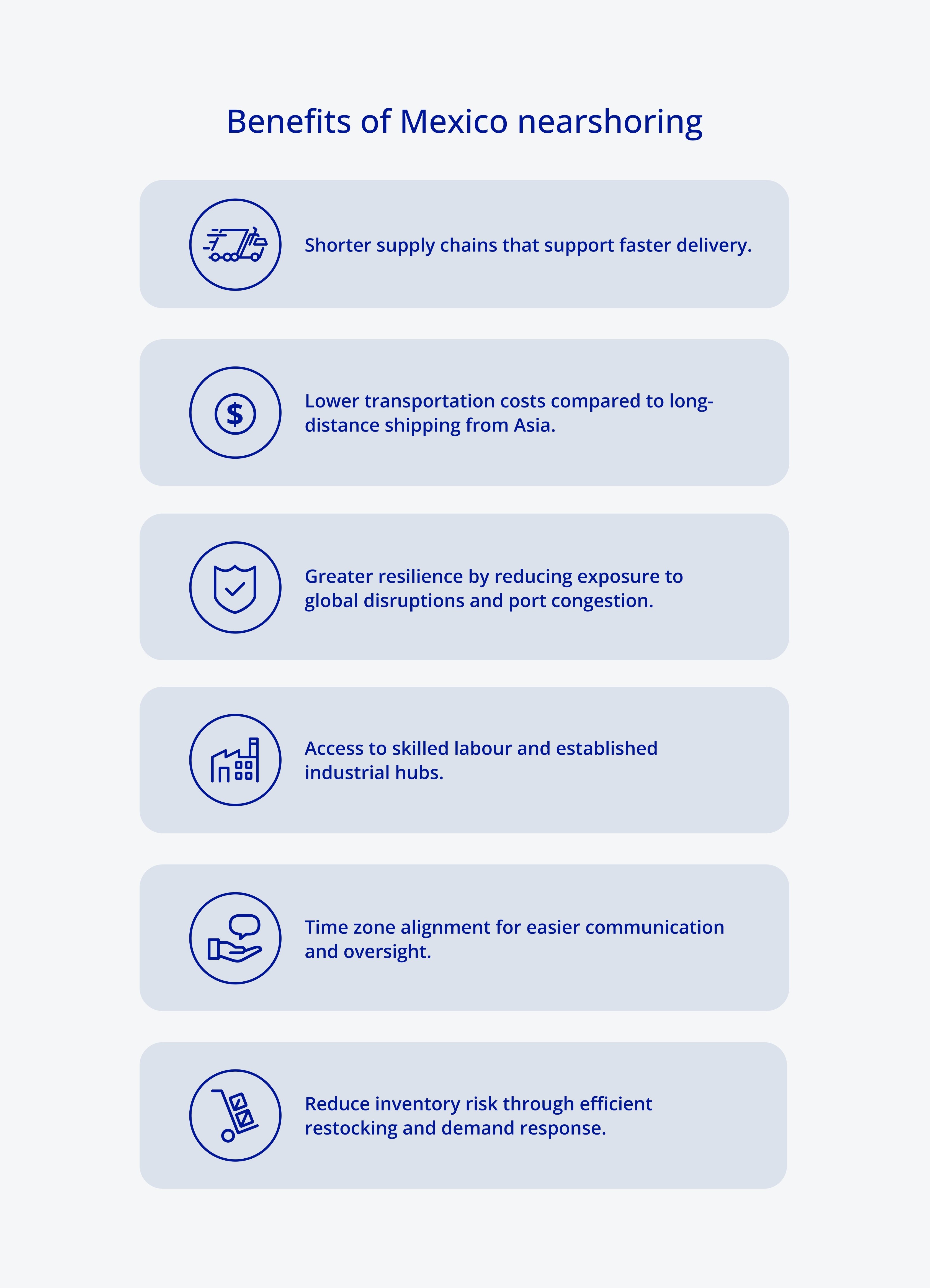
This practice provides several key benefits:
- Shorter supply chains that support faster delivery
- Lower transportation costs compared to long-distance shipping from Asia
- Greater resilience by reducing exposure to global disruptions and port congestion
- Access to skilled labour and established industrial hubs
- Time zone alignment for easier communication and oversight
- Reduce inventory risk through efficient restocking and demand response
Discover how businesses are leveraging low-cost manufacturing opportunities while improving logistics efficiency with Mexico nearshoring strategies.
How Mexico to Canada logistics works
To navigate shipping from Mexico to Canada effectively, businesses need a clear understanding of how cross-border logistics works. From cross-border transit to customs processes and documentation, each step introduces complexity that can impact speed, cost and reliability.
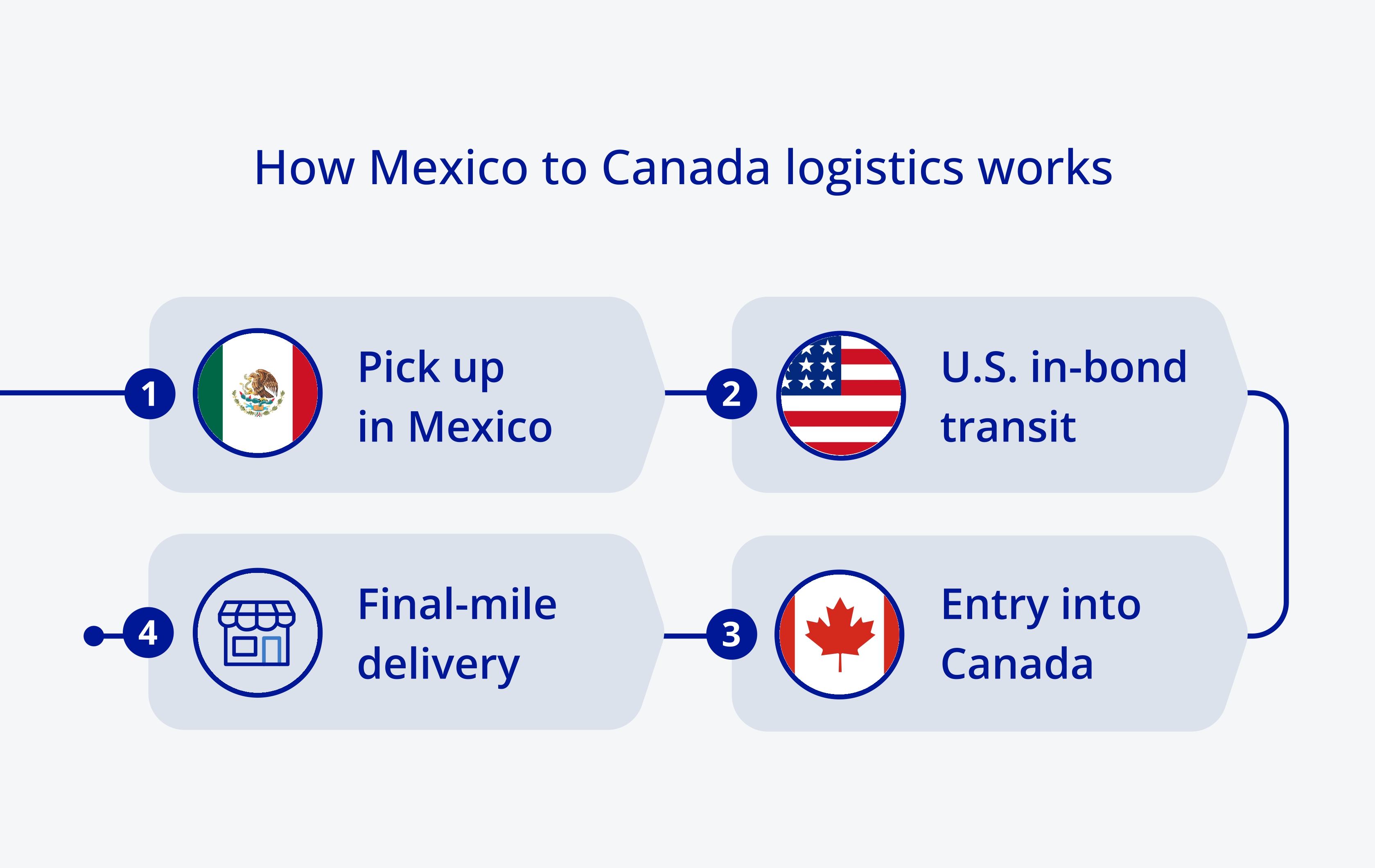
Process flow:
- Pickup in Mexico
- U.S. in-bond transit
- Entry into Canada
- Final-mile delivery
Cross-border shipments often require transfers between carriers due to regional regulations. These hand-offs can impact transit time and increase the risk of delays, loss or theft if not carefully managed.
In-bond shipping helps streamline this process by allowing goods to move across the U.S. without a formal customs entry. This reduces administrative requirements, avoids multiple duty payments and supports more efficient cross-border movement before final clearance in Canada.
Strengthen your cross-border strategy with leadership insights on Mexico-to-Canada logistics and supply chain efficiency.
Required documents for shipping from Mexico to Canada
Accurate documentation is essential at every stage of the journey to keep shipments moving smoothly across borders. Missing, incomplete or incorrect paperwork can quickly lead to delays, additional costs or shipment holds.
Required documents include:
- Commercial Invoice: Provides detailed shipment information and is required for customs clearance.
- Certificate of Origin (CUSMA): Confirms eligibility for reduced tariffs and streamlined border procedures.
- Customs Declaration: Ensure shipments meet regulatory requirements at each border crossing.
- Bill of Lading: Contains shipment details and functions as a contract of carriage.
- Additional Industry-Specific Documentation: Required for certain regulated goods to ensure compliance and safe transport.
As documentation requirements continue to evolve, working with a logistics partner that stays up to date on regulations is critical to maintaining compliance and avoiding costly disruptions.
What does Canada import from Mexico?
Canada imports a wide range of goods from Mexico, highlighting both the scale and diversity of cross-border trade.
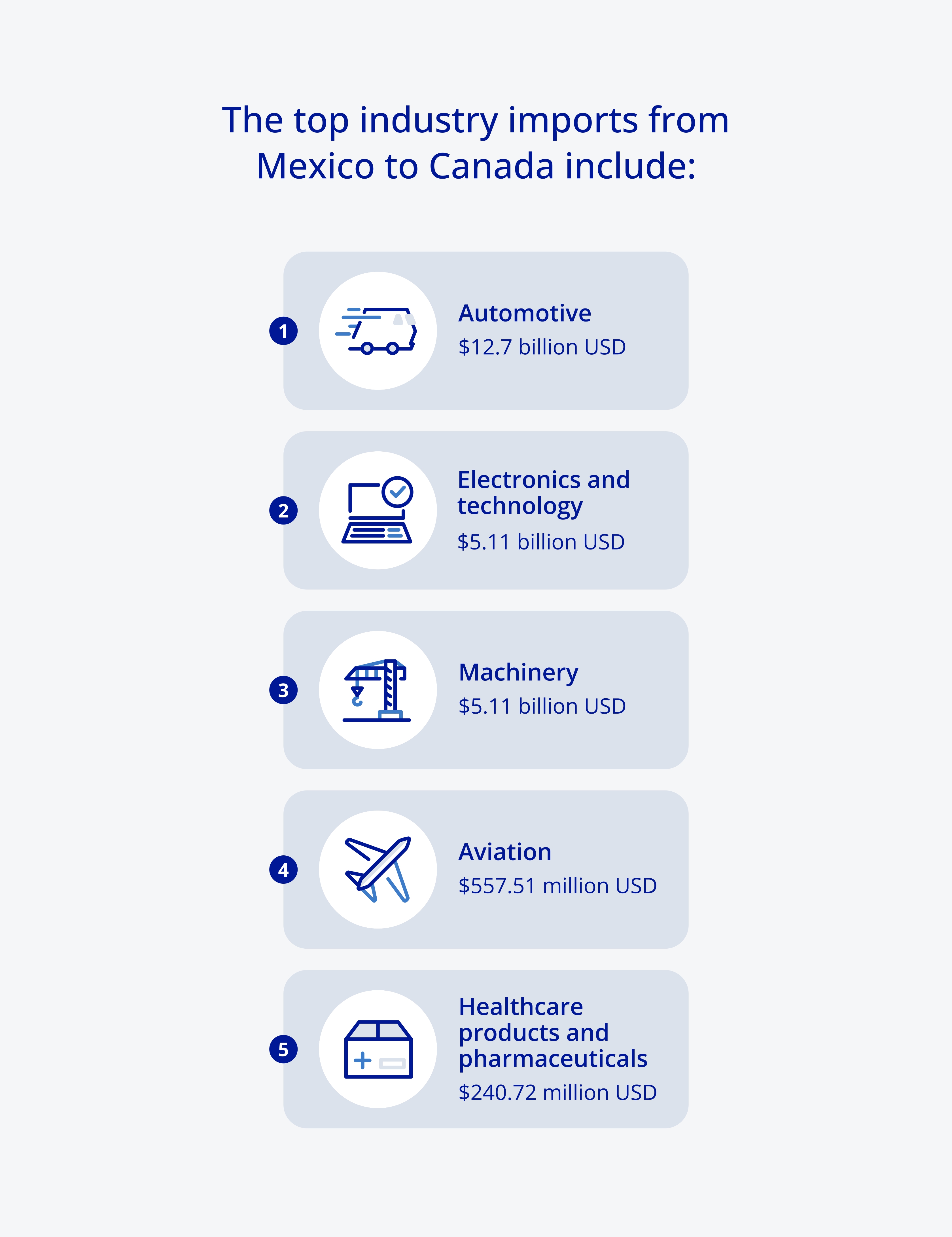
The top industry imports from Mexico to Canada include:
- Automotive $12.7 billion USD
- Electronics and technology $5.11 billion USD
- Machinery $5.11 billion USD
- Aviation $557.51 million USD
- Healthcare products and pharmaceuticals $240.72 million USD
Together, these industries represent some of the main exports of Mexico, driven by established production networks and increasing demand across North America.
Tailor shipments from Mexico to Canada according to your industry with guidance from a Purolator expert.
Automotive imports
Mexico is a global leader in automotive production, with high export volumes of light vehicles, heavy-duty vehicles and auto parts, supported by a strong network of production facilities and suppliers.
In 2024, Mexico ranked as the fifth-largest globally in light vehicle manufacturing and exports, with overseas vehicle exports reaching approximately $104.8 billion USD. The country has a strong OEM (original equipment manufacturer) base, with 37 light-vehicle manufacturing plants spanning 12 states.
Keep automotive supply chains moving from Mexico to Canada with reliable international delivery. Explore Purolator’s automotive logistics solutions.
Mexico also plays a major role in heavy-duty vehicle production, ranking as the fifth-largest globally and leading exporter of tractor trucks, with overseas shipments reaching approximately $52 billion USD. These heavy-duty vehicles are manufactured across 12 nationwide plants.
Also, Mexico is the fourth-largest global producer and exporter of spare auto parts, with exports totalling approximately $106 billion USD. Common auto components that Mexico exports include seating systems, suspensions, engines and transmission parts.
Electronics and technology imports
Electronics and technology are expanding segments of Mexico’s exports, driven by innovation hubs and large-scale manufacturing capabilities.
Ship delicate, high-value electronics securely across borders. Discover Purolator’s technology logistics solutions.
Guadalajara, often called Mexico’s “Silicon Valley,” is home to more than 1,000 technology companies across software, electronics, AI and fintech. Mexico also has over 120 electronic manufacturing plants, reinforcing its position as a major technology hub.
Aerospace imports
Mexico’s aerospace sector is a growing contributor to the country’s exports, supported by increasing global demand and specialized manufacturing capabilities.
Move time-critical aerospace shipments securely with specialized handling protocols. Explore Purolator’s aerospace logistics capabilities.
In 2024, Mexico ranked as the 12th-largest globally in aerospace manufacturing and was the fourth-largest exporter of aerospace products, with exports reaching approximately $10.7 billion USD. These exports include components such as airframes, harnesses and electronic systems. Commonly produced components and small parts include harnesses, airframes and electronic systems.
Healthcare products and biopharmaceutical imports
Mexico continues to strengthen its position in global healthcare supply chains, particularly in medical devices and biopharmaceuticals.
Maintain compliance and control for sensitive healthcare shipments from Mexico to Canada. Learn more about Purolator’s healthcare capabilities.
The country is the largest medical device exporter in Latin America and ranks eighth globally. Key Mexico exports include diagnostic imaging, patient monitoring, minimally invasive tools, innovative drugs and biosimilars.
E-commerce imports
Rapid e-commerce growth is increasing the need for fast, flexible shipping from Mexico to Canada.
Meet customer expectations with consistent cross-border delivery to Canada. Learn how Purolator can support your e-commerce delivery and returns.
Mexico’s e-commerce logistics market reached $10.7 billion USD in 2025 and is projected to grow to $45.9 billion USD by 2034. This forecasted e-commerce growth is driving demand for reliable cross-border shipping solutions that can support high shipment volumes.
Key challenges in shipping from Mexico to Canada
As cross-border trade increases, shipping from Mexico to Canada requires navigating a range of operational complexities, especially for industries with strict handling, compliance and documentation requirements.
Managing cross-border shipping
Shipments from Mexico to Canada rarely follow a single, uninterrupted route. Typically, shipments pass through multiple checkpoints and carriers, especially when moving across borders.
Each hand-off introduces potential friction, from routing inefficiencies to a higher risk of delays, damage or theft. Without a coordinated logistics network, these touchpoints can quickly impact delivery timelines and product safety.
Navigating customs and compliance requirements
Customs regulations and documentation are one of the most critical and complex aspects of cross-border shipping. Requirements can vary by country, product type and regulatory updates.
Businesses must ensure documentation is complete and accurate while meeting additional requirements for highly regulated products, such as Dangerous Goods. Even small documentation errors can lead to shipment holds or added fees.
Managing different shipment types across industries
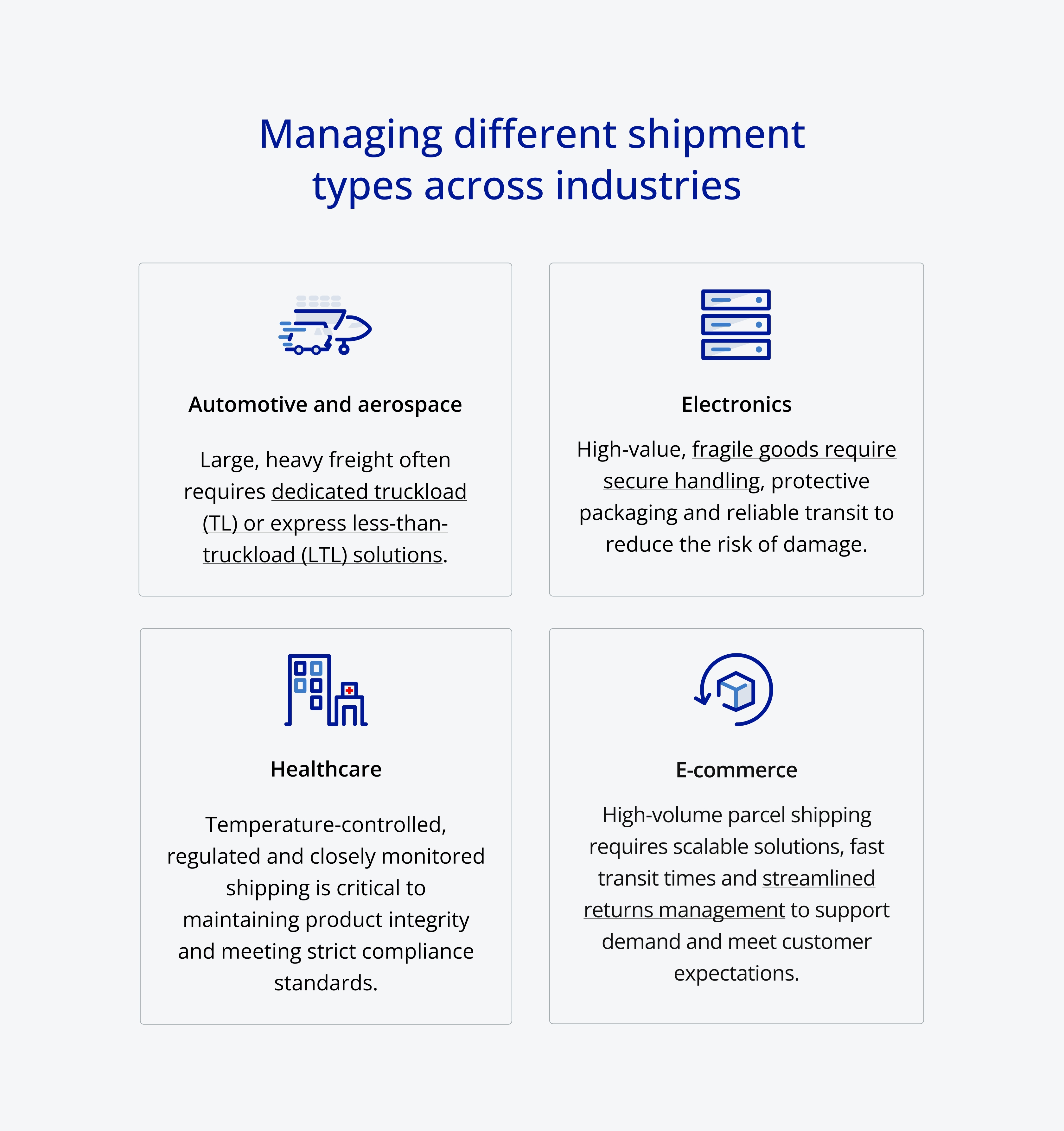
Shipping from Mexico to Canada isn’t a one-size-fits-all approach. Each industry has distinct requirements that influence how shipments are handled, transported and delivered, such as:
- Automotive and aerospace: Large, heavy freight often requires dedicated truckload (TL) or express less-than-truckload (LTL) solutions.
- Electronics: High-value, fragile goods require secure handling, protective packaging and reliable transit to reduce the risk of damage.
- Healthcare: Temperature-controlled, regulated and closely monitored shipping is critical to maintaining product integrity and meeting strict compliance standards.
- E-commerce: High-volume parcel shipping requires scalable solutions, fast transit times and streamlined returns management to support demand and meet customer expectations.
End-to-end visibility and control
Limited oversight across multiple carriers and borders can make it difficult to track shipments. Disconnected systems can lead to fragmented updates, reduced operational control and slower response times when issues arise. This lack of transparency can undermine planning, delay issue resolution and reduce overall supply chain confidence.
Managing costs across borders
Balancing cost efficiency with speed and reliability can be challenging for cross-border shipping, where multiple factors influence pricing and timelines.
Transportation costs can fluctuate as shipments move between providers and modes, while customs processing, delays and additional handling can introduce unexpected fees. Without clear visibility into the full shipment journey, forecasting landed costs becomes more difficult, forcing businesses to weigh trade-offs between speed, cost efficiency and service performance.
Simplify shipping from Mexico to Canada with Purolator
As cross-border supply chains grow more complex, businesses need a reliable and streamlined approach to shipping from Mexico to Canada. Purolator supports cross-border logistics with integrated transportation, customs expertise and end-to-end visibility for enhanced coordination and improved delivery timelines.
Coordinated, end-to-end shipping from Mexico to Canada
Purolator manages the full shipment journey from pickup in Mexico to final delivery in Canada. With a single point of coordination, businesses benefit from optimized routing, fewer hand-offs and greater control throughout transit. This integrated approach reduces delays, improves reliability and keeps shipments moving predictably across borders.
Flexible transportation options that accommodate your shipment
Our transportation modes can be tailored to the needs of different industries, allowing businesses to manage delivery costs and speed.
- Flexible shipping services: Choose from parcel, LTL and TL services, with multimodal options across truck, rail, air and sea to match shipment size, urgency and budget.
- Specialized handling capabilities: Receive specialized support for oversized, irregular or regulated shipments, including Dangerous Goods, to ensure products are safely handled and comply with industry requirements.
- Time-definite delivery options: Meet critical deadlines with guaranteed delivery windows and pickups as early as 7:00 AM at Purolator Shipping Centres to keep supply chains on schedule.
- Infrastructure built for growth: Our scalable services and integrated network enable businesses to manage fluctuating volumes and confidently expand operations.
- Sustainable delivery strategies: Reach sustainability goals with optimized routes, consolidated shipments and efficient transportation methods powered by our growing EV fleet.
Customs and documentation support you can depend on
Reliable cross-border shipping depends on accurate documentation and compliance. Purolator’s compliance experts and Livingston International’s team help businesses navigate evolving regulations and ensure shipments are properly prepared at every stage.
For increased efficiency, our cross-border consolidation framework combines multiple smaller shipments into a single larger unit, enabling goods to clear customs under a single entry. Consolidation simplifies paperwork, improves delivery times and lowers overall transportation costs.
Our digital self-serve customs tools help businesses prepare and submit required trade forms. Purolator Trade Assistant and our Digital Commercial Invoice help streamline paperwork, support commodity classification and reduce manual errors.
Visibility from origin to delivery
End-to-end visibility helps businesses stay informed and in control throughout the shipment journey. Our tracking tools provide businesses and their customers with insights and tailored delivery features.
Purolator Vision, our enterprise-level tracking platform, centralizes shipment data and provides scheduled, tracking and exception reports to support planning and enhance supply chain confidence.
Customers can use Purolator Your Way to access user-friendly tracking, turn on shipment notifications and customize their delivery with options such as remote signature release and photo proof of delivery, for convenient fulfillment experiences.
Dependable delivery across Canada
Final-mile delivery is a critical part of the customer experience. With coverage across 100% of Canadian postal codes, Purolator ensures shipments reach their destinations, no matter the urban, rural or remote destination.
Within our highly controlled network, 99% of deliveries are fulfilled by our own assets. Through monitored facilities and chain-of-signature (COS) protocols, we safeguard shipments from damage, loss and theft, as illustrated by our 99% damage-avoidance rate.
Delivering consistency across Mexico to Canada logistics
As evolving trade regulations and nearshoring practices continue to reshape trade across North America, seamless shipping between Mexico and Canada is becoming increasingly critical for more businesses.
Successfully managing cross-border logistics requires strong coordination, compliance expertise and clear visibility at every stage. With the right processes in place, businesses can reduce delays, improve consistency and keep goods moving efficiently.
Purolator brings the network, expertise and coordination needed to simplify cross-border shipping from Mexico to Canada and support reliable performance for all industries.