
How to Ship Electronics Safely: 4 Key Steps for Packing and Transport
Innovative advances in technology are transforming the way we live, work, and connect with each other. As technology becomes more powerful and efficient, demand grows, with the Canadian electronics market projected to reach $5.42 billion CAD by 2030. But electronics remain some of the most easily damaged items during shipping and the most susceptible to cargo theft. The impact of a damaged shipment can cause disruptions across your business, negatively impacting your brand loyalty, customer trust, and revenue. So how do you ship electronics safely and protect against these risks?
From special packaging to white-glove service and security, it pays to plan in advance. Here’s how to ensure the secure transport of your electronics, plus how to choose the right logistics partner to support your growth.
Key takeaways
What electronics can be shipped in Canada?
Generally, the majority of electronics can be shipped in Canada, but may come with different classifications and requirements depending on their type (for example, lithium batteries need to follow specific rules applied to dangerous goods). These are dictated by regulatory bodies including:
- Health Canada, Canada Consumer Product Safety Act (CCPSA)
- Transport Canada, Transportation of Dangerous Goods Regulations
- Innovation, Science and Economic Development Canada (ISED), Radio Standards Specification (RSS)
- Environment and Climate Change Canada (ECCC), Electronics and E-Waste Regulations
Types of electronic goods shipped in Canada
Here are the most common types of tech items, including the most popular consumer electronics products in the country.
- Electronic devices and associated parts (e.g. smartphones, smartwatches, headphones)
- Telephone apparatuses (e.g. landline phones, VoIP and IP telephony technology)
- Memory and memory storage devices (e.g. USB sticks, memory modules)
- Computers (e.g. laptops and desktop computers)
- Computer terminal and computer peripheral equipment (e.g. mice, keyboards, monitors)
- Other computer equipment (e.g. networking hardware, storage drives)
- Computer and computer peripheral equipment and software (e.g. servers, external hard drives, printers)
- Bare printed circuit boards (e.g. flexible circuits, metal core PCBs, high-frequency PTFE boards)
- Televisions and entertainment systems (e.g. streaming devices, display panels, gaming consoles)
- Radio and television broadcasting and wireless communications equipment (e.g. antennas, microphones, GPS receivers)
- Audio and video equipment (e.g. mixers, cameras, projectors)
- Telecommunications technology (e.g. fibre optics, satellite communication)
- Telecommunications networking equipment (e.g. firewalls, modems, switches)
- Wired communication carriers (e.g. coaxial cables, Fieldbus/RS-485 serial buses, ethernet and LAN networks)
- Photographic equipment and supplies (e.g. DSLRs, memory cards, battery packs)
- Tablets (e.g. tablet computers, e-readers, tablet gaming devices)
- Smart home devices (e.g. smart speakers, security cameras)
- Semi-conductors and related devices (e.g. transistors, integrated circuits/microchips)
- Electronic accessories (e.g. external power banks, travel adapters)
- Remote-controlled tech (e.g. drones, toy cars)
- Home appliances (e.g. electric shavers, autonomous vacuum cleaners)
- Capacitor, resistor, coil, transformer, and other inductors (e.g. carbon composition resistors, ceramic capacitors, chokes, step-down transformers)
- Electronic connectors (e.g. HDMI, 3.5mm audio jacks, DC barrel power plugs)
- Printed circuit assembly (e.g. smartphone motherboards, IoT sensor nodes, automotive control units)
Get reliable logistics solutions that understand your telecommunications business. Learn more.
How much does it cost to ship electronics?
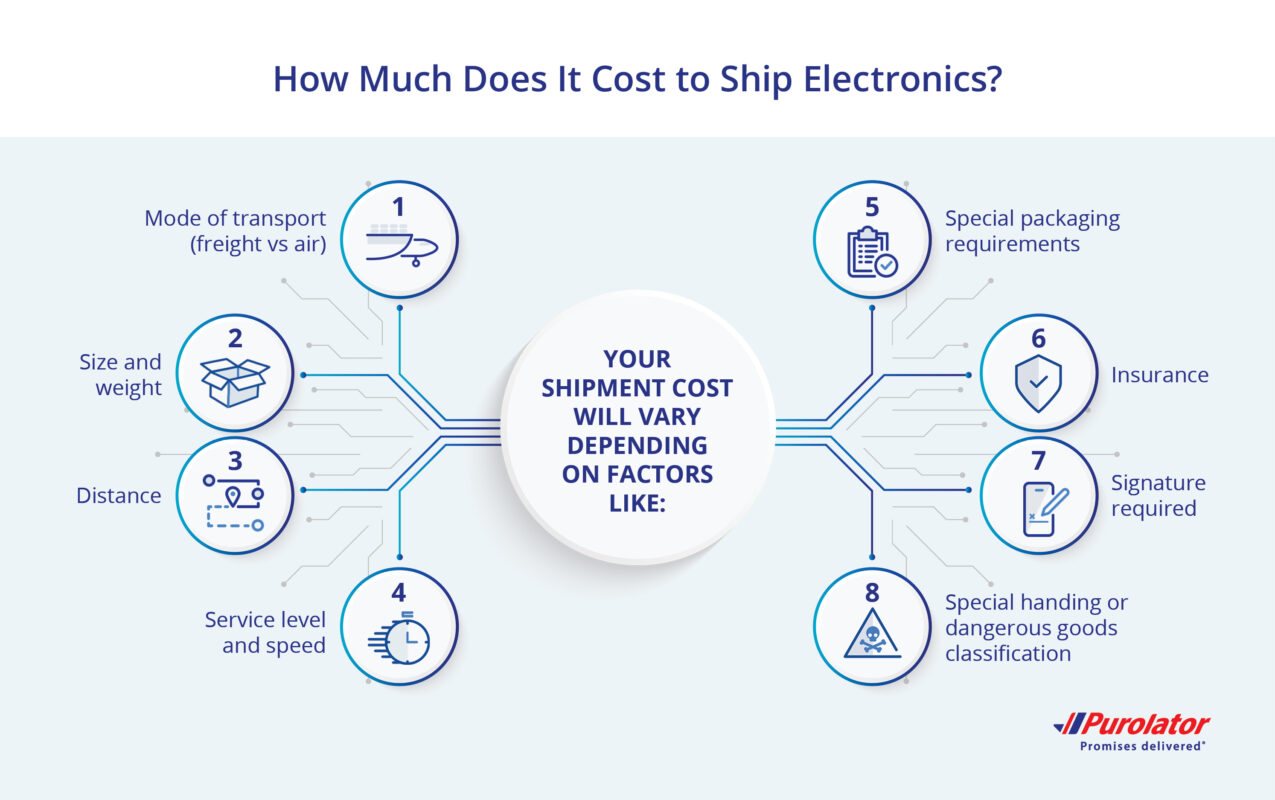
Your electronics shipment will vary in cost depending on factors such as:
- The mode of transport (freight vs air)
- Size and weight of the package
- Delivery distance
- Service level and speed
- Special packaging requirements
- Insurance
- Signature required
- Special handling or dangerous goods classification
Speak to an experienced shipping logistics provider to get an accurate quote and recommendations for your budget for items such as proper packing, exclusive discounts, service level options, and consolidated shipments.
Power your growth with shipping that gives you the speed and flexibility your tech business needs. Contact us.
How to Ship Electronics Safely: 4 Key Steps for Packing and Transport
Secure electronics shipping benefits both your business and your consumers by reducing:
- Damage and theft
- Loss of product and profit
- Negative impact on your general operations and supply chain
- Your ecological footprint
The best way to ship electronics safely requires compliance with special regulations and considers these 4 important factors:
- Proper packaging (e.g. temperature control, vibration protection)
- Type of service
- Minimizing risk of theft
- In-transit safeguards
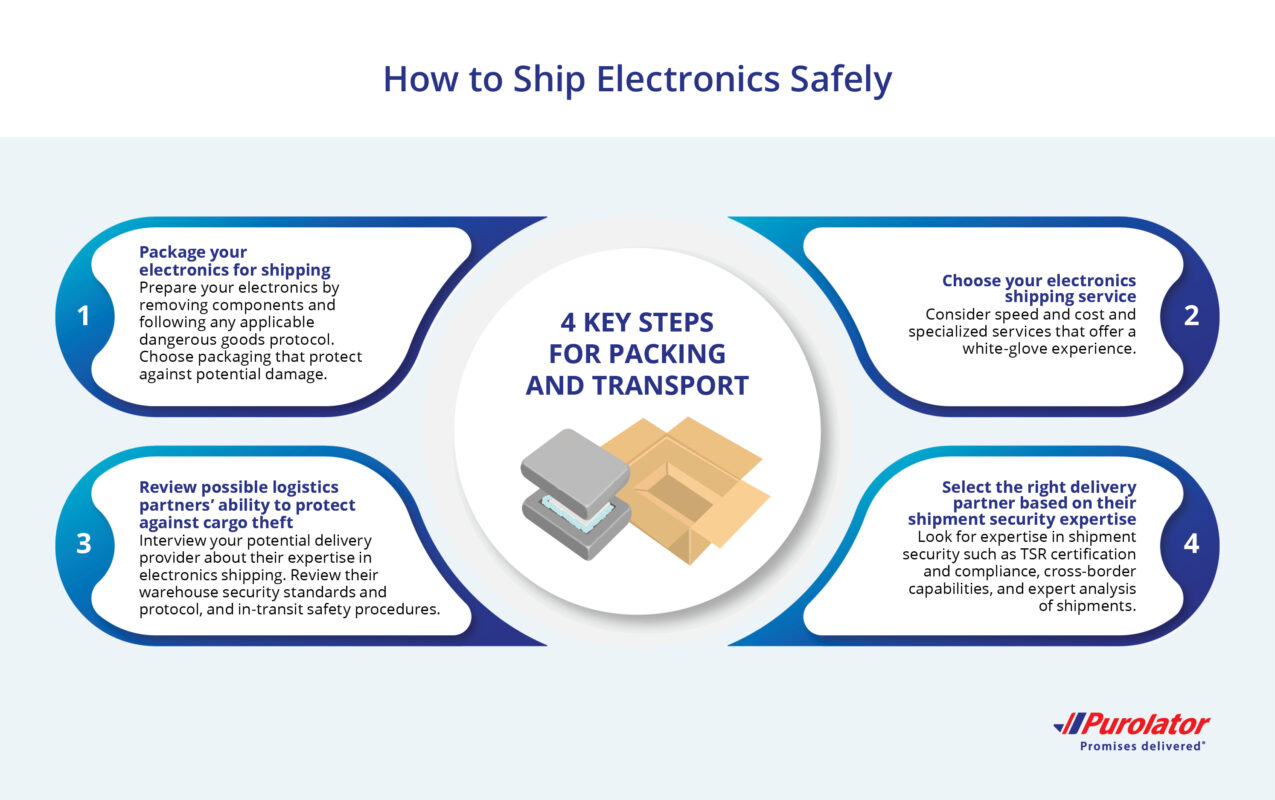
Ready to get started? Follow these 4 key steps for transporting your electronics.
1. Package your electronics for shipping
A recent report showed damaged goods cost companies $48.5 billion a year. With the heightened vulnerability of electronics, packaging is a crucial component in preventing the loss of your goods and profits, capable of safeguarding against damage like:
- Electrostatic discharge
- Theft and security breaches
- Temperature volatility
- Shock and vibration
Here’s how to package your electronics for shipping:
i. Prepare your electronics for shipping
Take apart any components (such as cords, power cables, stands or mounts). Protect any vulnerable parts like corners, screens or terminals. If you’re shipping lithium batteries, follow all special considerations and protocol that includes:
- Separating each battery from any metal objects to prevent short-circuits
- Using ESD/non-conductive material to insulate battery terminals
- Packaging and protecting each battery to ensure minimal shifting and movement
ii. Choose the right packaging
Select the right packaging for your product. You can avoid unnecessary delivery mishaps with logistics solutions like specialty shipping boxes.
Climate controlled packages and transport
Extreme weather events and climate hazards are projected to have a $1.2 trillion annual cost for the world’s largest companies by 2050, highlighting the importance of mitigating and preparing for these risks. Climate-controlled packages deter moisture and particles that can cause damage to electronics, while protecting against outside weather conditions during shipping.
Anti-static packaging materials
Anti-static materials, such as ESD-resistant bubble wrap and styrofoam, can protect against permanent damage that can include metal melt, oxide failure, or junction breakdown or even cause flammable solutions to ignite, rendering electronics fully or partially unusable. Wrap all electronics in ESD-resistant material before placing them together in boxes for shipping.
Heat and fire mitigating packaging
For secure electronics returns, look for this specific packaging which is designed for damaged, defective, or recalled (DDR) electronics, ensuring safe transport should a lithium battery ignite. This packaging contains and extinguishes the fire and is ideal for damaged cell phones and tablets.
Tamper-evident packaging and sealers:
Electronics remain the most stolen item in cargo thefts, with numbers rising by 31% over recent years. Tamper-evident packages or tamper-evident seals protect both against loss of expensive products and the security breach of customers’ highly sensitive personal data (e.g., phones and laptops). Learn more about how to prepare your shipments against cargo theft here.
Packaging with impact, damage, and vibration sensors
Sensor-equipped packaging offers in-transit protection by anticipating and preventing damage. Look for technology like:
- Impact sensors. Can immediately detect if your packages are being compromised.
- Sensory tags. Alert crew members and drivers in real-time of potential damage, allowing them to address the issue promptly.
- Shock loggers. Measure the shock, tilt, vibration and roll of your shipments and monitor temperature and humidity—imperative when products need to be kept dry and cool.
Reusable packaging:
Reusable packages add ease to your returns process and reduce the amount of packaging used, while also elevating your brand and increasing your appeal. Plus, across the globe, both high-income earners and Gen-Z consumers (which are projected to have the most buying power), have the highest-expressed willingness to pay for more sustainable packaging. Take full advantage of this growing preference by partnering with a logistics provider that seamlessly integrates eco-friendly solutions that instantly benefit your business. Learn more about Purolator’s commitment to environmental sustainability here.
iii. Package and prepare shipment
Package each electronic item individually, and then place them in a corrugated double-walled cardboard box with proper padding. Include any relevant documentation and seal with the H-taping method. Add clear labels where necessary. Follow our full step-by-step guide to properly and safely package your shipment.
Looking for specialized shipping services? Purolator tailors your logistics and fulfillment to you and your customers. Learn more here.
2. Choose your electronics shipping service
The right service level will depend on your budget, business needs, and customer expectations. Here’s an overview of how to choose what’s right for you.
Speed and cost
Speedy shipping remains a key factor in transporting electronics. Immediacy remains a top priority that consumers are willing to pay for, and high tech generally has a short shelf life, with mobile phones depreciating in market value within 6 to 9 months.
If you have a high-value, high-demand product, investing in the fastest shipping service will boost your appeal, enhance customer loyalty, and garner more business through word-of-mouth and positive customer experiences, since 88% of customers trust recommendations from friends more than any other channel.
For long-distance and overseas shipping, there are two options:
- Ocean carriers. Slower, taking weeks to reach their destinations, but is cheaper. Due to exposure to moisture and rougher transport, there’s a greater risk of damage.
- Air transport. Faster but more expensive, up to 10 times the cost of ocean carriers. Safer due to minimal handling, reduced shipping time, and greater predictability with environmental control.
You may also consider express, next-day and fully-flexible, expedited services such as Purolator’s Mission Critical. Budget-friendly solutions include ground service, local lockers and pick-up points.
White-Glove Service
In today’s ultra-competitive tech industry, a customer’s experience with your product can make all the difference. Beginning at the delivery stage, offering specialty, white-glove service can differentiate you and help retain and attract customers, build customer loyalty, and strengthen your reputation. You may consider:
- Coordinating proper transport for customers for bulky, oddly shaped and large items
- Offering full installation services that include in-house delivery and positioning
Look for logistics solutions like Purolator’s:
- Customized delivery options, including flexible and secure signature options, such as no signature required
- Eco-friendly and easy returns solutions
- Saturday service for pickup and delivery
- Added transparency and visibility with advanced technological solutions and tracking
Learn more about our specialized services here.
See the difference the right logistics partner can make when shipping your consumer electronics. Learn more.
3. Review possible logistics partners’ ability to protect against cargo theft
Selecting the right logistics partner is your key against the increasing threat of cargo theft, supplying benefits including strategies for risk management, anticipation, and prevention. Review the experience of all possible providers by asking questions like:
- Do they conduct comprehensive background checks on all of their employees?
- Do they offer real-time tracking of your shipments en route?
- Do they have established procedures in place that prioritize security and trace missing items?
- Do you have a detailed contract in place with them specifying how your items will be transported and handled from pick-up to delivery?
Also, ensure your shipper has advanced security equipment inside and outside their warehouses including:
- State-of-the-art security equipment (e.g., cameras, motion detectors, perimeter protection, etc.);
- Security guards patrolling the grounds and inside the warehouse;
- Good lighting to deter theft.
Finally, establish and review detailed in-transit safety procedures for your deliveries beforehand.
- Decide on how your goods will be described in the documentation. Consider keeping the descriptions generic to conceal the contents’ value.
- Minimizing the amount of handoffs in-transit. The more times a shipment is loaded on and off a carrier increases exposure to theft or damage.
- Reduce the amount of time your high-tech products are sitting in any one place—this is when shipments are most vulnerable to theft.
- Set the maximum shipment size and value to contain the impact of any potential loss.
Protect against cargo theft with this easy checklist. Read now.
4. Select the right delivery partner based on their shipment security expertise
As a tech company advancing your own operations, you need a logistics partner that consistently integrates and refines tech and automation in its systems to support not only safe electronics delivery but also to create processes that work in stride and scale up with your business.
Look for a shipping partner that’s optimized delivery capabilities for electronics delivery, with advanced shipment security like Purolator’s:
- Internal team of security experts. Employing decades of experience to minimize shipment risk, reviewing every shipment and assigning optimized protocols for secutiy.
- Security-prioritized employee training. Background and credential checks are conducted on all employees. Rigorous, relevant training includes suspicious activity identification and reducing risk during hijacking.
- Comprehensive cross-border capabilities. All shipments are controlled from pickup to delivery by Purolator, significantly reducing transfers, touches, and risk of cargo theft.
- Customized, full-scope of services. Time-definite, security-focused services as well as expedited services like Mission Critical, with the highest level of customer support and guaranteed deliveries.
- Meets and exceeds International Security Standards. Purolator is Trucking Security Requirements (TSR) certified. Purolator also meets and exceeds the International Security Standards outlined by The Transported Asset Protection Association (TAPA) beyond logistics processes, including warehouse/distribution center/yard security, fleet security, and cyber security.
Learn more about Purolator’s full commitment to security here.
How to ship electronics internationally
As you prepare your electronics shipment for international transport, make sure you’re fully compliant with international shipping regulations and standards in the Government of Canada’s Trade Commissioner’s Step-by-Step Guide to Export.
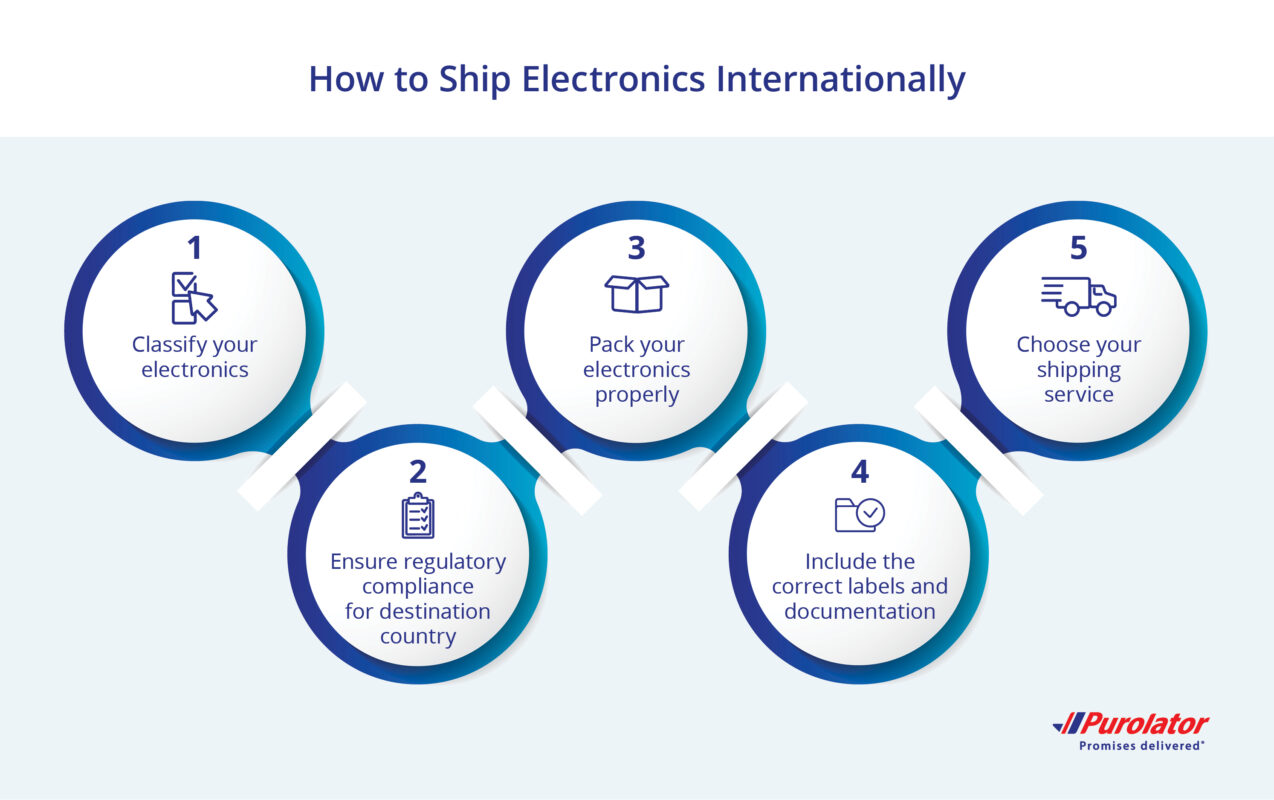
1. Classify your electronics
Look up relevant guidelines for packing and shipping your electronics based on whether your item has a battery or needs one to supply power, if it is lithium-ion vs lithium-metal, and how it is packaged (alongside the device or separately).
2. Ensure regulatory compliance for the destination country.
Review mandatory documentation, labelling, shipping classification and other requirements, as well as any restrictions based on regulatory bodies within the destination country.
3. Pack your electronics properly.
Prepare your electronics for shipping, including any recommendations for lithium batteries from Transport Canada and the destination country. Use ESD-resistant packaging, climate-controlled and tamper-evident packaging, and sensors for impact damage and vibration. For more information, follow our guide for properly packaging electronics and consult your shipping logistics provider for support.
4. Include the correct labels and documentation
Apply all necessary labels correctly using best practices such as:
- Ensuring labels are clearly visible on one surface
- Not applying any labels on a seam
- Including fragile labels and warnings
Include shipping documents like:
- Commercial invoice
- Special packing or marking list
- Certificate of origin
- Certificate of insurance
- Bill of lading/air waybill
- Additional documents such as:
- Certificates of origin
- Certificates of inspection
- Import and export licences like NAFTA certificate of origin
You can choose to lean on your shipping partner to help with this process or fill them out yourself.
5. Choose your shipping service
Look for international service options that include:
- Flexible nearshoring and offshoring
- Air, ground, and sea service
- Cross-border returns management
- Affordable shipping options like express and economy for US and international destinations
- Support for customs clearance
- Optimized security for loss prevention and to safeguard against theft
- Customization, transparency and convenience
Learn more about international shipping with Purolator here.
Ship smarter across borders and avoid hidden fees with our guide to landed costs. Read here.
How the right logistics partner delivers beyond safe electronics shipping
The right shipping logistics partner enables your growth through its services and expertise, prioritizing technological integration in its full cycle logistics, understanding consumer behaviour, anticipating and safeguarding against risk, offering client forecasting, and scaling alongside your business as it expands.
Purolator provides your business with capabilities that understand the complexities of shipping high-value tech goods, providing features that give you:
- Speed for added market advantage to meet consumer preferences
- Insightful data to inform your business decisions
- Consistency, speed, visibility, and security with minimal handoffs
- Extensive reach including remote areas
- Express returns for added security, and improved customer trust and experience
Purolator’s longstanding experience in tech and electronics shipping, partnered with its capabilities in secure shipping and flexible, customized services put customers and businesses first, making it the optimal choice. Our services include:
- Time-definite speed with Mission Critical, Early A.M. and Express shipping, and QuickShip
- End-to-end visibility and tracking, and flexible customized delivery with Purolator Your Way
- Fraud and loss prevention with security initiatives and customized security protocols
- Nationwide reach to 100% of postal codes within Canada
- Cross-border expertise and simplified shipping for electronics
- Smart shipping logistics, AI systems, and integrated tech
- Priority and last-minute service levels
- LTL, TL, bulk freight, and freight forwarding solutions
- Simplified returns management
- Eco-friendly solutions to elevate your business
Enable your business with logistics support and specialized expertise in security and tech. Partner with us.
Shipping your electronics with confidence
Ensuring the safe transport of your electronics is an important final step in the journey to getting these prized products to their intended users and building customer trust and loyalty. Look for a shipping partner, like Purolator, that instills confidence with the safe handling and protection of your goods, and a level of service and speed that suits your needs and budget. With the right provider, you’ll secure a great experience for your customers, right to their front door.