
As the prevalence of chronic diseases rises and the aging population grows, Canada’s healthcare industry is experiencing a surge in demand for high-quality healthcare supplies, translating to a rise in the volume of U.S. suppliers importing medical devices into Canada. In fact, as of 2024, imports from the United States accounted for 42% of Canada’s total medical device imports, valued at CAD$5.9 billion.
However, managing medical device shipping across borders is no easy feat. Medical devices are highly regulated federally by Health Canada’s Medical Devices Bureau of the Therapeutic Products Directorate (TPD) and governed by Canada’s Food and Drugs Act (F&DA) and Canadian Medical Device Regulations (CMDR). As medical device importers look into the future of healthcare technology supply chains and shifting cross-border trade tariffs, the importance of understanding the nuances of shipping medical equipment into Canada and partnering with an experienced logistics partner is more important than ever.
To help you quickly and reliably deliver medical equipment, we’ve created this resource that tackles primary regulations and requirements, how to prepare for importation, how to avoid customs delays, and more.
Key takeaways
-
- Primary regulations for importing medical devices into Canada
- How to Prepare Your Medical Devices for Import into Canada
- What to do if items are refused at the border
- Returns and reverse logistics for importing medical devices into Canada
- What solutions should a delivery provider offer for importing medical devices into Canada?
- How Medline Canada boosted on-time delivery performance to 98%
- Prioritizing patient care with unmatched medical device delivery
- Frequently Asked Questions (FAQs)
Primary regulations for importing medical devices into Canada
Complying with medical device regulations in Canada impacts the safe transport and border approval of your import shipments and are subject to change. These can include:
- Food and Drug Act
- Medical Device Regulations
- Labeling Regulations
- Advertising regulations
- Licensing requirements
- Medical Device Establishment License (MDEL for importers)
- Medical Device License (product must have a valid MDL, as verified by the Medical Devices Active License Listing.)
- Medical Device application and report forms
- Relevant documentation and records if used for testing on human subjects
For more information, refer to the Government of Canada’s Medical Device Regulations.
Additional requirements for importing medical devices into Canada
Beyond regulatory standards, Health Canada requires the following established procedures for your medical device imports prior to cross-border shipping.
- Quality management system. Ensure you have complete written procedures for handling, storage, complaints, and recalls regarding your medical devices.
- Distribution records. Retain records of all distribution of your device for recalls. They must be kept for a given period and can be accessed.
- Complaint system. You must have a system to record and investigate all complaints and report these to Health Canada.
- Recall procedure. It’s important you have a documented recall procedure and notify Health Canada within 24 hours.
Avoid Canadian customs delays with these top 4 medical device regulatory tips. Read more.
What is the Exceptional Medical Device Pathway in Canada
The Exceptional Medical Device Pathway in Canada allows medical devices that do not appear in Health Canada’s medical device database, the Medical Devices Active Licensing Listing (MDALL), to be imported into Canada as substitutes or medical devices that are experiencing active or anticipated shortages. These exceptional medical devices are included in Health Canada’s List of medical devices for exceptional importation and sale.
Learn about supply chain considerations for shipping medical devices into Canada including customs and regulatory compliance. Read more.
How to Prepare Your Medical Devices for Import into Canada
1. Classify your medical devices
Health Canada’s medical device classification is based on the device’s patient risk and safety level. It determines the criteria for import and applicable regulations, and whether you need to complete a medical device license application.
The four medical device classes in Canada are:
- Class 1 (lowest risk): Includes non-electric wheelchairs and surgical tools
- Class 2 (low risk): Includes syringes and catheters
- Class 3 (moderate risk): Includes glucose monitors and orthopedic implants
- Class 4 (high risk): Includes pacemakers and mechanical heart valves
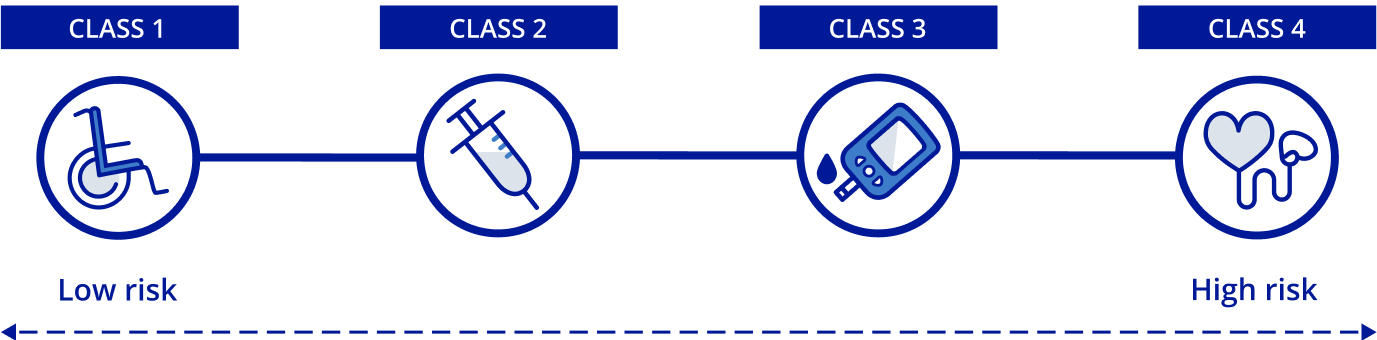
Here are the applicable licensing and medical device import requirements for each class level:
| Medical Device License (MDL) Requirements | Medical Device Establishment License (MDEL) Requirements | Additional Importation Requirements | |
|---|---|---|---|
| Class I | N/A | Unless import activity is exempt, importer must have a MDEL. | N/A |
| Class II, III or IV | Must have MDL | Unless import activity is exempt, importer must have a MDEL. | N/A |
| Investigative testing on humans | N/A | N/A | Letter of Authorization (LOA) from Health Canada's Medical Devices Directorate for Class II, III, or IV investigative testing devices. Label identification as "Investigational Device" and "To Be Used by Qualified Investigators Only" |
| Special access and custom-made devices | N/A | N/A | All classes of Special Access devices require a LOA. Class III and IV of custom-made devices require a LOA. Labelling specifies it is a custom-made or special access device. |
Source: Health Canada Importation Requirements for Medical Devices
2. Apply for your medical device establishment license (MDEL)
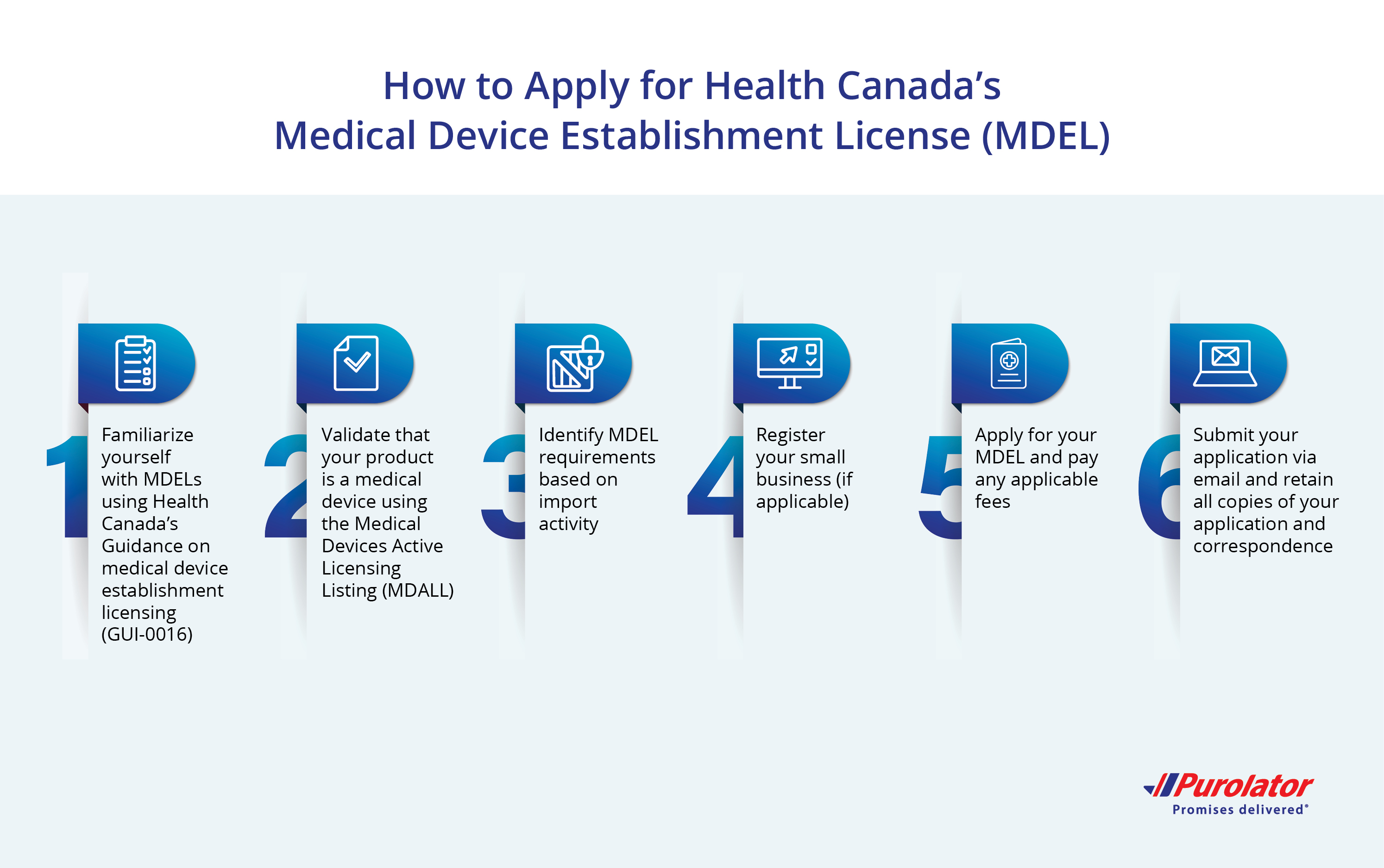
Having a Health Canada Medical Device Establishment License (MDEL) is a crucial part of getting your medical device approved and imported into Canada, and must be renewed annually. According to Health Canada, here’s how to get your Medical Establishment License (MDEL):
- Step 1: Familiarize yourself with MDELs. Consult Health Canada’s Guidance on medical device establishment licensing (GUI-0016).
- Step 2: Validate that your product is a medical device. Contact your manufacturer class verification and medical device licensing Canada. Search for your product using Health Canada’s Medical Devices Active Licensing Listing (MDALL).
- Step 3: Identify required MDEL. Consult Health Canada’s Guidance on medical device establishment licensing (GUI-0016) for MDEL requirements based on your import activity.
- Step 4: Register your small business (if applicable). Complete the Drug and Medical Device Small Business Application before applying for your MDEL.
- Step 5: Apply for your MDEL and pay applicable fees. Complete the Medical Establishment License Application form and pay any required fees once Health Canada screens your application.
- Step 7: Submit your application. Submit one copy via email to the designated address and retain all copies of your application and correspondence.
For more information on the MDEL application process, please see Health Canada’s MDEL application instructions page.
Who is exempt from a Medical Device Establishment License?
According to Health Canada, all importers of medical devices of any class level must have a valid Medical Device Establishment License (MDEL) unless they are a:
- Retailer
- Healthcare facility
- Class I device manufacturer importing class I devices via another individual with a valid MDEL
- Class II, III or IV device manufacturer only selling medical devices in Canada they hold a valid licence for
- Veterinary device importer or seller
- Dispenser
- Importer or seller of devices that are custom-made, Special Access, or for Investigational Testing on human subjects.
3. Complete your labels
Correctly labelling your medical devices is an essential step in adhering to import regulations and preparing your shipment, where failure to do so can result in border action, delays, seizure and destruction of your products. The right shipping partner can provide services and guidance for proper labelling protocol to lessen your stress and ensure safe and approved transport cross-border.
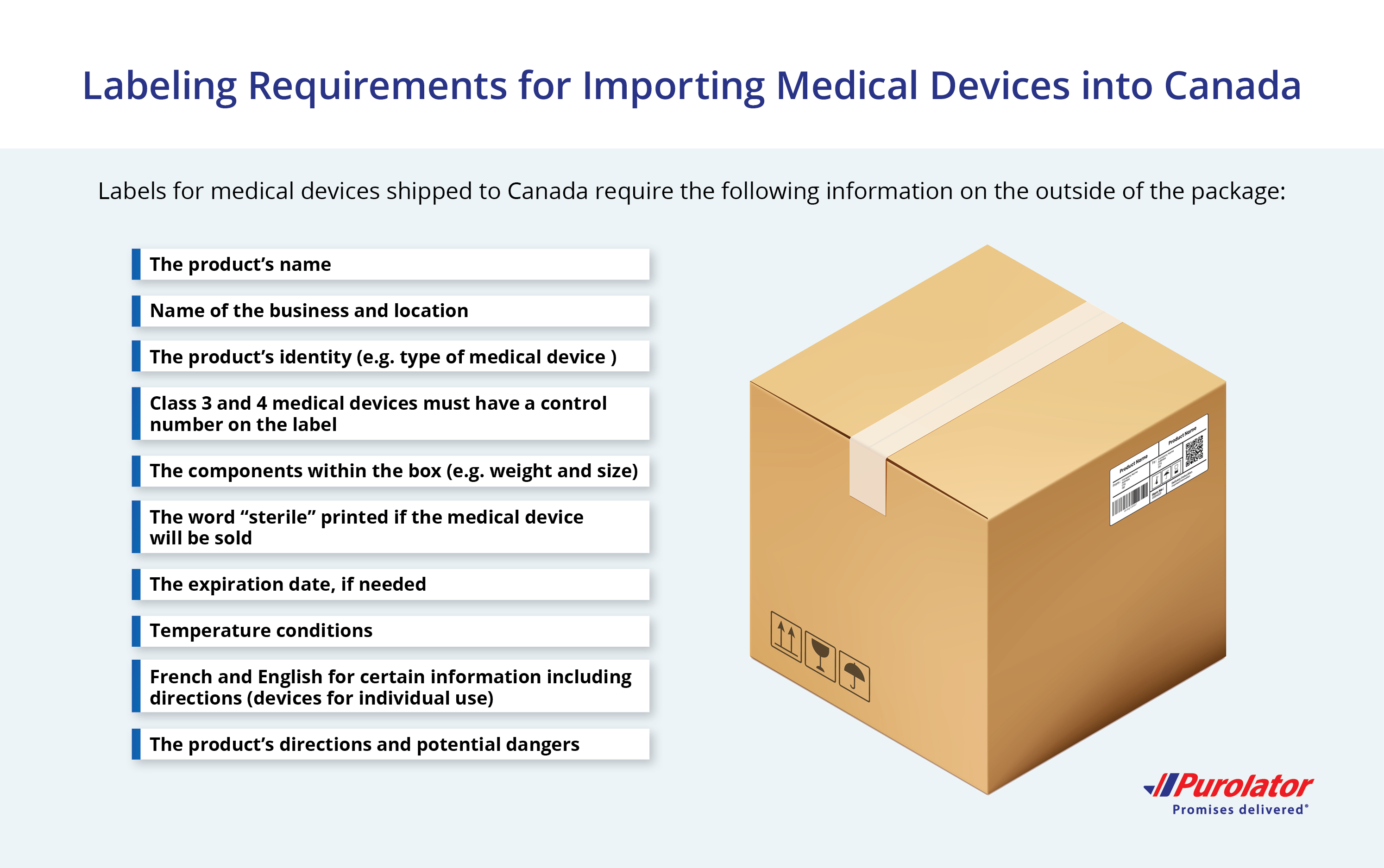
There must be a clearly placed label on the outside of the package that includes:
- The product’s name
- Name of the business and location
- The product’s identity (e.g. type of medical device )
- Class 3 and 4 medical devices must have a control number on the label
- The components within the box (e.g. weight and size)
- The word “sterile” printed if the medical device will be sold
- The expiration date, if needed
- Temperature conditions
- French and English for certain information including directions (devices for individual use)
- The product’s directions and potential dangers
As required by Health Canada, all descriptions on your packaging must accurately reflect and support medical claims for the device and language that suggests otherwise must be removed. For complete information, visit Health Canada’s Guidance for Labelling Medical Devices page.
Learn how to correctly package your medical device shipments with our comprehensive infographic. Read now.
4. Identify the Incoterms for importing your medical devices into Canada
Incoterms are 11 internationally recognized rules issued by the International Chamber of Commerce (ICC) that define the responsibilities of sellers and buyers in international transactions and covers:
- Insurance
- Shipping destination
- Transfer of legal ownership
- Shipping documentation responsibilities
- Costs including transport, duties, and packaging
As of 2020, the Incoterms are grouped into two categories which reflect modes of transport.
Incoterms for mode of transport
- EXW (ex works). The buyer holds responsibility for any costs and risks during transport of goods from the seller’s premises to the shipping destination.
- FCA (free carrier). Seller is responsible for export clearance of goods and delivery to the carrier or another person designated by the buyer.
- CPT (carriage paid to). Seller is responsible for all risks and costs during goods delivery to the carrier at a mutually approved destination by the seller and the buyer.
- CIP (carriage and insurance paid to). Defines who is responsible for costs incurred during shipment to a destination.
- DAP (delivered at place). The seller is responsible for delivery of goods and all risks involved until the point of unloading at the shipping destination. The buyer assumes all unloading risks and costs.
- DPU (delivered at place unloaded). Seller is responsible for delivery of goods, as determined by buyer, after unloading from transport at the shipping destination. Seller also clears goods for export.
- DDP (delivered duty paid). Responsibilities and costs during delivery of goods are attributed to the seller, including export and import formalities, fees, duties and taxes (insurance exempt).
Incoterms for sea and inland waterway transport
- FAS (free alongside ship). Seller is responsible for export clearance of goods and placing goods at the port of departure. Buyer is responsible for vessel loading and onward carriage, discharge, import formalities, and duties to final destination.
- FOB (free on board). Defines the point in which the liability for goods being shipped gets transferred to the buyer or seller.
- CFR (cost and freight). Seller is responsible for the delivery of the goods to a foreign port, including shipping and all associated documentation for the buyer to receive the goods.
- CIF (cost insurance and freight). Seller is responsible for delivery of goods that have been cleared for export onto the vessel at shipment port, transport to port of destination, and associated minimum insurance until port of destination. All risk is transferred to the buyer when goods are on the vessel for primary transport, but costs are not transferred until shipment arrives at the port of destination.
For more information, visit the International Chamber of Commerce’s Incoterms Rules.
5. Identify duty rates and tariffs on your medical devices
Here’s an overview of the applicable fees and costs for medical devices imported into Canada.
What tariffs apply to medical devices imported into Canada?
Tariffs applied to medical devices depend on the item type and any existing tariff remissions periods. You can calculate your tariffs using the Government of Canada’s Tariff Finder Calculator and learn more with the Canadian Border Services Agency Guide to Tariff Classification for Canadian imports.
For more information, download our whitepaper on tariff classification for U.S. and Canadian importers shipping cross-border.
Is there import duty on medical equipment in Canada?
Medical devices imported into Canada can be subject to unexpected landed costs including import duties.. To determine if duty rates apply, verify the HS code on your medical device alongside its place of origin. For more information, visit the Canadian Border Services Agency Valuation for Duty.
What medical devices are exempt from import duty and GST in Canada?
Certain medical and assistive devices and their associated supplies are exempt from import duty and GST in Canada. For a full list of zero-rated devices, refer to the Canadian Revenue Agency’s Medical and Assistive Devices page.
Reduce your cross-border shipping costs with these customs optimization tactics. Learn more.
6. Avoid delays by completing your CBSA declarations
Complete your paperwork correctly and submit it early to ensure smooth transport of your medical devices, cross-border compliance, and to avoid unnecessary customs delays. Working with an experienced international delivery partner can give you an advantage by boosting your shipping efficiency and cost-savings by identifying opportunities like adopting a cross-border consolidation strategy.
Your CBSA declaration will include:
- HS Code (Tariff Classification)
- Country of Origin
- Valuation
- Duties and Taxes
- eManifest
Take advantage of resources such as the CBSA checklist for import. For the most up-to-date information on CBSA compliance, refer to CBSA Importing Goods Guide.
Learn how your shipping partner’s reach is crucial for the on-time fulfillment of healthcare products across Canada. Read more.
What to do if items are refused at the border
If your items are refused at the border, the shipper will be notified of the reason and necessary action, which can include:
- How to correct any missing information
- How to complete the Advance Notice of Importation (for mislabelled products)
- In some circumstances, how to appeal the refusal decision.
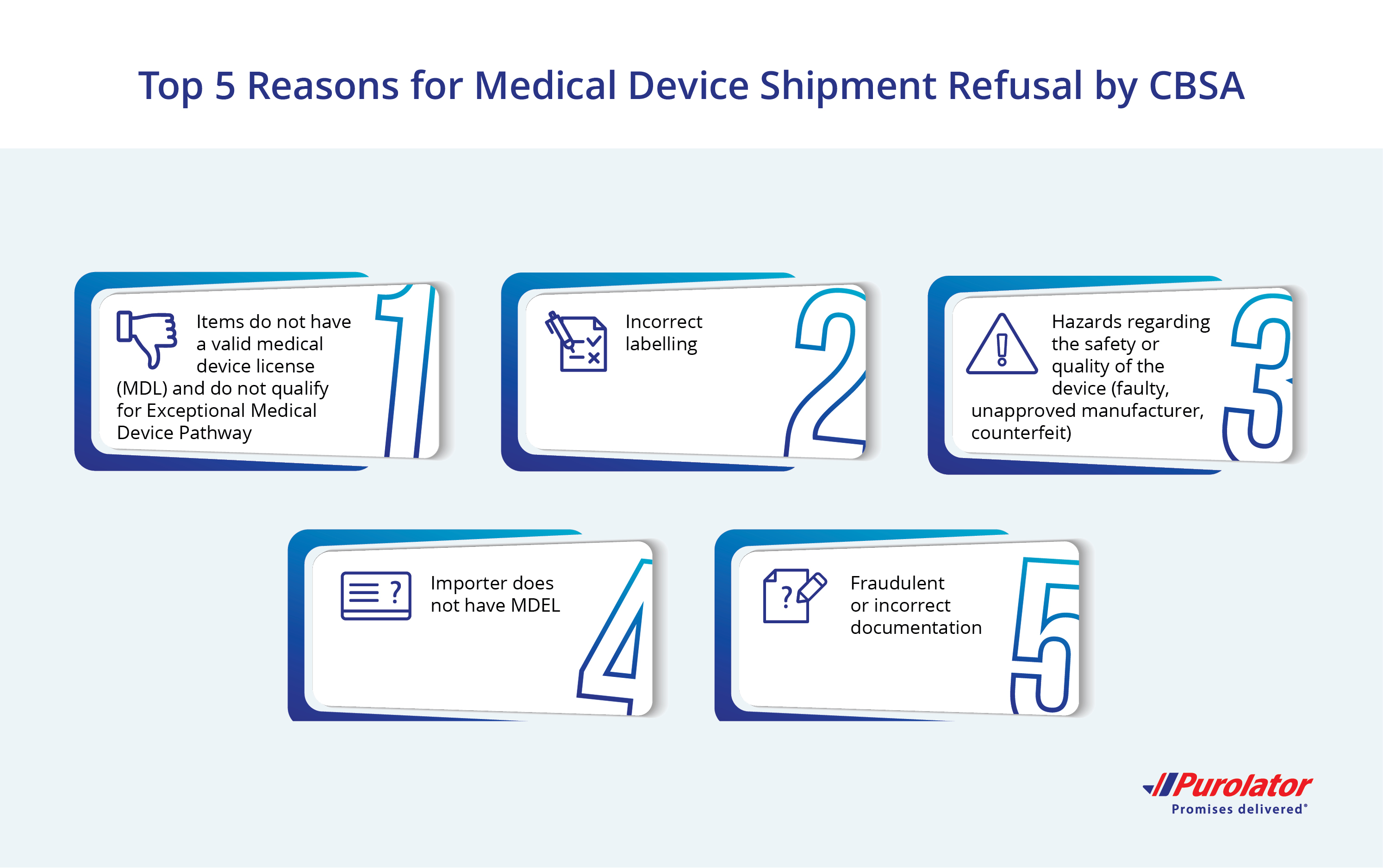
Here are the top 5 common reasons for shipment refusal at the Canadian border:
- No valid MDL and devices do not qualify for Exceptional Medical Device Pathway
- Importer does not have MDEL
- Incorrect labelling
- Fraudulent or incorrect documentation
- Hazards regarding the safety or quality of the device (faulty, unapproved manufacturer or counterfeit)
Working with a courier that has a strong relationship with the border can help your shipments keep moving. For example, Purolator’s team of trade compliance specialists ensures your shipments are compliant and make each step as stress-free as possible.
Learn how to find the right logistics order fulfillment partner for your e-commerce business.
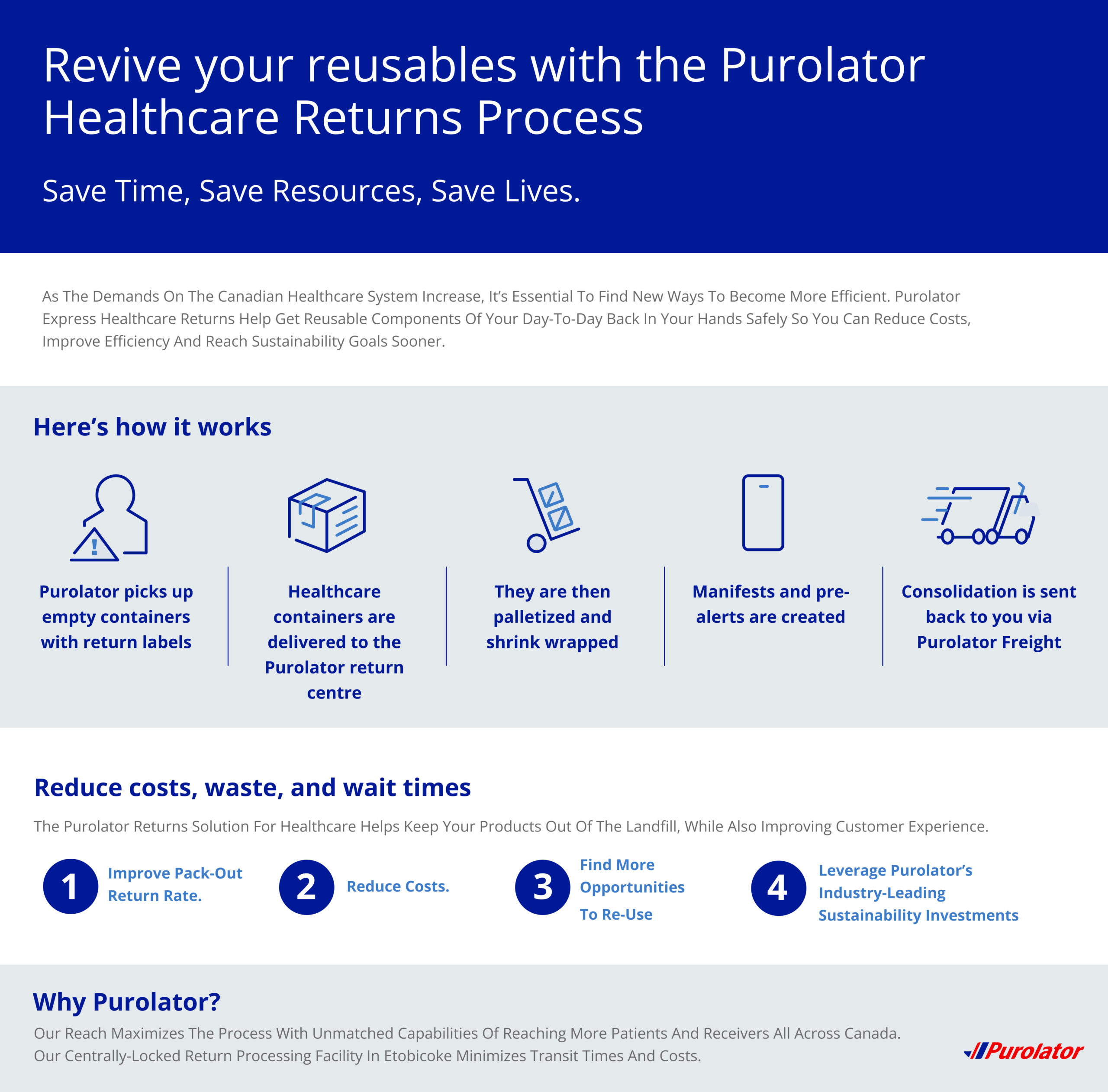
Returns and reverse logistics for importing medical devices into Canada
An effective reverse logistics process for defective medical devices and returns gives your business an added competitive edge, increases efficiency, reduces needless expenditure and loss of profits, and supports a stronger customer experience.
For efficient returns management you need a partner experienced in best practices in medical supplies logistics and equipped with the right services and strategies. Your cross-border shipping partner should:
- Cover return merchandise authorization (RMA), including returning items to the supplier
- Manage warranties
- Have expertise in dangerous goods and special handling delivery
- Offer customer tools to support heightened visibility
- Recycle salvageable components or offer safe disposal in compliance with regulations
Transform your accessibility and innovation in your healthcare logistics with these strategic services and solutions. Download the whitepaper.
What solutions should a delivery provider offer for importing medical devices into Canada?
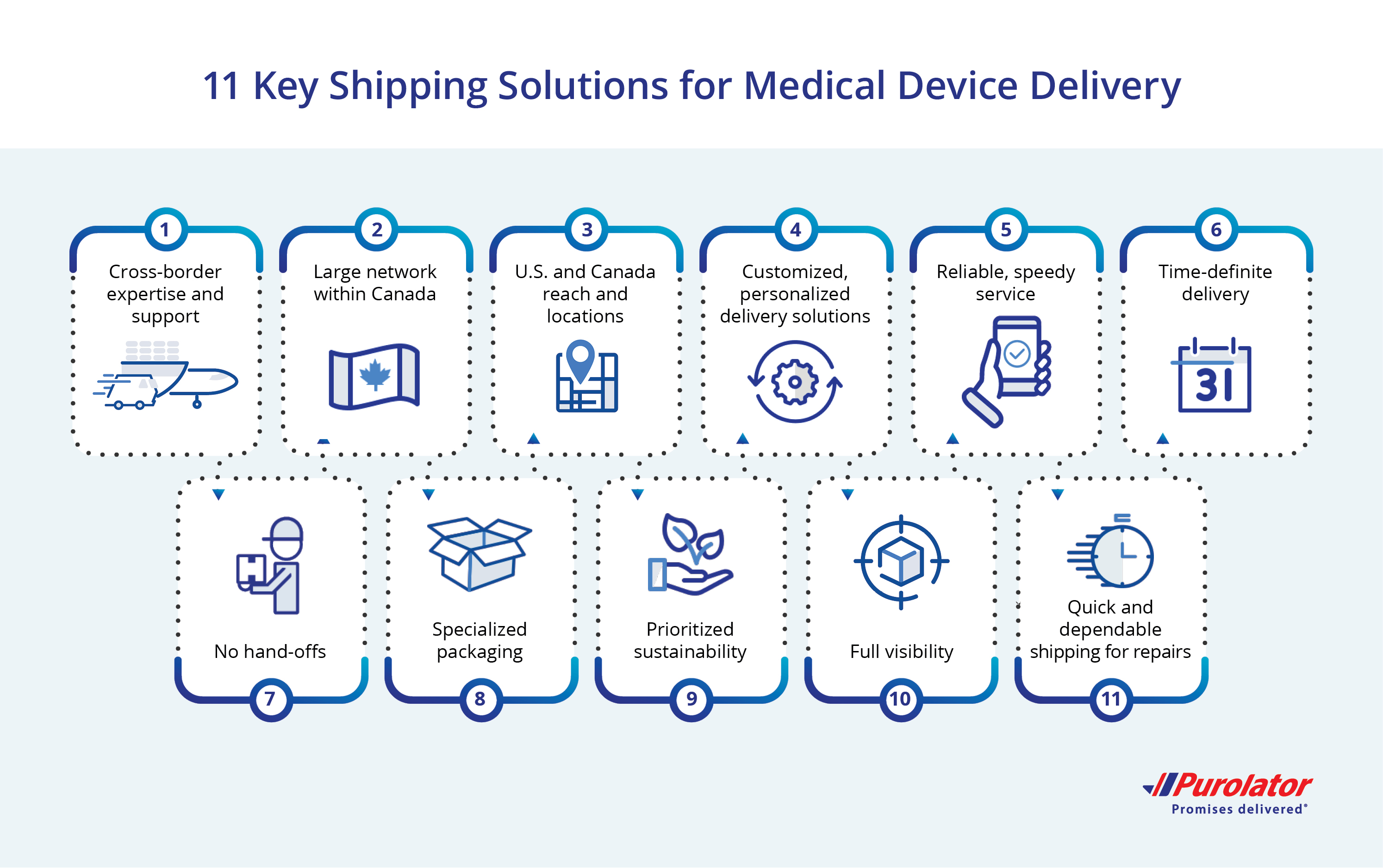
To ensure your medical devices arrive at their destination safely, quickly and in good condition while crossing borders, you need a trusted logistics partner with experience in cross-border shipping. Look for a medical device delivery provider, like Purolator, that offers:
- Cross-border expertise and support. Guaranteed compliance with expertise in medical device cross-border shipping, so you never encounter unexpected delays for the delivery of life-saving devices.
- Large network within Canada. Deliver your shipments to where they’re needed the most and differentiate your business with a shipping partner dedicated to promoting health equity and reducing your costs, like Purolator, with a reach that includes even the most remote regions in Canada.
- U.S. and Canada reach and locations. A comprehensive network in the U.S. and Canada guarantees secure and seamless shipments across borders with consistent level of service so you know exactly where your medical devices are and when they will arrive.
- Customized delivery solutions. Create personalized delivery solutions that are tailored to your business’ unique needs including remote signature release, customized preferences, and complete visibility.
- Reliable, speedy service. From 2-day express to Mission Critical, select from a variety of time frames to accommodate each delivery, so you always meet crucial windows and demand spikes.
- Time-definite delivery. To support critical surgeries and customer needs, look for a shipping partner with delivery accuracy that outperforms Canadian competitors, like Purolator, who offers special request services alongside guaranteed morning delivery.
- No handoffs. Your shipment remains in the hands of one delivery provider throughout its shipping journey, decreasing the chance of theft and damage. Look for services like Purolator’s inside deliveries that include direct to customer home delivery, and direct delivery into hospital wings and surgery facilities that help support strong client relationships and equipment integrity.
- Specialized packaging. Customized packaging solutions focused on preserving and ensuring safe transport of delicate medical devices, including temperature-sensitive packaging.
- Prioritized sustainability. Look for eco-friendly solutions in returns management and shipping like Purolator’s industry-leading sustainable investments that reduce your costs, boost efficiency, and promote a stronger customer experience.
- Full visibility. From the medical device’s manufacturer to its final destination, track shipments 24/7 with real-time updates with customized tools designed for your business like Purolator Vision.
- Quick and dependable shipping for repairs. Extend the life of medical equipment and deliver to your technicians quickly with an expedited shipping method, like Purolator’s Quickship service, that guarantees next day shipping, 7 days a week, with extended hour pickups and deliveries.
Purolator offers an integrated, closed-loop transportation network in Canada for medical device distributors cross-border and internationally to deliver healthcare supplies to support critical patient care, with heightened visibility and quality premium performance and capabilities that give your business an added competitive edge.
How Medline Canada boosted on-time delivery performance to 98%
Timely delivery to meet crucial patient care windows is an essential part of success, customer satisfaction, reliability, and growth in the medical device industry. Medline Canada, a prime supplier and distributor of critical medical supplies since 2003, required a trusted healthcare logistics partner that could deliver consistent service with end-to-end visibility in order to improve their on-time delivery of vital equipment to hospitals, long-term care homes and clinics across Canada.
With the help of Purolator, Medline Canada’s medical device delivery was streamlined, resulting in on-time delivery performance above 98% through Purolator’s:
- 100% postal code reach to even the most remote areas and severe weather conditions
- No hand-offs and end-to-end visibility
- Flexibility in pickups and pull-times in response to spikes in demand
- Priority handling, compliance, and protection for medical device transport
- Tailored shipping solutions customized to unique delivery needs
Learn how Purolator’s industry-leading healthcare solutions resulted in a faster, smarter, and more adaptive medical supply shipping service for Medline Canada. Read the case study here.
Enhance your competitive advantage with healthcare shipping solutions that prioritize efficiency, compliance, and customer impact. Read more.
Prioritizing patient care with unmatched medical device delivery
Delivering medical devices across the border doesn’t need to feel challenging. As an importer, understanding the complexities of shipping medical devices and their requirements and regulations is a key part of your success. Partnering with a trusted logistics provider like Purolator can make all the difference with the support, expertise, and services that make the process seamless and secure.
Purolator offers full-cycle support for importing medical devices into Canada, including regulatory compliance expertise, customized delivery solutions, heightened flexibility and safety, time-definite services and more. Elevate your medical device distribution with a leading provider that understands how to streamline your shipping so you are exceeding customer expectations, jump-starting your efficiency, and providing reliable, competitive service that brings vital supplies to patients that need it the most.
Frequently Asked Questions (FAQs)
What qualifies as a medical device?
According to the Canadian Food and Drug Act, medical devices are instruments used to treat, mitigate, diagnose, or prevent disease and divergent physical conditions and include:[Text Wrapping Break]
- Adhesive bandages
- Contact lenses
- X-Rays
- Insulin pumps
- Blood glucose monitors
For more information, visit Health Canada’s About Medical Devices.
What items are not regulated by Health Canada?
Medical devices that do not comply with Health Canada’s Medical Device Regulations are not permitted to be sold or imported in Canada. Consult Health Canada’s List of Unauthorized Medical Devices to find what equipment is no longer regulated, so you can avoid surprises at the border, which can result in response to non-compliance that includes detention, seizure of license, refusal for entry, and financial liability.
For more information, see Health Canada’s Guidance on Medical Device Compliance and Enforcement: Response to Non-Compliance page.
Who can import medical devices into Canada?
Any individual who is not a manufacturer of medical devices is considered an importer. Whether or not you can import your medical device into Canada is determined by the applicable Food and Drug Act Medical Device Requirements and Regulations, and your device Class Level. As a foreign importer, you must have a valid Medical Device Establishment License (MDEL) with an activity of import. Depending on class level, your product will need an active Medical Device License (MDL).