
While industrial companies are restructuring supply chains, retail is absorbing the end of de minimis and technology is buried in compliance complexity, healthcare has been largely insulated from the immediate financial tariff impact hitting other sectors. That’s because many healthcare goods are classified under HTS codes—Harmonized Tariff Schedule codes that determine how goods are categorized and taxed at the border—that are broadly exempt from duties under CUSMA/USMCA or shipped at values above the thresholds that trigger the most disruptive tariff measures.
Domestic-heavy healthcare supply chains have also provided some insulation from the tariff pressure hitting other sectors. But healthcare sourcing extends well beyond North America, making those protections irrelevant for many goods. The pharmaceutical sector also now faces a Section 232 investigation into pharmaceutical imports, with potential tariffs of up to 100% on patented pharmaceuticals and active pharmaceutical ingredients. For healthcare companies with significant pharmaceutical supply chains outside North America, the period ahead may look very different from the relative stability of the past 18 months.
In 2026, Purolator commissioned HelloInfo to survey 348 shipping and logistics decision-makers across industrial, retail, healthcare and technology in Canada and the United States. The results reveal that the healthcare sector has avoided the worst of the tariff disruption so far—but the upcoming review could shift that protection quickly.
This article breaks down why healthcare’s protected status is contingent rather than guaranteed, how Canadian and U.S. healthcare companies are reading that risk differently and what every healthcare shipper needs to have in place before the review.
“There’s definitely a lot of noise and uncertainty out there, but I would add that we are relatively in a better place than some of the other industries. As long as drugs are moving and manufactured within the U.S., Canada, Mexico, they are exempt from any duties.” — Senior Director, Healthcare, Canada
Read the full global trade report
Key takeaways
-
- Why healthcare has been largely protected from tariff impacts
- How Canadian and U.S. healthcare companies are responding differently despite similar insulation
- Why the CUSMA/USMCA review is the highest-stakes moment for healthcare shippers
- What healthcare companies are planning next
- What companies need from their healthcare logistics partners
- How healthcare shippers can get ahead of the CUSMA/USMCA review
Why healthcare has been largely protected from tariff impacts
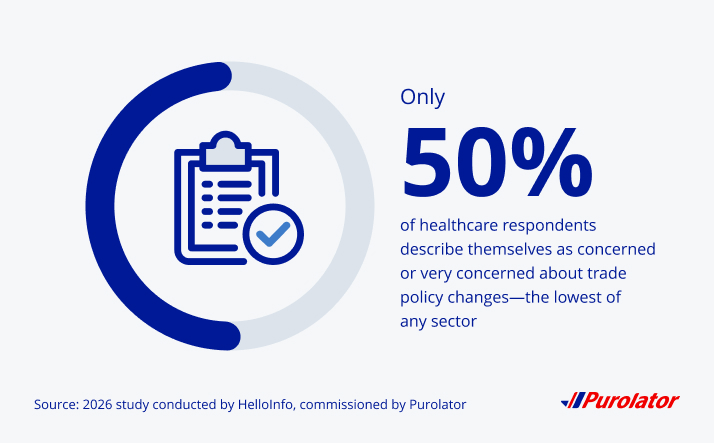
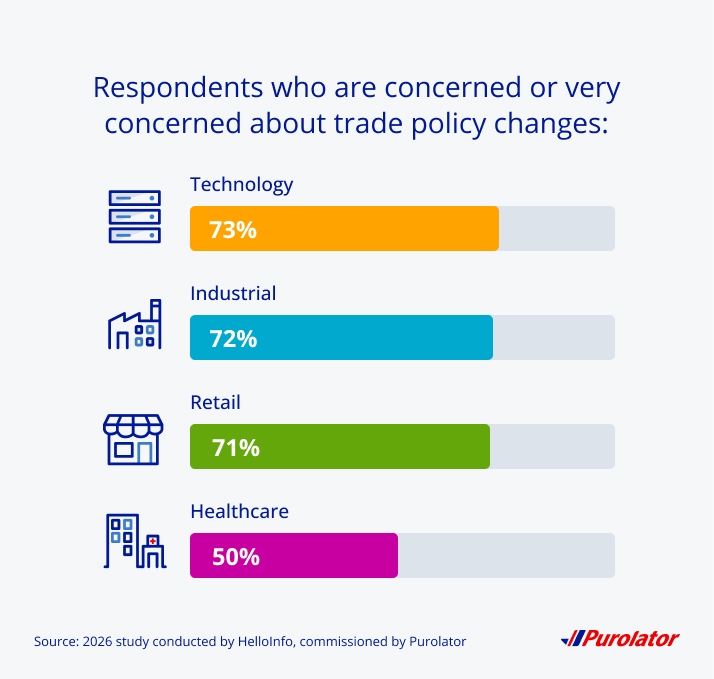
While still significant numbers, healthcare stands apart from every other sector in this research in terms of tariff impact. Only 50% of healthcare respondents describe themselves as concerned or very concerned about healthcare trade policy changes, compared to 73% for technology, 72% for industrial and 71% for retail. It’s the only sector where a meaningful share of respondents report no concern at all, and roughly half of the companies across all industries that reported no impact on business planning are from healthcare.
The protection comes from a specific advantage. Many healthcare goods—pharmaceuticals, medical devices, diagnostic equipment—are classified under HTS codes that carry broad duty exemptions under CUSMA/USMCA. Others are shipped at values that fall above the thresholds triggering the most disruptive tariff measures. Healthcare supply chains also rely heavily on domestic sourcing, making CUSMA/USMCA-compliant goods exempt from tariffs as well. Unlike retail, which lost the de minimis exemption that underpinned its cross-border e-commerce model, or industrial, which has few exemptions available and costs rising from both directions, healthcare entered the current tariff environment with some built-in buffers.
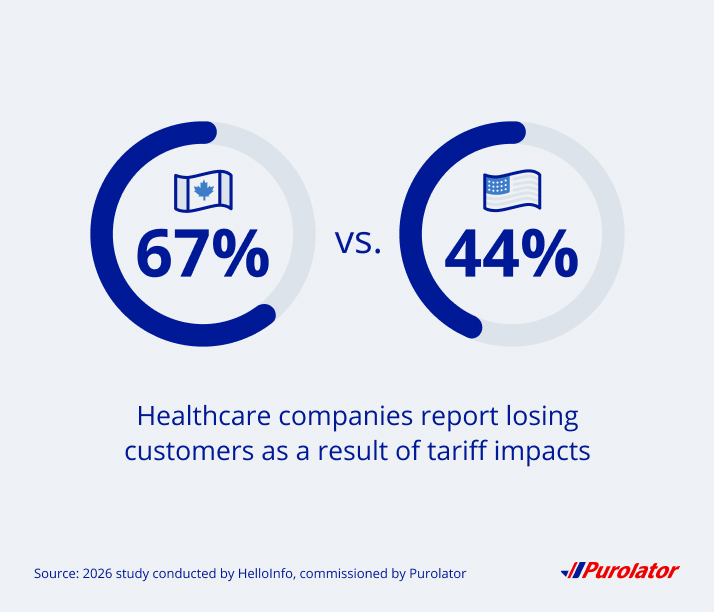
That buffer shows up in the customer loss data too. Healthcare companies report minimal customer loss overall, with demand supported by the essential nature of healthcare purchasing. Where losses do occur, they’re driven more by cost competitiveness and healthcare supply chain shifts than by tariffs directly. Still, the country gap is real: 67% of Canadian healthcare companies report losing customers as a result of tariff impacts, compared to 44% of U.S. peers. The pattern is consistent across industries.
But this illusion of protection is a result of how goods are classified and where they’re sourced from, not blanket immunity. It holds as long as the HTS codes that define exempt healthcare goods remain that way and only for goods sourced domestically. This is precisely what the July CUSMA/USMCA review could change and why healthcare shippers need to start preparing now.
Explore Purolator’s healthcare shipping solutions
How Canadian and U.S. healthcare companies are responding differently despite similar insulation
Despite operating under similar levels of tariff insulation, Canadian and U.S. healthcare companies are behaving very differently in response to medical trade changes. The gap reveals how each side is assessing its own exposure.
Read the full global trade report
Canadian healthcare: proactive repositioning despite insulation
Canadian healthcare companies aren’t waiting for disruption to arrive before acting. They’re nearly twice as likely as U.S. peers to be changing their routing and shipping of goods (48% vs. 25%), a proactive operational move for a sector that hasn’t yet experienced direct tariff impact. Some have already sourced secondary suppliers to mitigate potential CUSMA/USMCA changes, further reflecting their forward-looking approach.
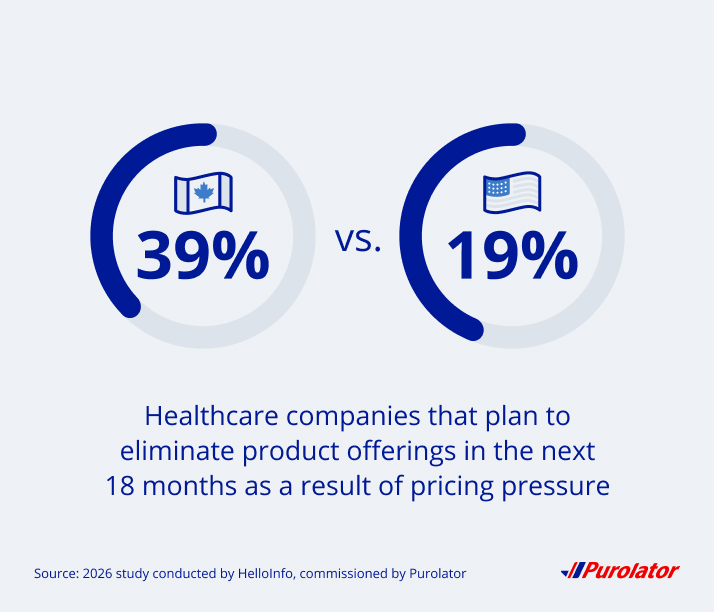
Pricing pressure is also more pronounced in Canada: 54% of Canadian healthcare companies plan to increase selling prices in the next 18 months, compared to 31% of U.S. peers. Thirty-nine percent plan to eliminate product offerings in the same time frame, compared to 19% of U.S. peers. Among the 72% of Canadian healthcare companies that have adjusted shipping to and from the U.S., the biggest shifts include decreasing the use of U.S.-based suppliers (61%) and passing through additional fees to U.S.-based suppliers (48%).
External consultants—such as experts in trade, legal and cross-border shipping matters—are also central to how Canadian healthcare companies are managing the current environment. Healthcare and industrial are the two sectors most reliant on external consultants for day-to-day operations and disruption management, treating specialized advice as essential to operations rather than a contingency resource.
Learn how tariffs are affecting Canadian businesses and how they’re responding
U.S. healthcare: watching and waiting
U.S. healthcare companies are more passive than their Canadian counterparts. That’s likely because those with domestic-heavy supply chains feel largely insulated and show higher levels of optimism about the CUSMA/USMCA review outcome so they’re less urgent to react. U.S. companies across industries are more likely to mention supply chain dynamics as a key focus area, while Canadian companies are more likely to actively adjust pricing strategy and operational infrastructure in response to tariff pressure because many Canadian healthcare companies need to import their products and supplies.
Read how U.S. companies are reacting to tariff pressure and preparing for the CUSMA/USMCA review
Why the CUSMA/USMCA review is the highest-stakes moment for healthcare shippers
The outcome of the CUSMA/USMCA review will have a ripple effect across global industries, but the stakes are arguably highest for healthcare. It’s the moment that determines whether the protection the industry has relied on for the past 18 months holds or disappears.
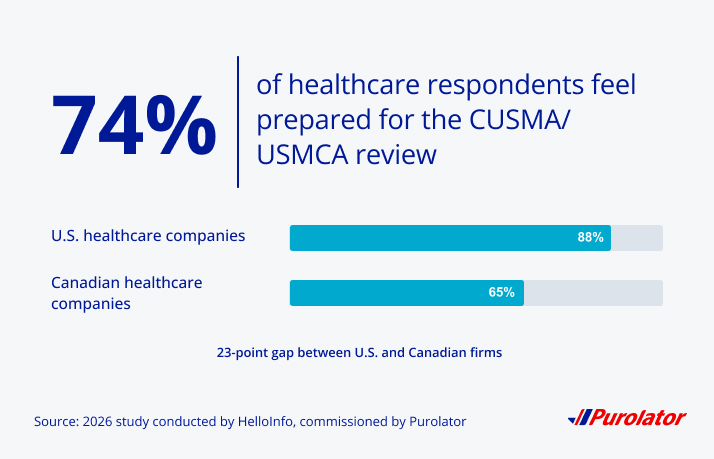
Seventy-four percent of healthcare respondents are aware the review is coming and equal numbers feel prepared, but U.S. companies are significantly more prepared than Canadian firms (88% vs. 65%). Healthcare companies also expect significant disruption from the review, showing that despite being the least affected industry so far, they understand the gravity of what losing their exemptions would mean.
Read the full global trade report
U.S. healthcare companies are highly optimistic
In the U.S., healthcare respondents are among the most confident about the review outcome: 80% think USMCA will improve trade in their country. U.S. healthcare also leads in preparedness at 88%. This may reflect the strength of the domestic healthcare supply chain that insulates U.S. companies from a negative outcome.
Canadian healthcare companies worry their U.S. peers hold the leverage
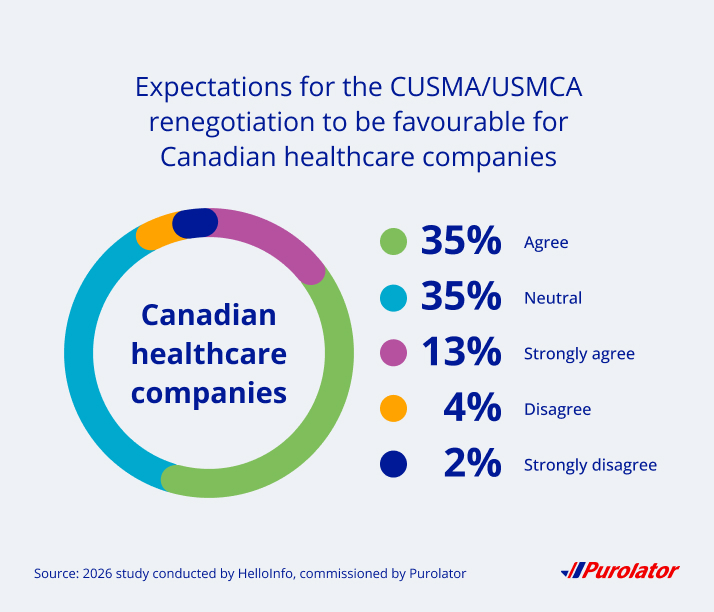
The Canadian healthcare picture is more nuanced than simple pessimism. About a third (35%) are neutral on whether the CUSMA/USMCA renegotiation will protect Canadian goods from future U.S. tariffs, while 48% agree or strongly agree and only 6% disagree or strongly disagree.
Discover how Purolator supports healthcare shippers
Canadian healthcare companies hold the view that the U.S. has the leverage in any renegotiation. Some larger Canadian healthcare organizations are channeling that concern into active lobbying through pharma industry associations, working to protect the specific HTS classifications that matter most to their product categories.
“We have to think that in these types of fights, usually the most powerful party wins. The U.S. is the strong party in this fight. They’re probably going to have the advantages.” — Canadian healthcare company
Learn how Purolator supports cross-border medical logistics
What healthcare companies are planning next
Healthcare companies report the fewest structural operational changes of any sector, but that’s a product of the insulation they’ve experienced so far, not a lack of awareness about what’s at stake. As the review approaches, savvy organizations are starting to build their response capacity now.
Companies across industries, particularly those in Canada, are modeling best- and worst-case tariff scenarios with their finance teams, making CUSMA/USMCA certificates of origin mandatory on all inbound supplier shipments and building secondary supplier relationships outside the U.S. that can be activated if the review outcome changes their cost structure. These choices provide the structural flexibility that companies will need to move quickly if (or when) they have to.
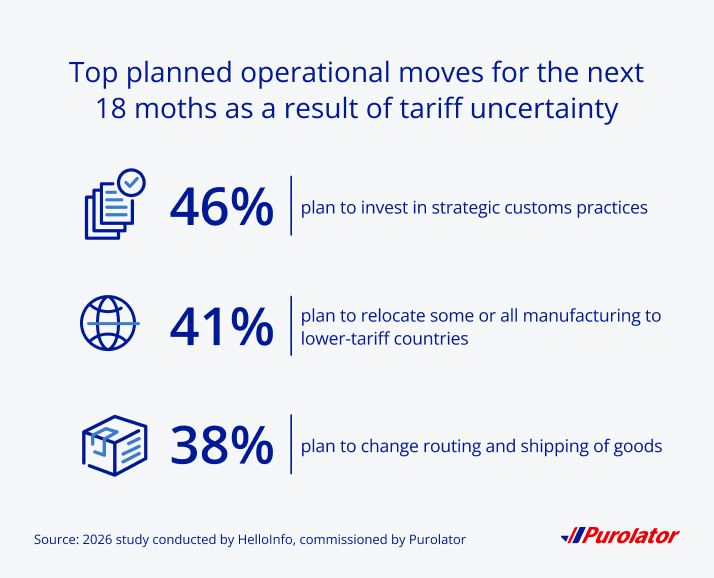
Across the broader healthcare dataset, the top planned operational changes for the next 18 months reinforce the theme of proactive repositioning: 46% plan to invest in strategic customs practices, 41% plan to relocate some or all manufacturing to lower-tariff countries and 38% plan to change routing and shipping of goods. Canadian companies lead the routing changes disproportionately at 48% vs. 25% for U.S. peers.
The scenario that should cause most concern for healthcare shippers is if the review outcome changes which HTS codes remain exempt. This would change or eliminate some of the insulation the industry has experienced so far. Companies that haven’t found alternative sourcing or built compliance infrastructure will face the same restructuring pressure that industrial companies have been dealing with for 18 months.
Find out how Purolator can help healthcare companies navigate tariff changes
What companies need from their healthcare logistics partners
According to the research, healthcare companies feel more supported by their cross-border shipping providers than other sectors (77%), but the country gap is large: 39% of U.S. companies say they feel “very supported” vs. 9% of Canadian companies. On both sides, companies note that their current shipping partner support remains inconsistent and largely transactional.
Unlike industrial and retail companies that need immediate tariff cost management, healthcare shippers are more focused on operational adjustments they can make to reduce tariff impact and guidance around CUSMA/USMCA certification. They want to understand what their exposure would look like under different review outcomes and how to build compliance infrastructure before it’s needed rather than after.
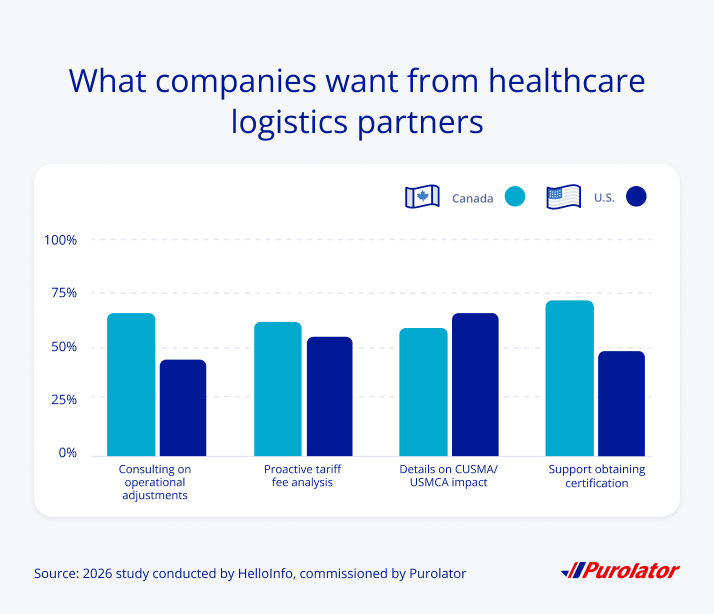
The gap between Canadian and U.S. healthcare on consulting support (65% vs. 47%) is the widest of any healthcare support metric. In anticipation of CUSMA/USMCA review, shippers in both countries should look for a healthcare logistics partner that understands the distinction between exempt and non-exempt HTS codes and can help model the changes if the rules shift.
Discover tariff relief and global market opportunities
How healthcare shippers can get ahead of the CUSMA/USMCA review
The CUSMA/USMCA review is the moment when healthcare’s protected status either holds or changes. The companies that have done the preparation work will be positioned to respond quickly either way. Those that haven’t will face a tight window to adjust their operations. 2q3
For healthcare shippers that want to get ahead of the outcome, these are the actions to prioritize: Audit your current HTS code classifications and confirm their exemption status under CUSMA/USMCA, model both a favorable and unfavorable review outcome against your specific product mix and supplier network and build secondary supplier relationships before they’re needed rather than after.
Partner with the experts in cross-border healthcare shipping
How Purolator supports healthcare shippers
Purolator’s healthcare shipping capability is built around the compliance precision and supply chain reliability that the sector needs.
For CUSMA/USMCA classification and compliance
Purolator’s acquisition of Livingston International provides healthcare shippers with access to trade specialists who understand HTS code classification in depth, including the specific exempt categories that healthcare companies rely on and the documentation requirements that protect that status at the border. The Purolator Trade Assistant supports HTS code determination and duty estimation, giving healthcare teams a practical tool for auditing their current classification coverage before it becomes urgent. For teams navigating rules of origin complexity as they build secondary supplier relationships, Livingston’s brokerage expertise supports the documentation and validation work that keeps CUSMA/USMCA certification current through healthcare supply chain changes.
For scenario planning and healthcare trade intelligence
Through tariff-focused webinars, Purolator and Livingston provide healthcare shippers with current guidance on how evolving medical trade policy affects specific product categories.
For specialized handling
Purolator offers temperature-controlled shipping, dangerous goods expertise and the chain-of-custody capabilities that healthcare shipments require, backed by Canada’s largest integrated freight and courier network and delivery to 100% of Canadian postal codes.
For critical shipments
Our Mission Critical service provides a fully flexible expedited shipping solution, ensuring the best route is taken for your most urgent deliveries. You’ll also have best-in-class tracking visibility and 24-hour access to our shipping specialists. With Healthcare Plus, we offer an extra layer of service assurance and network prioritization for critical healthcare shipments with dedicated assistance for shipment monitoring, intervention and recovery support. This also includes Chain of Signature (COS), assuring secure and accountable transportation for packages that require multiple signatures throughout the transportation route.
For dedicated support
Purolator customers are assigned a dedicated representative with full visibility into their account, providing a single point of escalation. They also get support from our dedicated customer care team to ensure timely resolutions.
Curious how other industries measure up to healthcare in the face of tariff uncertainty? Read the full report.
Healthcare has seen relative stability throughout a volatile global trade environment, but that’s not a guarantee that stability will stay. The CUSMA/USMCA review will determine whether the HTS code exemptions that have protected parts of the healthcare supply chain remain intact. The companies that have used this period of security to audit their classifications, build secondary supplier relationships and put compliance infrastructure in place will be far better positioned regardless of the outcome. For the healthcare shippers navigating that preparation—and the cross-border complexity that follows the review outcome—Purolator’s healthcare shipping expertise, customs brokerage through Livingston International and dedicated cross-border support are there to help.
*This research was commissioned (paid for) by Purolator and conducted by HelloInfo, an independent research firm. Purolator was not identified as the sponsor during data collection.