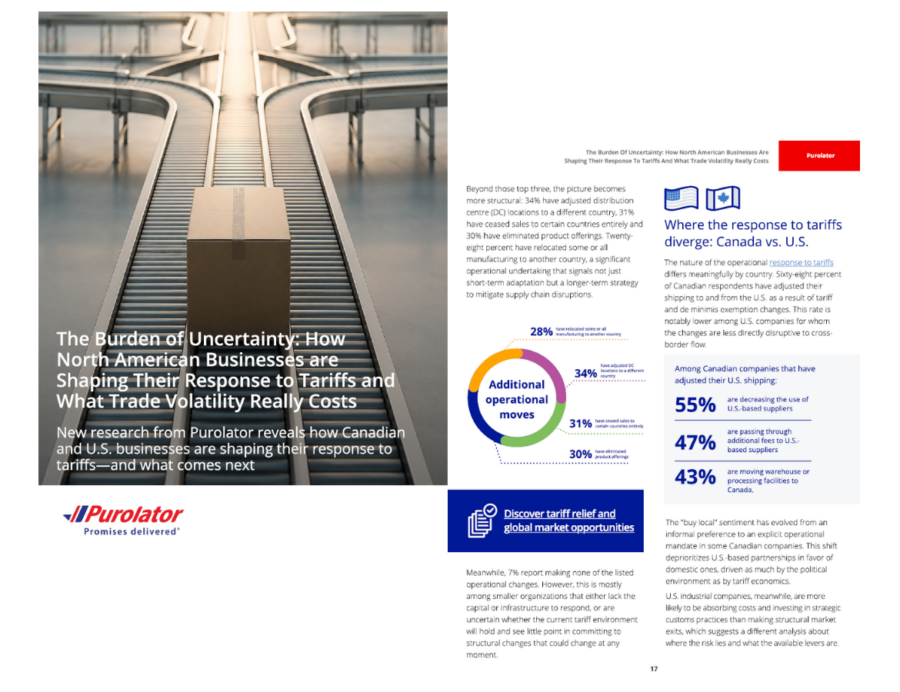

This report, The Burden of Uncertainty: How North American Businesses are Shaping Their Response to Tariffs and What Trade Volatility Really Costs, breaks down the data to provide cross-border shippers with the insights, context and action steps they need to take before the upcoming CUSMA/USMCA review.
Why this report matters now
- 74% of respondents say trade policy changes have had a moderate to significant impact on business planning, with tariff uncertainty named as the biggest challenge over costs.
- Many Canadian companies in specific industries face a two-front battle: U.S. tariffs on their exports and retaliatory tariffs on U.S. imports.
- 93% of respondents have made at least one operational change in the past 18 months but for many companies, strategy is still catching up to reality.
- The CUSMA/USMCA joint review in July 2026 will shape North American trade for the next 16 years, yet many businesses are passively monitoring rather than actively preparing.
- Industrial companies are the most exposed and the most active.
- Retail has been hit hardest by the end of the de minimis exemption.
- Healthcare is protected for now but watching closely.
- Technology is managing the burden through compliance investment rather than structural change.
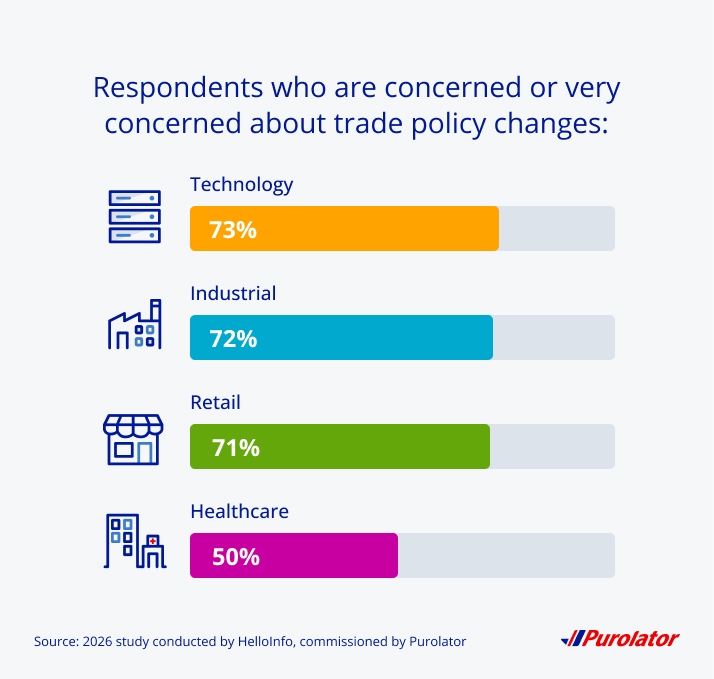
Ninety-one percent of North American businesses across industries are concerned about trade policy shifts. On average, businesses report that tariffs have affected revenues by 23%. Seventy-four percent say they’ve experienced a moderate to significant impact on business planning. But the most common thread across businesses in the industrial, retail, healthcare and technology sectors: Uncertainty is harder to manage than tariffs themselves.
In 2026, Purolator commissioned HelloInfo to survey 348 shipping and logistics decision-makers in Canada and the United States across these four supply chains. The goal: to understand how Canadian and American businesses are navigating an increasingly uncertain trade environment. The quantitative survey was complemented by 41 in-depth interviews with logistics and procurement leaders across both countries, providing the qualitative depth to go beyond the numbers. Respondents were split equally between Canada and the U.S. and represented companies ranging from less than 500 to more than 5,000 employees.*
What you’ll learn in this report
- The financial impact of tariffs across industries and both countries, including revenue impact and customer loss data
- How Canadian and U.S. businesses are responding differently and what separates the companies remaining stable from those still catching up
- A detailed breakdown of operational changes companies have made and are planning across supplier diversification, routing, manufacturing relocation and market exits
- The state of CUSMA/USMCA certification and preparedness for the July 2026 review, by industry and country
- What shippers want from their logistics partners (and what they’re not getting)
- A practical 12-month framework for the actions that matter most before and after the review
The findings in this report were commissioned for one reason: to move our customers from exposure to action. We’ve analyzed the data and interviewed the experts so you have a clear path forward, whatever the review brings.
Download the report now by filling out the form.
*This research was commissioned (paid for) by Purolator and conducted by HelloInfo, an independent research firm. Purolator was not identified as the sponsor during data collection.