
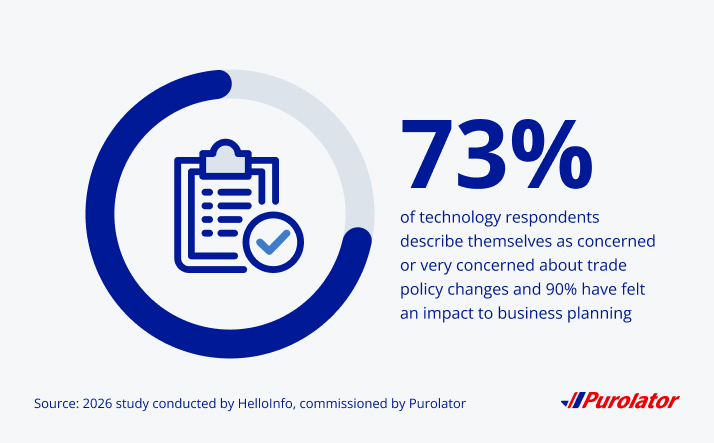
The changing tides of the current tariff environment have complicated supply chains across industries but technology companies occupy an unusual position. The tariff exposure they face is real: 73% of technology respondents describe themselves as concerned or very concerned about trade policy changes and 90% have felt an impact to business planning. But the lever that other sectors are pulling to reduce that exposure—like restructuring supply chains, moving manufacturing and finding alternative sourcing—is largely unavailable to technology companies in the short term. Since most technology manufacturing is concentrated in Asia, reshoring or nearshoring at any meaningful scale takes years, not months.
In 2026, Purolator commissioned HelloInfo to survey 348 shipping and logistics decision-makers across industrial, retail, healthcare and technology in Canada and the United States. The technology data reveals a sector that has stopped chasing policy changes and started building the compliance infrastructure that reduces tariff exposure regardless of what happens next.
For technology shippers, that shift from reactive to structural is the story that defines the past 18 months. This article looks at what the technology tariff data shows, how Canadian and U.S. technology companies are reacting and what every technology shipper needs to have in place before July’s CUSMA/USMCA review.
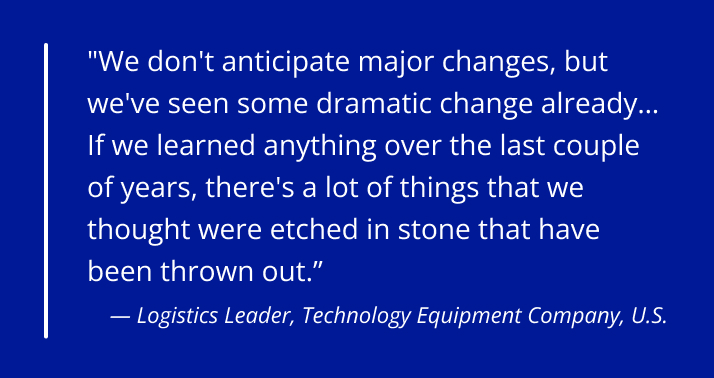
“We are keeping an eye on [the CUSMA/USMCA review]. We have not gone any further than that because if we’ve learned anything, it’s that whatever you hear, wait a day because it’sprobably going to be different. We started chasing and realized we’re spending a lot of time and effort bouncing around.” — Logistics Leader, Technology, U.S.
Read the full global trade report
Key takeaways
-
- The unique tariff pressure technology companies are absorbing
- How Canadian and U.S. technology companies are responding differently
- Why compliance investment is technology’s defining tariff strategy
- What the CUSMA/USMCA review means for technology shippers
- What companies need from their technology logistics partners
- How technology shippers can get ahead of the CUSMA/USMCA review
The unique tariff pressure technology companies are absorbing
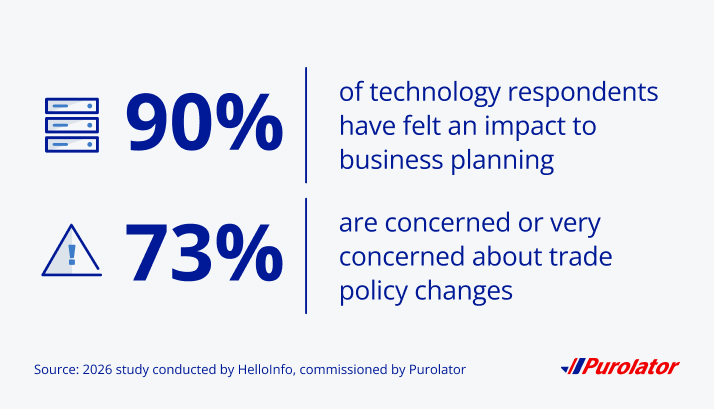
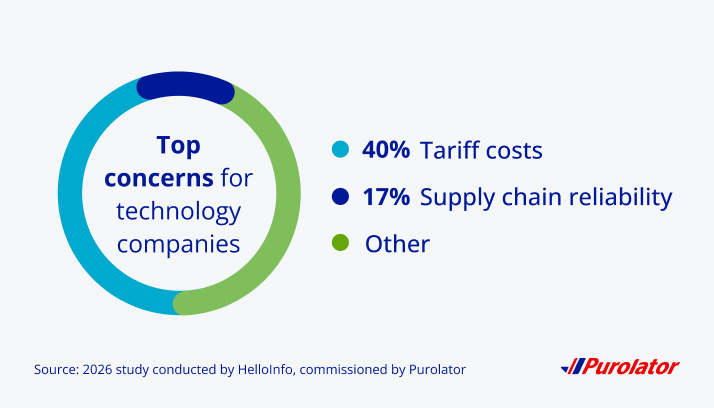
Technology companies report the highest concern levels of any sector in this research: 73% describe themselves as concerned or very concerned about trade policy changes. The financial impact has been substantial, with 90% of technology respondents reporting an impact to business planning (24% report a significant impact and 55% a moderate one). Tariff costs are ranked as the top concern by 40% of technology respondents, followed by supply chain reliability at 17%.
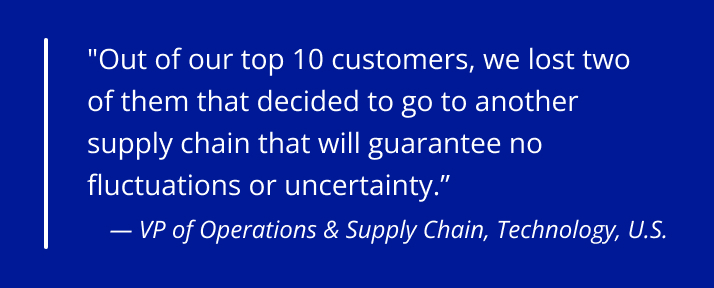
Technology companies on both sides of the border are losing customers—48% in Canada and 43% in the U.S.—but it’s not only because of direct tariff costs. They’re also losing customers because of the uncertainty those tariffs create. The data describes customer hesitancy to commit, delayed purchasing decisions, order cancellations and growing pressure on technology firms to absorb tariff costs rather than pass them through. In a B2B technology market where purchasing cycles are already long, tariff uncertainty appears to give buyers another reason to delay.
Explore Purolator’s technology sector shipping solutions for customized support
Why technology can’t simply restructure its way out
Other sectors have made operational changes in response to tariff pressures, such as moving manufacturing, diversifying suppliers and relocating distribution centres. Technology companies have made some of these moves—11 of the 23 organizations that moved manufacturing to Mexico in the past 18 months are technology companies, the highest of any sector—but those moves are the exception, not the rule. The primary thing holding technology back is the fact that manufacturing is concentrated in Asia. Since tech supply chains are deeply integrated across multiple countries and components are highly specialized, it’s essentially impossible to make quick pivots.
The companies that have tried to respond to every policy shift have found themselves, as one logistics leader put it, spending a lot of time and effort bouncing around. Instead, many have accepted that structural change is an ongoing process and are focused on what can be done now. That means investing in the compliance infrastructure that reduces tariff exposure within an existing tech supply chain rather than rebuilding that supply chain from scratch.
Read the full global trade report
How Canadian and U.S. technology companies are responding differently
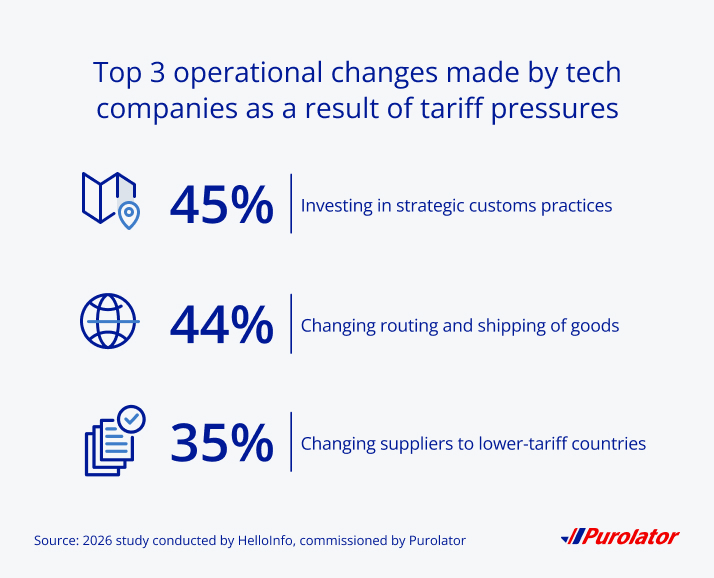
Canada and the U.S. are experiencing significant tariff pressure, but the operational response varies between countries. Across the tech industry, the top three operational changes companies have already made are investing in strategic customs practices (45%), changing routing and shipping of goods (44%) and changing suppliers to lower-tariff countries (35%). The top three planned changes for the next 18 months are identical, suggesting technology companies have settled on a consistent playbook and are continuing to execute it rather than pivoting to new strategies.
Canadian technology companies: pricing pressure and supply chain reviews
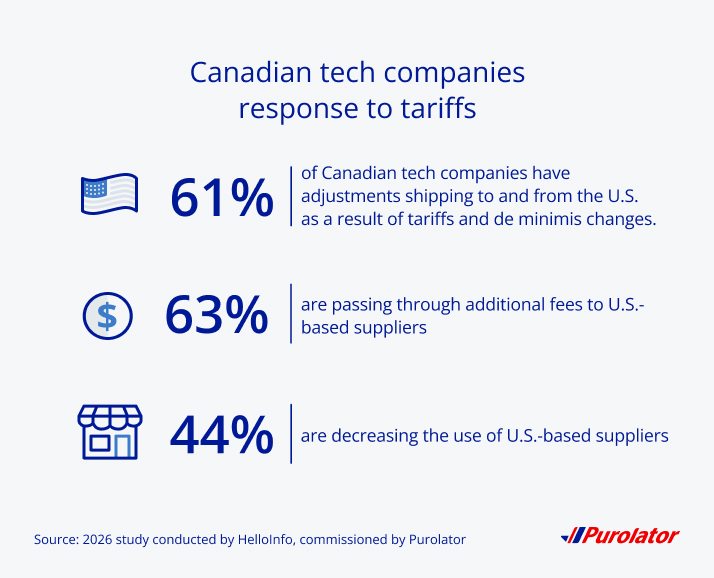
Canadian technology companies are feeling the impact of tariffs from both directions—U.S. tariffs on their exports and retaliatory tariffs on U.S. imports—and it shows in their pricing behaviour. Sixty-one percent have adjusted shipping to and from the U.S. as a result of tariffs and de minimis changes, 63% are passing through additional fees to U.S.-based suppliers and 44% are decreasing the use of U.S.-based suppliers.
When it comes to pricing, Canadian technology companies are more likely than their U.S. peers to plan supply chain reviews for cost-cutting (61% vs. 52%) and price increases (59% vs. 50%) in the next 18 months. They are also more likely to force internal cost cutting in the past 18 months (41% vs. 36%) and in the next 18 months (36% vs. 32%).
Learn how Canadian companies across industries are responding to tariff uncertainty
U.S. technology companies: compliance investment and supply chain dynamics
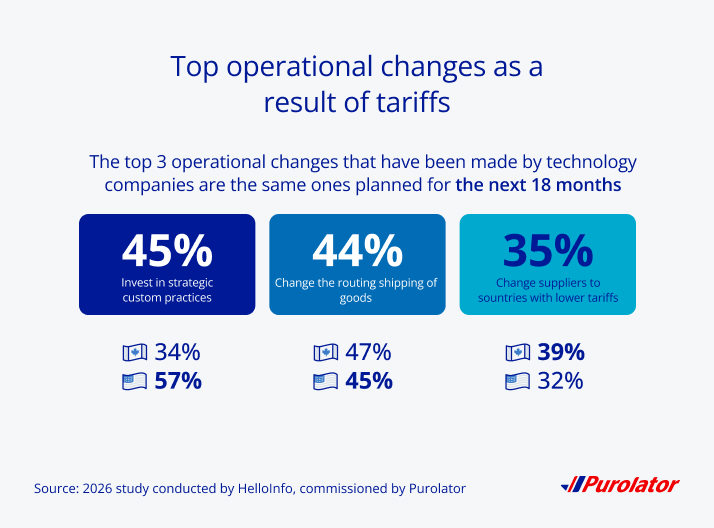
U.S. technology companies are further ahead on compliance infrastructure and this holds true for both what they’ve already done and what they’re planning next. They’ve invested in strategic customs practices at 57% (vs. 34% for Canadian peers in the past 18 months) and plan to continue at the same rates in the next 18 months, suggesting a strategic play rather than a one-time response. U.S. companies are also more likely to focus on supply chain dynamics (82% vs. 55% for Canada) and capital investments (61% vs. 32%) as key operational areas impacted by tariffs. This may be a sign that U.S. technology companies are playing the long game, investing now in the systems and processes that will reduce tariff exposure rather than managing costs reactively as more changes occur.
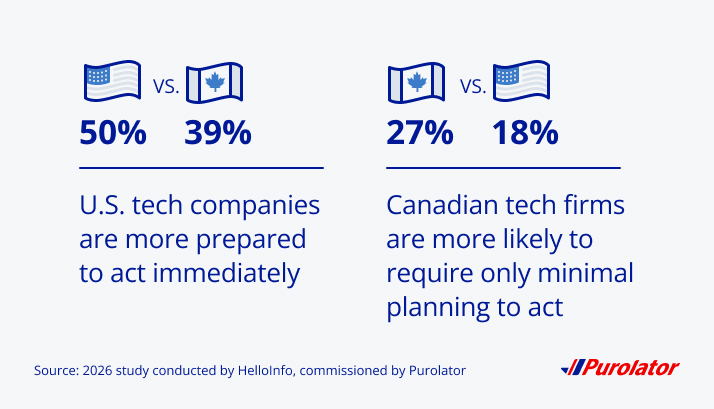
U.S. technology companies are also more prepared to act immediately if conditions deteriorate: 50% are fully prepared vs. 39% of Canadian firms. Canadian companies, however, are more likely to require only minimal planning before acting (27% vs. 18% for U.S.), which partially offsets the preparedness gap.
Learn how U.S. companies across industries are responding to tariff uncertainty
Why compliance investment is technology’s defining tariff strategy
Across both countries, the technology sector’s response to tariff pressure has hinged on a common tactic: Invest in the compliance tools, processes and expertise that reduce tariff exposure within an existing technology supply chain. This means optimizing CUSMA/USMCA certification, reclassifying HTS codes, documenting rules of origin and making use of duty drawback programs and free trade zones. Linking these tariff-mitigating tools and processes together is often bonded transportation solutions acceptable to North American Customs authorities.
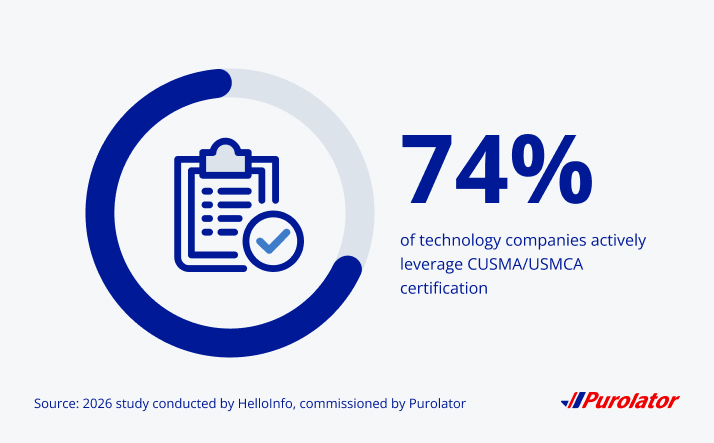
Seventy-four percent of technology companies are actively leveraging CUSMA/USMCA certification, but uncertainty around potential changes is driving caution. However, for a sector that can’t easily move manufacturing, the ROI on compliance investment has become clear: Every dollar spent on getting classification right or identifying a duty drawback opportunity is a direct reduction in tariff exposure without requiring any structural change.
Talk to a technology shipping expert for support
The fact that 45% of technology respondents have already invested in strategic customs practices, with similar rates planned for the next 18 months, shows the sector already understands what’s at stake. U.S. technology companies are further ahead in this investment but Canadian companies are catching up.
Read the full global trade report
What the CUSMA/USMCA review means for technology shippers
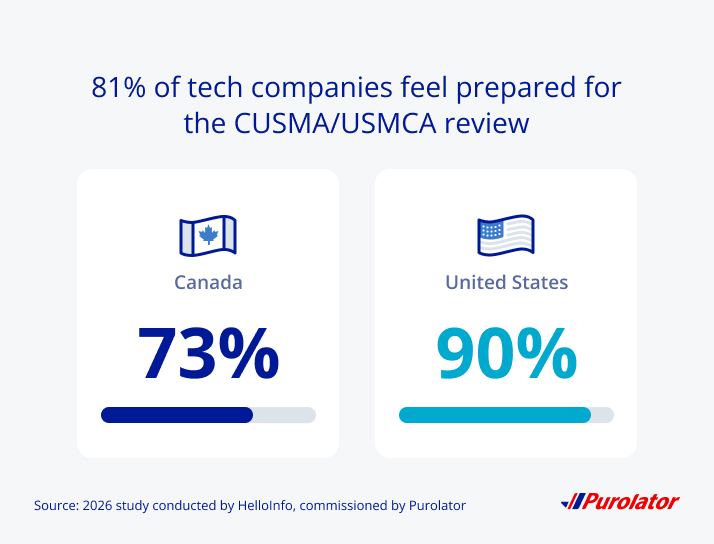
Seventy-three percent of technology respondents are aware the CUSMA/USMCA review is coming in July 2026, and 81% feel prepared, with U.S. companies significantly more ready at 90% vs. 73% for those in Canada. But rather than actively preparing, many technology companies are keeping a watchful eye. They’ve learned that chasing every policy development is costly and disorienting, so many are monitoring the situation without committing to substantial changes until the review outcome is known.
Despite feeling prepared, 59% of technology respondents expect some level of disruption from the review and 8% are unsure, but the mood is one of caution rather than true pessimism. On whether the CUSMA/USMCA renegotiation will protect Canadian goods from future U.S. tariffs, Canadian technology companies are among the more optimistic segments (61% strongly agree or agree, 30% are neutral and only 9% disagree). U.S. technology companies are even more confident, with 66% agreeing or strongly agreeing that the renegotiation will create a more favorable environment for U.S. companies.
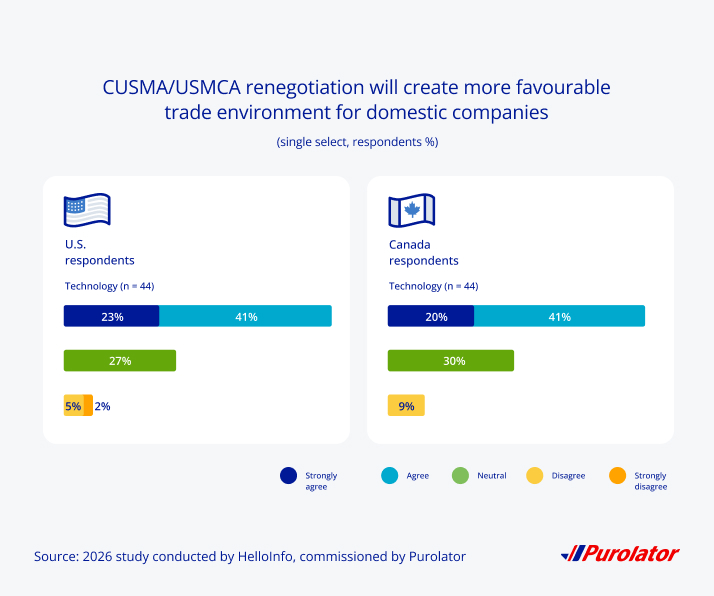
The risk in waiting things out is that it leaves companies scrambling if the review delivers an unfavourable outcome. For technology companies specifically, the review could primarily affect CUSMA/USMCA certification coverage: If the rules of origin requirements for technology goods change, companies that haven’t audited their current certification will face both immediate duty exposure and the burden of reclassification on a tight timeline.
Read the full global trade report
What companies need from their technology logistics partners
Seventy-nine percent of technology companies feel supported by their cross-border shipping partners but U.S. companies are more likely to feel very supported than Canadian peers (36% vs. 20%). Technology companies are clear on what they want from those partners: not transactional service, but strategic compliance advisory.
The top support needs reflect the industry’s focus on compliance: 63% of technology respondents want proactive support on reducing tariff fees by analyzing shipments, 57% want consulting on operational adjustments to reduce tariff impacts, 53% want details on how CUSMA/USMCA specifically affects their business and 47% want support with paperwork for customs clearance.
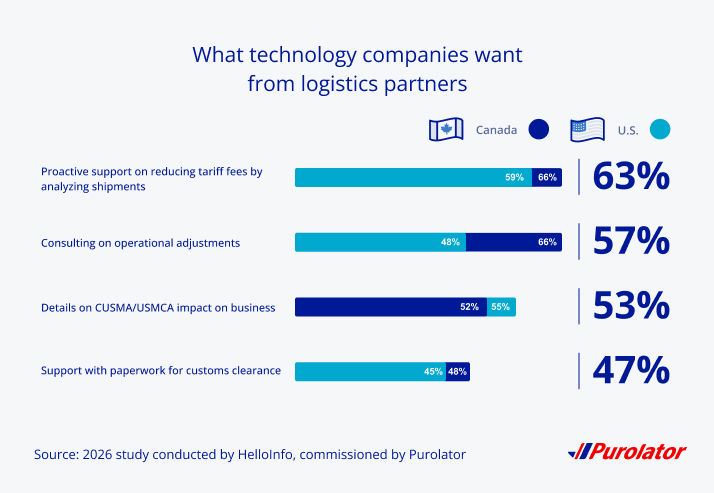
The biggest country split shows up in the desire for consulting support: U.S. technology companies want operational adjustment consulting at 66% vs. 48% of Canadian peers, despite already being further ahead on compliance investment. This suggests that even the most prepared technology companies recognize they need external expertise to optimize what they’ve built.
In both countries, companies are seeking technology logistics partners who act as strategic compliance advisors. They want partners who understand HTS classification, bring proactive analysis of tariff exposure across specific product categories and stay ahead of CUSMA/USMCA developments rather than reacting to them. That’s a higher bar than simply processing shipments accurately and invoicing on time—and it’s the standard technology companies are using to evaluate whether their current carrier relationship is worth keeping.
Discover tariff relief and global market opportunities
How technology shippers can get ahead of the CUSMA/USMCA review
Technology companies are navigating a tariff environment where the primary mitigation strategy is compliance investment, which requires specialized expertise that most internal teams don’t have and that many carriers don’t offer. Purolator’s technology shipping capability is built to fill that gap.
How Purolator supports technology shippers
For customs and brokerage expertise
Through its acquisition of Livingston International, Purolator provides technology shippers with access to trade specialists who understand the classification complexity that defines technology and electronics supply chains. This includes HTS code determination for multi-component products, rules of origin analysis for goods with manufacturing steps across multiple countries, duty drawback identification and free trade zone optimization. For technology companies managing CUSMA/USMCA certification across suppliers at different stages of the manufacturing process, Livingston’s brokerage expertise supports the documentation and validation work that keeps certification current as supply chains evolve.
For proactive tariff analysis
The Purolator Trade Assistant provides on-demand tariff classification codes, duty estimates and customs documentation requirements across product categories. For technology teams that need to audit their current classification coverage or model the duty impact of a supplier change, it’s a practical tool that doesn’t require a trade law engagement to use.
For CUSMA/USMCA review preparation
Purolator and Livingston host tariff-focused webinars to provide technology shippers with current guidance on how evolving trade policy, tariff changes and potential review outcomes affect specific product categories. This delivers the proactive intelligence that technology companies are often missing from their logistics partners.
Find out how tariff response differs across industries in our global tariff report. Download now
For cross-border technology logistics
Using a range of air, ground, freight and expedited options, Purolator offers end-to-end delivery solutions across Canada, the U.S. and internationally, while delivering to 100% of Canadian postal codes. Bonded transportation options for shipments transiting across borders from bonded warehouses and Foreign Trade Zones are available to further support compliance processes.
For security and loss prevention
As a TAPA-certified shipping provider, we use industry-leading security and loss prevention protocols to keep your shipments safe from theft and fraud, monitored and tracked from end-to-end.
For total visibility
We provide best-in-class visibility into your delivery at every step of its journey with Purolator Vision and Purolator Your Way. These tools provide increased delivery speed and a proactive approach to customer satisfaction.
Technology’s tariff challenge isn’t going away when the CUSMA/USMCA review concludes. The compliance infrastructure that reduces exposure today is the same infrastructure that will absorb whatever the review delivers. Download the full research report to see how businesses across industries are navigating tariff uncertainty. Or speak to a Purolator cross-border expert about building the compliance foundation your technology supply chain needs before July arrives.
*This research was commissioned (paid for) by Purolator and conducted by HelloInfo, an independent research firm. Purolator was not identified as the sponsor during data collection.