
Since the current American administration introduced broad tariffs on Canadian and Mexican goods in early 2025, industries have been bearing the weight of unexpected costs, lost customers and an increasingly uncertain trade environment. Industrial companies are among those feeling the impact most.
Purolator commissioned HelloInfo to conduct deep research into the challenges industrial companies in Canada and the United States are facing with cross-border shipping—and the tariff mitigation strategies they’re using to regain stability. Across 348 respondents in various industries (retail, industrial, technology and healthcare), we found that industrial companies report among the highest levels of concern with tariff uncertainty, the most aggressive operational changes and the deepest pessimism about what the upcoming CUSMA/USMCA review will deliver.
But despite the shared pressure that comes with broad industrial tariffs, Canadian and U.S. companies are responding differently. There’s a gap between those who adapted early and those who are still catching up.
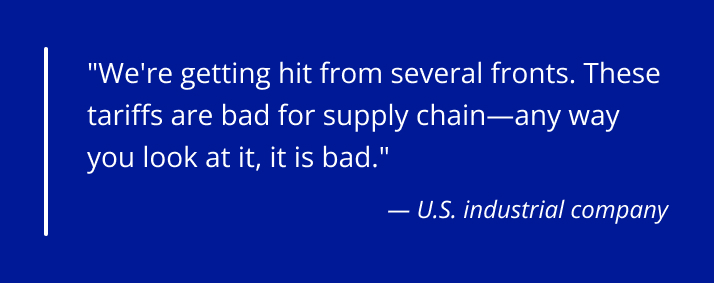
“We’re getting hit from several fronts. These tariffs are bad for supply chain—any way you look at it, it is bad.” — U.S. industrial company
This article unpacks what the data shows about the current state of global industrial trade, where industrial companies stand, what the most prepared businesses are doing and how every industrial shipper can prepare for July’s review. We also explore what sets the companies adapting early apart from those still catching up to the current trade reality.
Read the full global trade report
Key takeaways
-
- Where industrial companies are feeling the impact of tariff changes most
- How industrial companies are safeguarding against tariff uncertainty
- Why industrial companies are the least optimistic about the upcoming CUSMA/USMCA review
- What industrial companies are planning next
- What industrial shippers need from their supply chain management logistics partners
- How industrial companies can get ready for the CUSMA/USMCA review
Where industrial companies are feeling the impact of tariff changes most

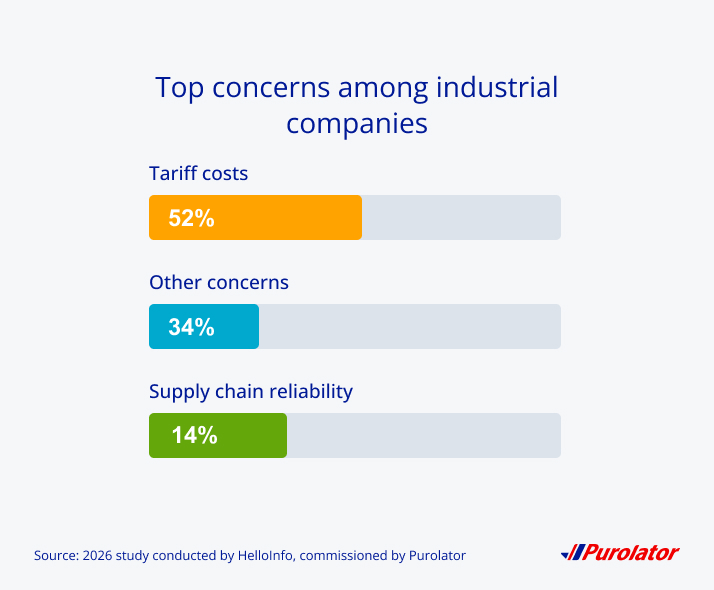
Industrial companies are among the businesses most concerned with trade policy changes: 72% describe themselves as “concerned” or “very concerned,” which is similar to the retail and technology sectors but much higher than healthcare at 50%. For industrial decision-makers, that shows up in pricing conversations, routing decisions and network changes that can’t wait for conditions to stabilize. Tariff costs are ranked as the top concern by 52% of industrial respondents, followed by industrial supply chain reliability at 14%. Industrial companies are also more likely than other sectors to have relocated manufacturing, stopped sales to certain countries and eliminated product offerings entirely.
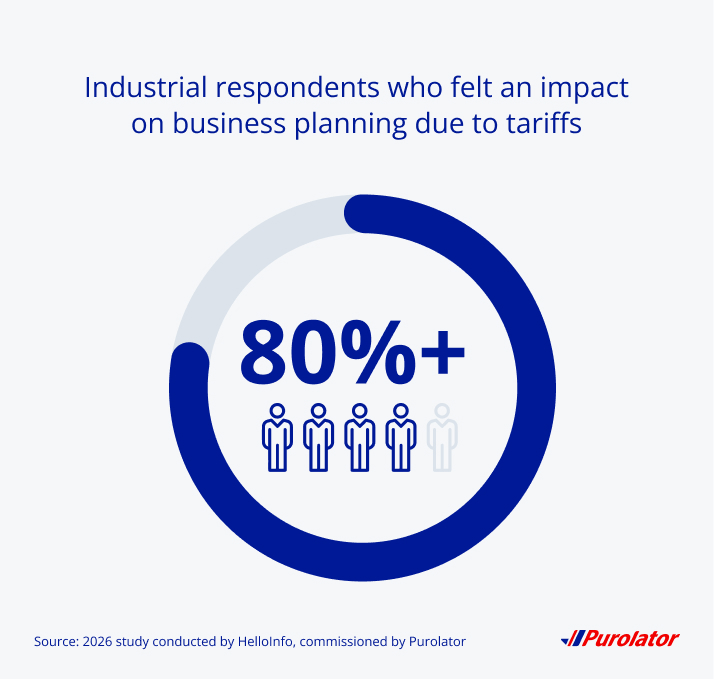
More than 80% of respondents say they’ve felt an impact to business planning, with 25% reporting a significant impact and 58% reporting a moderate impact. For Canadian industrial companies, the pressure is compounded. They’re managing both U.S. tariffs on their exports and retaliatory Canadian tariffs on U.S. imports at the same time. For companies that sell into the U.S. market and source from U.S. suppliers, costs are rising from both directions at once.
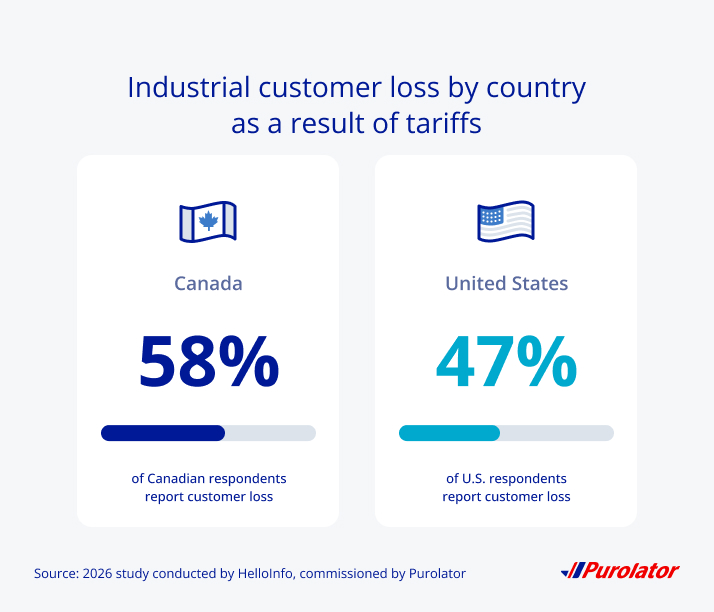
Customer loss is also occurring across all industries and is generally higher in Canada, however industrial companies report the most direct loss of customers as a result of tariff changes. In Canada, 58% of industrial companies report losing customers compared to 47% of U.S. peers. The qualitative data, captured in 41 interviews with shipping and logistics leaders in both countries, captures what that looks like in practice. One U.S.-based respondent lost two of its top 10 customers to competitors that promised “no fluctuations or uncertainty.” The cost of instability shows up in lost revenue and relationships that are hard to rebuild.
Fear and misperception have deepened the impact. One Canadian industrial company lost U.S. customers early in the tariff escalation period—not because of actual duty costs, but because customers assumed they would immediately face a 25% tariff on all products. Many of those customers are now being won back as CUSMA/USMCA protections become better understood, but the reaction from customers shows how quickly uncertainty can translate into lost business and how much work it takes to recover it.
Discover the future of industrial logistics
How industrial companies are safeguarding against tariff uncertainty
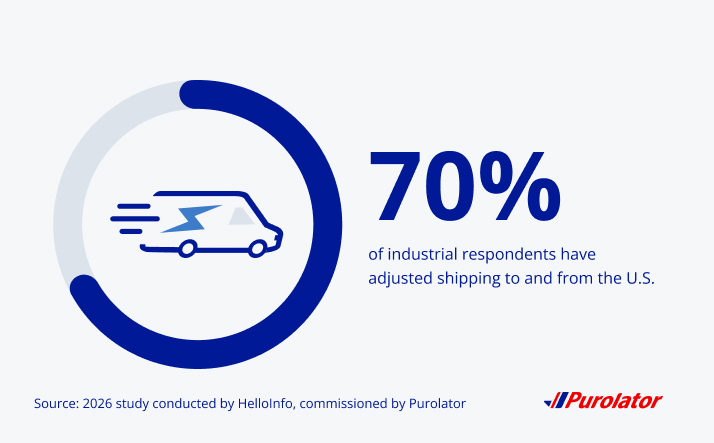
The industrial sector hasn’t been standing still. In Canada, 70% of industrial respondents have adjusted shipping to and from the U.S. as a result of tariffs and changes to de minimis exemptions. Across both countries, companies are restructuring supply chain management of the logistics industry, rethinking sourcing strategies and investing in compliance infrastructure at some of the highest rates of any sector.
Moving industrial manufacturing and distribution centres to North America
Companies across industries are actively switching manufacturing and distribution centre locations, with industrial companies among those that have shifted facilities away from Asia and toward North America. Many are also moving away from China to other Asian countries, based on tariff schedules. Meanwhile, Mexico is emerging as a strategic buffer: As a CUSMA/USMCA-compliant location, Mexico allows companies to reduce direct Canada-U.S. border exposure while remaining within the trade agreement’s protections.
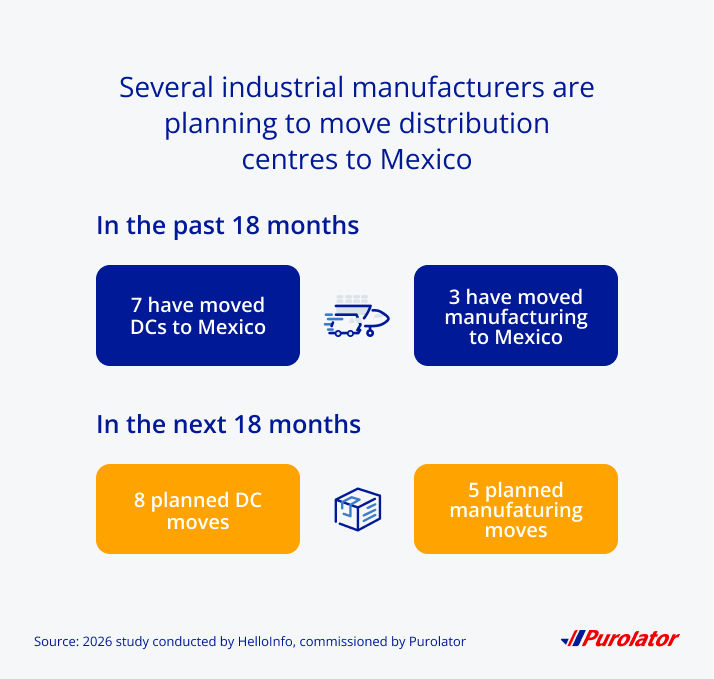
So far, seven industrial companies surveyed have moved distribution centre operations to Mexico in the past 18 months and eight more plan to follow suit—predominantly Canadian companies that are likely seeking to minimize direct U.S. border crossings. Industrial manufacturing moves to Mexico are more modest (three in the past 18 months and five planned), with technology and healthcare companies leading the trend. So while Mexico is a meaningful directional signal, it hasn’t yet become the go-to manufacturing destination for industrial shippers.
Read the full global trade report
CUSMA/USMCA certification as a cost-mitigation strategy
CUSMA/USMCA certification has become a strategic tool for many industries to mitigate the ongoing cost of tariffs. The program enables duty-free or reduced-tariff access for goods that undergo sufficient production within North America. Industrial companies have the highest and most actively managed certification rates of any sector outside healthcare, but Canadian and U.S. industrial companies are taking slightly different approaches to certification.
For instance, many Canadian companies, including industrial, have made CUSMA/USMCA certificates of origin mandatory on all inbound supplier shipments, showing their heightened commitment to limiting tariff exposure. U.S. companies across industries, however, are more mixed on CUSMA/USMCA management: Some are actively optimizing certification while others are unsure of their organization’s current status.
Learn how cross-border shippers can mitigate tariff fallout
Working with industrial shipping partners and global trade experts
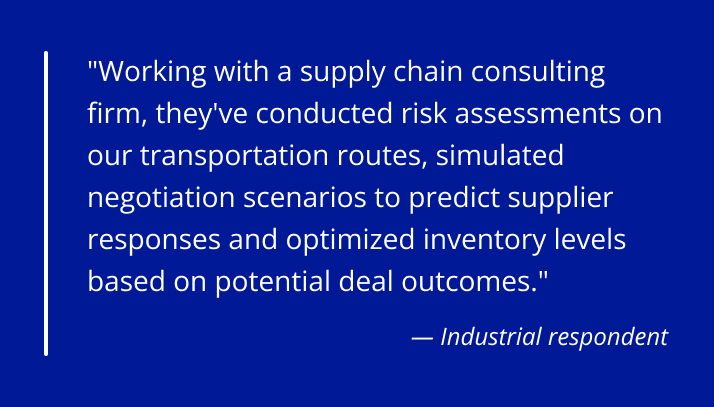
In both countries, the companies that are most prepared for changes to industrial trade are those using external expertise to build contingency plans. This includes consultants, trade law firms and logistics partners who can offer proactive support and strategies to mitigate the impact of tariff uncertainty.
Purolator can help create a contingency plan. Speak to a supply chain expert for guidance. Connect with an expert
Why industrial companies are the least optimistic about the upcoming CUSMA/USMCA review
The upcoming CUSMA/USMCA review is an opportunity for Canada, the U.S. and Mexico to come together and jointly assess whether the current agreement is serving the needs of North American trade. It comes six years after the agreement was first put in place and will determine whether it will continue for the next 16 years.
Given the unpredictability of global and industrial tariffs, businesses are wary of what the review will deliver. Despite being the most active users of CUSMA/USMCA certification, industrial companies—particularly Canadian ones—are the least optimistic about the outcome.
Eighteen percent of Canadian industrial respondents disagree or strongly disagree that the renegotiation will create a more favourable environment for Canadian companies, which is the highest pessimism rate of any sector. Forty percent are neutral, meaning fewer than half of Canadian industrial respondents (42%) are genuinely optimistic about the outcome.
Discover our cross-border industrial shipping options
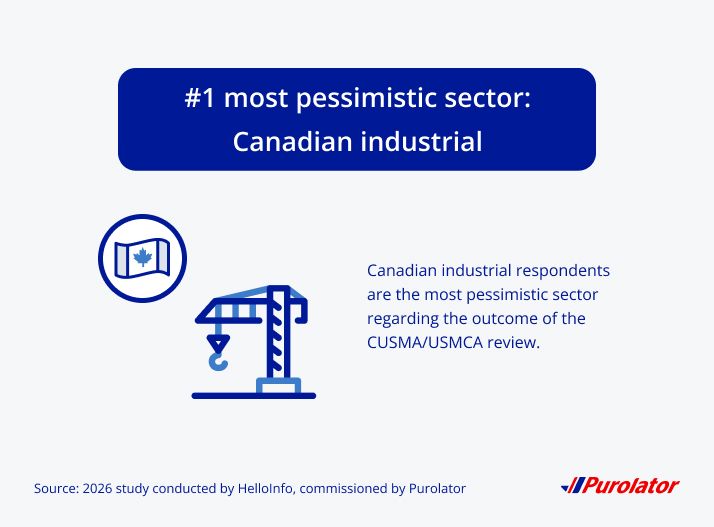
This pessimism is rooted in experience. Canadian industrial companies have already spent 18 months living with the consequences of tariff instability, so they understand better than most what a negative or ambiguous review outcome would mean for supply chain management of the logistics industry. They have more to lose, fewer alternatives and less insulation from a deteriorating trade agreement than their U.S. counterparts.
This paints a clear picture that Canadian industrial companies aren’t hoping the CUSMA/USMCA review will improve the trade environment. They’re wondering whether the current agreement will hold and they believe holding is the most realistic outcome.
Read the full global trade report
What industrial companies are planning next
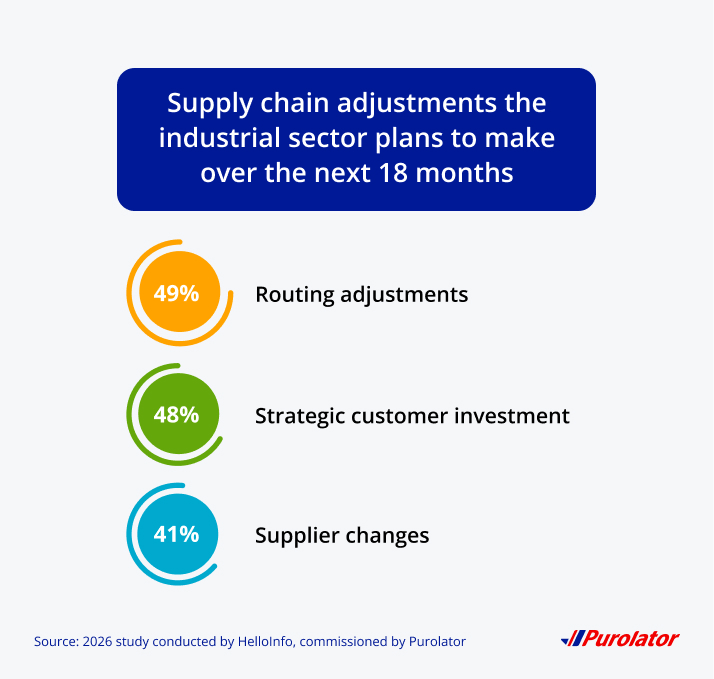
The industrial sector has adapted quickly, but it’s not a one-time adjustment. It’s an ongoing restructure of industrial supply chains that will continue regardless of what the CUSMA/USMCA review brings. Businesses in both countries are actively planning their next moves. The most planned changes across industrial respondents are routing adjustments at 49%, followed by strategic customs investment at 48% and supplier changes at 41%.
Learn how Purolator helps businesses navigate cross-border trade
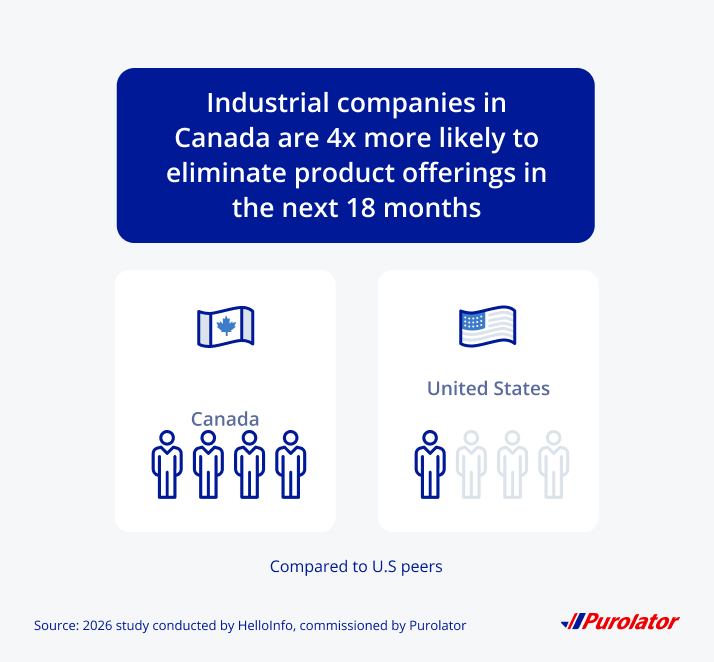
But planned tariff mitigation strategies differ between countries. In Canada, industrial companies are four times more likely to eliminate product offerings compared to their U.S. counterparts. This suggests that tariff complexity has driven Canadian industrial companies to reevaluate and simplify what they make and sell to focus on the products and markets with the strongest margins. This could also be a result of de minimis changes: A change in exemptions or product-specific tariff can instantly render the product non-competitive in the U.S. market.
Meanwhile, U.S. industrial companies are more likely to invest in strategic customs practices (56% vs. 40% of Canadian peers) and routing changes, and less likely to exit markets, suggesting they have a greater capacity to absorb costs without restructuring.
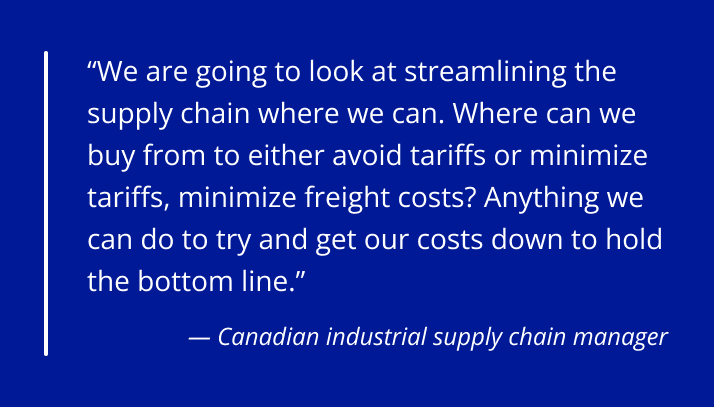
What’s clear is that Canadian and U.S. industrial companies are responding to tariff changes in ways that reflect the unique pressure they’re under. Canadian industrial companies are restructuring—simplifying product lines, reconsidering markets and repositioning their industrial supply chains—because the two-front nature of their tariff exposure leaves them with fewer options to simply absorb costs and move on. Some stopped bringing in SKUs that were imported into the U.S. first before crossing into Canada entirely but resumed those product flows after moving production to lower-tariff countries.
U.S. industrial companies, on the other hand, are investing in the infrastructure to manage tariffs more efficiently without dismantling what they’ve built. Neither approach is without risk and both will be tested by the outcome of the CUSMA/USMCA review.
What industrial shippers need from their supply chain management logistics partners
Industrial companies are among the sectors most likely to seek outside support, using consultants, trade law firms and logistics partners to navigate complexities they’re not equipped to handle internally. But there’s room for shipping partners to provide more specific support.

Industrial shippers want proactive analysis of their tariff exposure, consulting on operational adjustments they can make, and stronger guidance around CUSMA/USMCA certification. Seventy-seven percent say they feel supported by their shipping partners—but that number masks a significant gap between Canadian and U.S. industrial companies. Only 9% of Canadian industrial respondents say they feel “very supported,” compared to 27% of their U.S. peers.
For a proactive analysis of your supply chain’s tariff exposure, speak to a trade specialist
Given that Canadian industrial companies are operating under greater tariff pressure, the distance between the support they’re receiving and the support they need is widest exactly where the stakes are highest. U.S. industrial companies, meanwhile, seek proactive tariff fee analysis at higher rates than their Canadian peers (58% vs. 44%), suggesting that even where satisfaction is higher, demand for more substantive support is real.
The pattern holds across both countries: Carriers are currently showing up as reactive rather than proactive. They’ve been inconsistent in their guidance during peak volatility and slow to bring the kind of proactive counsel that industrial shippers are explicitly asking for. Industrial companies that feel genuinely supported by their logistics partner are more likely to consolidate volume, renew contracts and stay loyal through uncertainty—and those that don’t are actively looking for alternatives.
Learn how customs optimization can add efficiency and reduce cross-border shipping costs
How industrial companies can get ready for the CUSMA/USMCA review
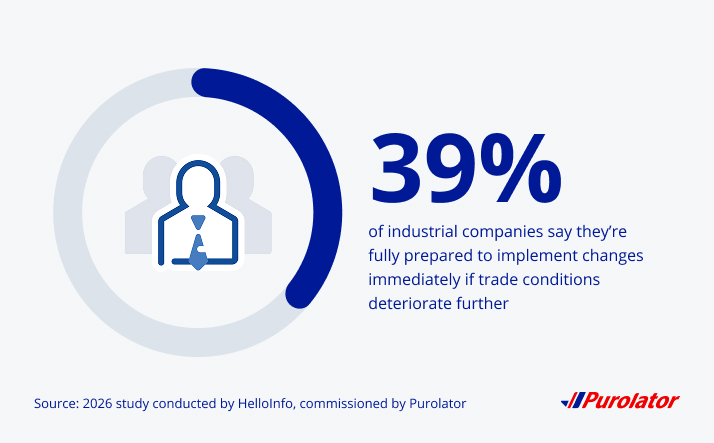
With the CUSMA/USMCA review approaching, the data proves that industrial companies that have acted early are better positioned than those still waiting for certainty before moving. Only 39% of industrial companies say they’re fully prepared to implement changes immediately if trade conditions deteriorate further. Among Canadian industrial companies, that number drops to 30%. For a sector with some of the broadest tariff exposure of any industry in this research, that preparedness gap has real consequences.
For industrial shippers that haven’t yet locked in their position, the priority actions are clear: Audit your CUSMA/USMCA certification coverage, map your tariff exposure by SKU and supplier origin and establish a single point of escalation with your cross-border shipping partner before the review. This proactivity can help mitigate the impact of lost customers, eliminated product lines, lower margins and industrial supply chain disruption.
Read the full global trade report
How Purolator supports industrial shippers
Purolator has been supporting industrial shippers across the Canada-U.S. border for more than 25 years and has been operating in Canada for over 65 years. Backed by Purolator’s 65+ years of Canadian delivery expertise, we bring both the cross-border specialization and the domestic network that industrial supply chains depend on. Purolator’s U.S. gateway and branch network provides the operational infrastructure to move industrial freight across the border with the visibility, compliance support and execution reliability that industrial shippers need, regardless of the size, shape or if special handling is needed. Purolator has the expertise and network size to adapt to your shipping needs.
Want to know what the CUSMA/USMCA review means for global supply chains? Read the full report.
For CUSMA/USMCA guidance
The Purolator Trade Assistant helps industrial shippers determine the right HS codes and customs documentation for their specific goods. With our trade compliance specialists and acquisition of Livingston International, North America’s leading customs broker, Purolator provides the expert brokerage support that industrial companies need as certification becomes a stronger cost mitigation tool.
For tariff exposure and operational support
Purolator’s cross-border team brings proactive analysis of shipment-level tariff impacts across the full North American network, including Canada, the U.S. and Mexico. We operate as a single-source end-to-end partner, offering full visibility and dedicated support when conditions change.
For freight management
Purolator offers less-than-truckload (LTL) and truckload (TL) cross-border shipping options for the large, heavy and irregularly shaped shipments that define industrial supply chains, with flexibility across ground, air, ocean and rail. Purolator also ranks #1 among Canadian LTL shipping carriers for billing accuracy and performance, and #1 in quality among national LTL shipping carriers, two metrics that matter when duty outlays are up and every invoice line is under scrutiny.
For commercial trade invoicing
With Purolator’s Digital Commercial Invoice, you can transmit trade records electronically to accelerate customs clearance and save time. This reduces delays caused by missing or incorrect paperwork, saves time by eliminating the need to print and attach invoices to shipments, and enables quick customs clearance.
For shipment consolidation
Our shipping consolidation service combines smaller shipments into a single, larger unit that clears customs as one piece. This offers clear benefits including improved transit time, reduced freight costs and a streamlined customs process.
For multimodal shipping options
Purolator is flexible and has the capability to provide next-day service solutions into and within Canada better than the competitors. We offer multimodal options across ground, air, rail or a combination that’s tailored to your budget, freight type and deadlines.
The tariff environment has tested industrial supply chains in new ways. Industrial companies are managing costs from both directions, restructuring supply chains and preparing for a CUSMA/USMCA review that will shape North American trade for the next 16 years. The companies being proactive and adjusting operations early are the ones that will make it through uncertainty. For the cross-border shipping complexity that comes with whatever the review delivers, Purolator’s industrial shipping expertise, customs brokerage and dedicated cross-border support are there to help keep industrial supply chains moving.
Want to learn what the CUSMA/USMCA review means for global supply chains? Download the full report
*This research was commissioned (paid for) by Purolator and conducted by HelloInfo, an independent research firm. Purolator was not identified as the sponsor during data collection.
*Purolator is Canada’s most reputable delivery brand in Canada, according to the 2026 Leger Reputation Study.