
The impact of tariffs can be felt far and wide across industries and countries, but, as our research finds, no one is taking the blow quite as hard as Canadian companies. U.S. tariffs on Canada have made goods crossing southbound less competitive, while retaliatory tariffs on U.S. imports for some specific industries (like steel, aluminum and automotive) have simultaneously increased the cost of goods moving northbound. For companies that sell these products into the U.S. market and source from U.S. suppliers, costs are rising from both directions at once.
U.S. tariffs on goods imported from Canada have also reduced the competitiveness of Canadian exports in the U.S. market, while Canada’s dependence on the U.S. as its dominant trading partner makes diversifying away from that exposure complex. This dependency colours the Canada tariff experience and it explains why the data in this research looks so different on each side of the border.
In 2026, Purolator commissioned HelloInfo to survey 348 shipping and logistics decision-makers across industrial, retail, healthcare and technology in Canada and the United States, split equally between both countries. The data shows that Canadian companies are far from passive. Rather than simply absorbing tariff pressure and waiting for it to pass, they’re restructuring more aggressively than their U.S. counterparts. By eliminating products, exiting markets, moving manufacturing and systematically reducing their dependency on highly exposed U.S. trade relationships, the most prepared companies have built contingency plans that will support them through July’s CUSMA/USMCA review.
Read the full global trade report
Key takeaways
-
- Why the Canadian tariff experience is fundamentally different from the U.S.
- How Canadian companies are responding and why it looks different from the U.S.
- Why Canadian companies have more at stake going into the CUSMA review
- What shippers need from their Canadian logistics partners
- What Canadian companies should do ahead of the CUSMA review
Why the Canadian tariff experience is fundamentally different from the U.S.
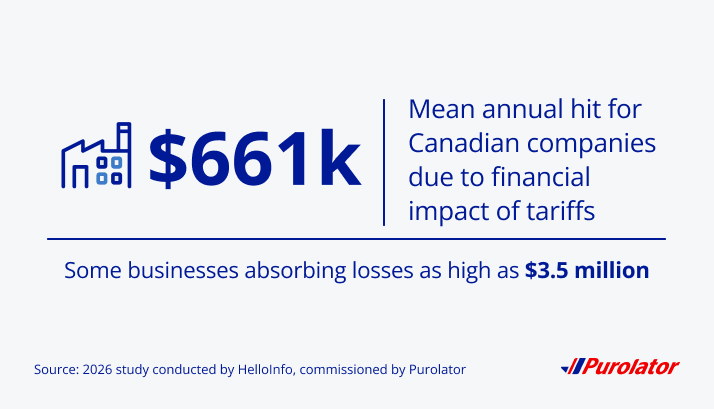
Canadian companies report a mean annual tariff hit of $661,000, with some businesses absorbing losses as high as $3.5 million
The financial impact of tariffs is significant on both sides of the border. Canadian companies report a mean annual hit of $661,000 CAD, with some businesses absorbing losses as high as $3.5 million because of the financial impact of tariffs. On a percentage basis, tariffs have affected Canadian revenues by 22.6 cents on the dollar, nearly identical to the 22.9% impact reported by U.S. companies.
Tariffs have affected Canadian revenues by 22.6%, nearly identical to the 22.9% impact reported by U.S. companies
On the surface, that 23% revenue impact looks the same in both countries. But when you’re absorbing a 23% hit while costs are rising simultaneously on the other side of the supply chain, it reveals a deeper picture of the Canadian tariff experience.
The customer loss data makes the gap visible. Across every sector in this research, Canadian companies report losing customers at higher rates than their U.S. counterparts:
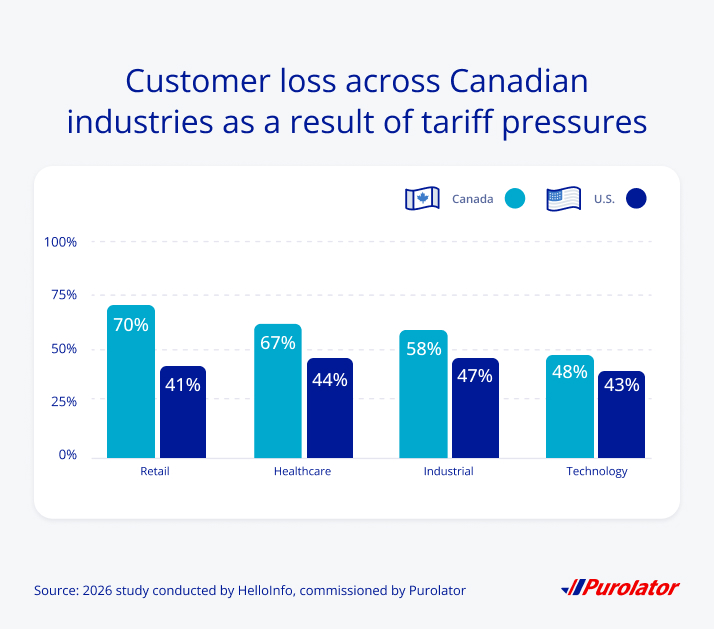
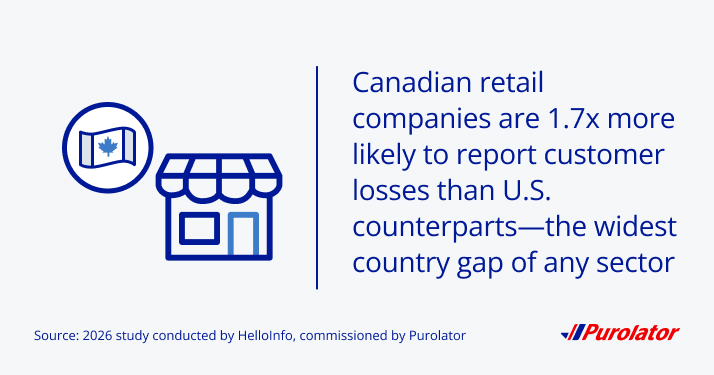
The retail gap is largest, but the pattern holds across every sector. Canadian companies are losing customers at higher rates across industrial, healthcare and technology as well, showing that the two-front tariff burden is producing real commercial consequences and not just operational complexity.
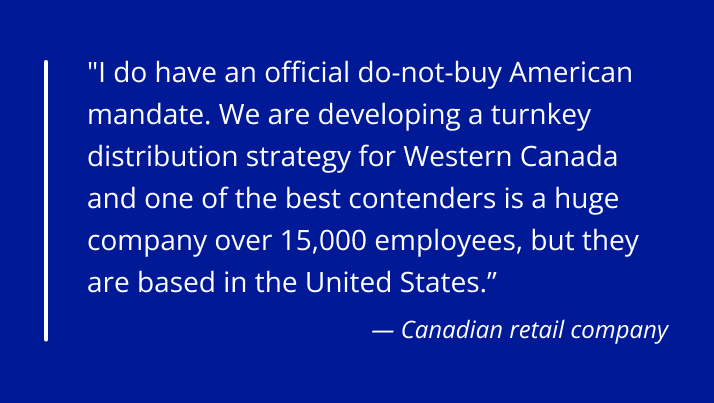
With such broad impacts of tariffs across industries, it makes sense that many Canadian businesses are actively reducing their dependency on U.S. suppliers. Eleven of the Canadian companies that participated in the research plan to exit the U.S. market entirely in the next 18 months, but no U.S. companies plan to do the same in Canada. That’s not a supply chain decision—it’s a statement about how some Canadian businesses now see the relationship itself.
See how companies south of the border are handling tariff changes.
Read the full global trade report
How Canadian companies are responding and why it looks different from the U.S.
Both countries have been deeply affected by shifting U.S.-Canada trade policies, but their response to these tariff changes is where they differ. U.S. companies are predominantly absorbing costs and investing in compliance infrastructure that reduces tariff exposure within existing supply chains. Canadian companies are restructuring by eliminating products, exiting markets, moving manufacturing and systematically reducing their exposure to a trading relationship that has been a pillar of their supply chains for decades.
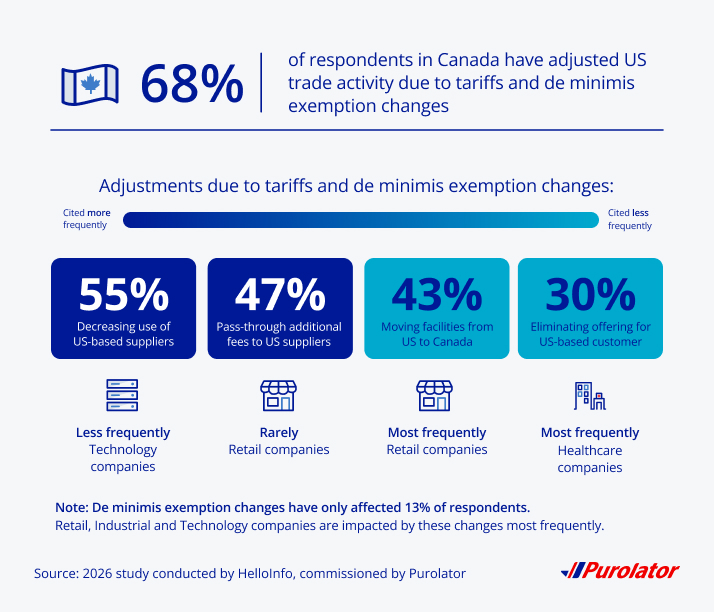
Sixty-eight percent of Canadian respondents have adjusted shipping to and from the U.S. as a direct result of tariff and de minimis changes. Among those, 55% are decreasing the use of U.S.-based suppliers, 47% are passing through additional fees to U.S.-based suppliers, 43% are moving warehouse or processing facilities to Canada and 30% are eliminating offerings for U.S.-based customers.
Canadian companies are also shifting operations toward Mexico more than U.S. peers. As a CUSMA/USMCA-compliant alternative to direct Canada-U.S. border crossings, Mexico offers insulation from tariffs. Of the 19 organizations that moved DC operations to Mexico in the past 18 months, 12 were Canadian companies, and 12 of the 23 companies that moved manufacturing to Mexico were Canadian. Looking ahead, 14 of the 22 organizations planning DC moves to Mexico are Canadian, and 14 of the 24 planning manufacturing moves are Canadian. These are directional signals rather than a mass migration, but Canadian companies are driving the trend disproportionately and they’re picking up speed.
Read how Mexico is becoming a strategic buffer for Canadian companies
Industrial: the most aggressive restructuring of any segment
Canadian industrial companies are among the most broadly exposed sectors and they’re responding accordingly: They’re more likely than any other Canadian sector to have relocated manufacturing, ceased sales to certain countries and eliminated product offerings entirely. In the next 18 months, Canadian industrial companies are four times more likely than their U.S. industrial peers to plan product eliminations, likely due to declining volumes amongst U.S. buyers as a result of tariffs.
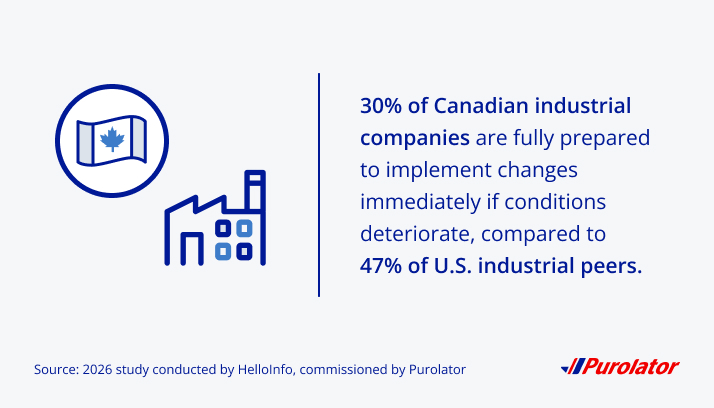
Only 30% of Canadian industrial companies are fully prepared to implement changes immediately if conditions deteriorate, compared to 47% of U.S. industrial peers. Despite that difference in readiness, Canadian industrial companies have among the highest CUSMA/USMCA certification engagement rates of any sector and many have made certificates of origin mandatory on all inbound supplier shipments, suggesting they’re treating certification as a frontline cost mitigation tool.
Learn more about the impact of tariffs on industrial companies
Retail: the highest customer loss rate of any Canadian segment
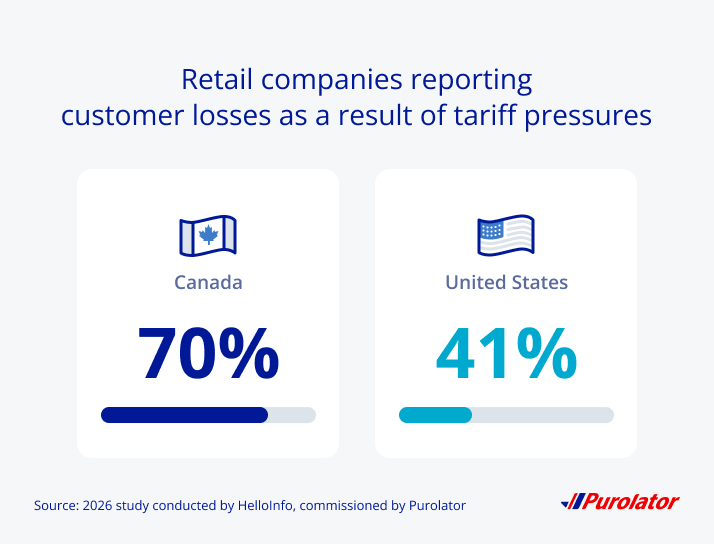
Canadian retail companies are up against both general tariff pressure and the end of the de minimis exemption, which fundamentally changed the economics of cross-border e-commerce. The result is the highest customer loss rate of any Canadian industry segment: 70% of Canadian retail companies report losing customers, compared to 41% of U.S. retail peers.
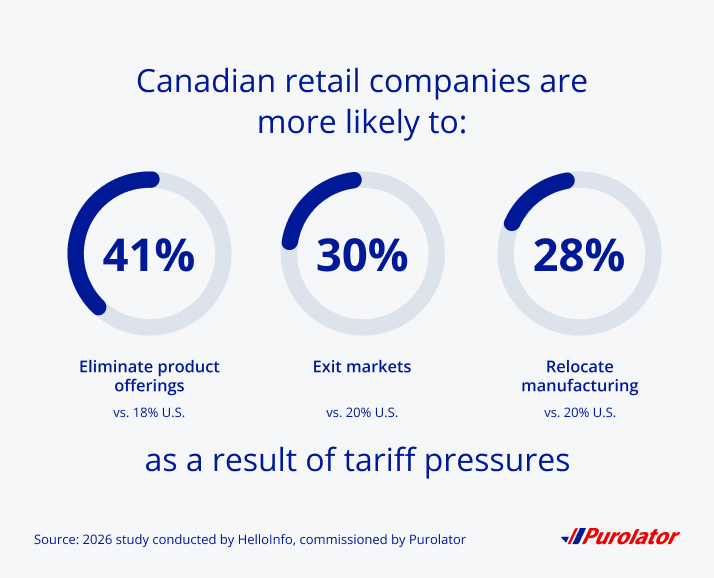
Canadian retail companies are more than twice as likely as their U.S. peers to have already eliminated product offerings (41% vs. 18%) and are more likely to have exited markets (30% vs. 20%) and relocated manufacturing (28% vs. 20%). The one area where Canadian retail lags is strategic customs investment: Only 24% of Canadian retail companies plan to invest in strategic customs practices in the next 18 months, compared to 45% of U.S. peers. Meanwhile, only 61% of Canadian retailers are aware of the upcoming CUSMA/USMCA review—the lowest of any sector in this research.
Learn more about the impact of tariffs on retail companies
Healthcare: proactive repositioning despite insulation
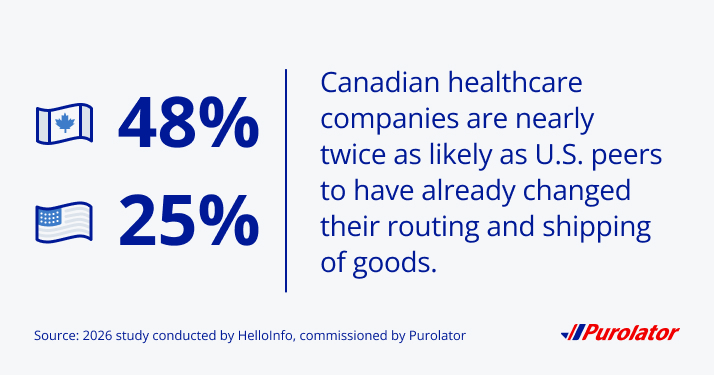
Healthcare companies are the outlier in the global dataset and in Canada. They’re largely protected by tariff-exempt HTS code classifications, so they haven’t absorbed the direct financial shock hitting industrial and retail. But they’re not treating that protection as permanent: Canadian healthcare companies are nearly twice as likely as U.S. peers to have already changed their routing and shipping of goods (48% vs. 25%) and plan product eliminations at nearly double the U.S. rate.
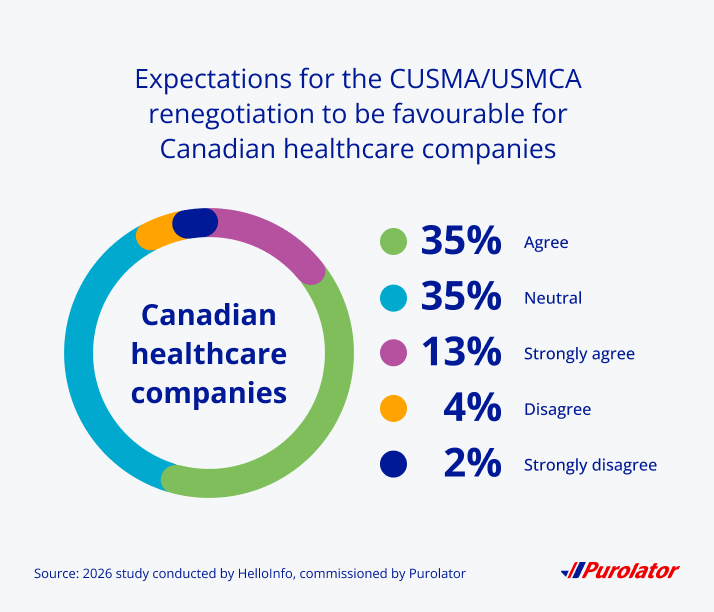
As for how Canadian healthcare companies feel about the CUSMA/USMCA, 35% are neutral on whether the renegotiation will protect Canadian goods from future U.S. tariffs, while 48% agree or strongly agree and only 6% disagree or strongly disagree. The sector doesn’t expect the worst but it also isn’t willing to assume the best either, given the prevailing view that the U.S. holds structural leverage in any renegotiation.
Learn more about the impact of tariffs on healthcare companies
Technology: margin pressure and cost management
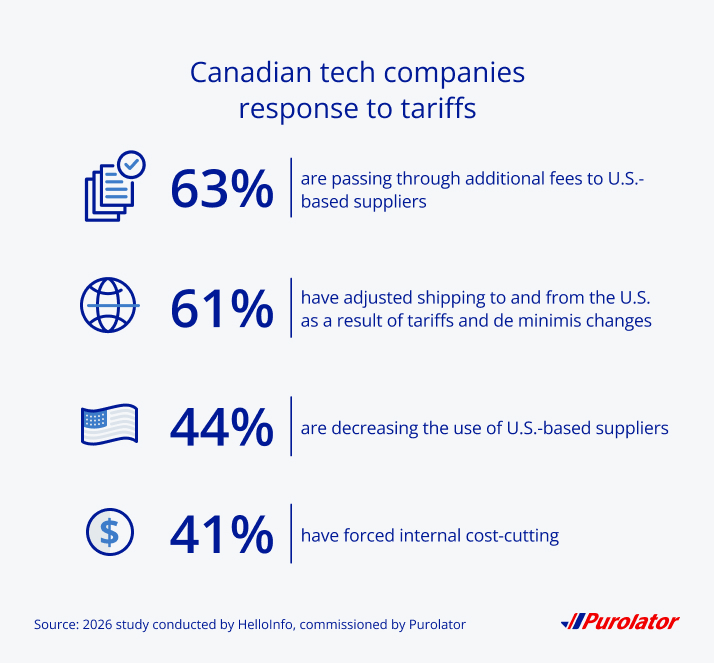
Canadian technology companies are responding to tariff pressure primarily through pricing and cost management, a trend that holds true south of the border. That’s because technology manufacturing is concentrated in Asia, making it harder to make quick changes to supply chains. Sixty-one percent of Canadian technology companies have adjusted shipping to and from the U.S. in response to tariffs and de minimis changes, 63% are passing through additional fees to U.S.-based suppliers and 44% are decreasing the use of U.S.-based suppliers. They’re more likely than U.S. peers to have forced internal cost-cutting in the past 18 months (41% vs. 36%). In the next 18 months, they’re more likely to plan supply chain reviews for cost-cutting (61% vs. 52%), price increases (59% vs. 50%) and internal cost-cutting (36% vs. 32%).
On the CUSMA/USMCA compliance side, Canadian technology companies are investing in strategic customs practices at 34%, well below U.S. peers at 57%. With tariffs on Canada unlikely to go away anytime soon, investing in compliance tools is one of the few ways for companies to reduce what they pay without overhauling their entire supply chain. For Canadian technology companies, closing that gap before July is worth prioritizing.
Learn more about the impact of tariffs on technology companies
Why Canadian companies have more at stake going into the CUSMA review
The CUSMA/USMCA joint review is scheduled for July 1, 2026. For Canadian companies, this is a defining moment that will determine whether their most crucial cross-border trading relationship stabilizes or deteriorates further. Seventy percent of all respondents are aware of the review, but Canadian companies show higher rates of awareness than U.S. counterparts.
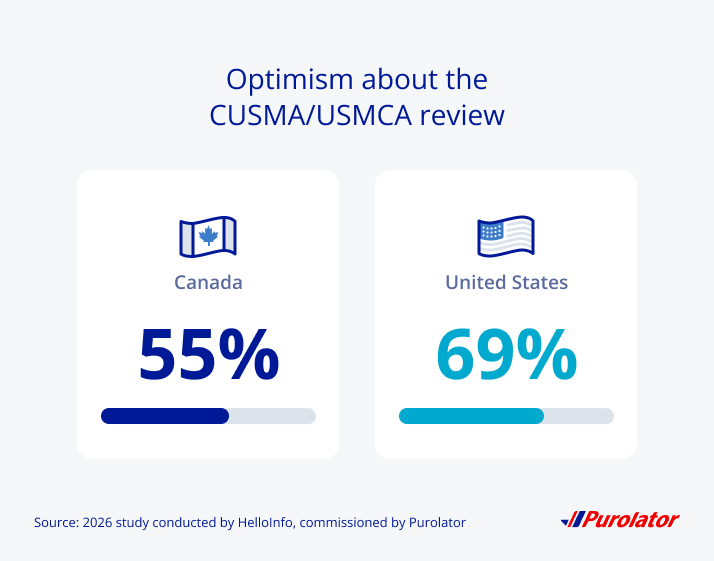
Fifty-five percent of Canadian respondents are optimistic about the review outcome, compared to 69% of U.S. respondents, and only 50% of Canadian respondents believe the review will offer protection from future U.S. tariffs on Canada. This suggests Canadian companies have a solid understanding of who has more to lose going into the CUSMA/USMCA review.
Read the full global trade report
Across industries, companies vary from uncertain to outright pessimistic. Canadian industrial companies are the most pessimistic segment of any industry/country combination: 18% disagree or strongly disagree that the renegotiation will create a more favorable environment, 40% are neutral and fewer than half are genuinely optimistic. Canadian retail and technology companies are more optimistic—but in retail’s case, that optimism may reflect the sector’s low awareness of the review rather than genuine confidence about the outcome.
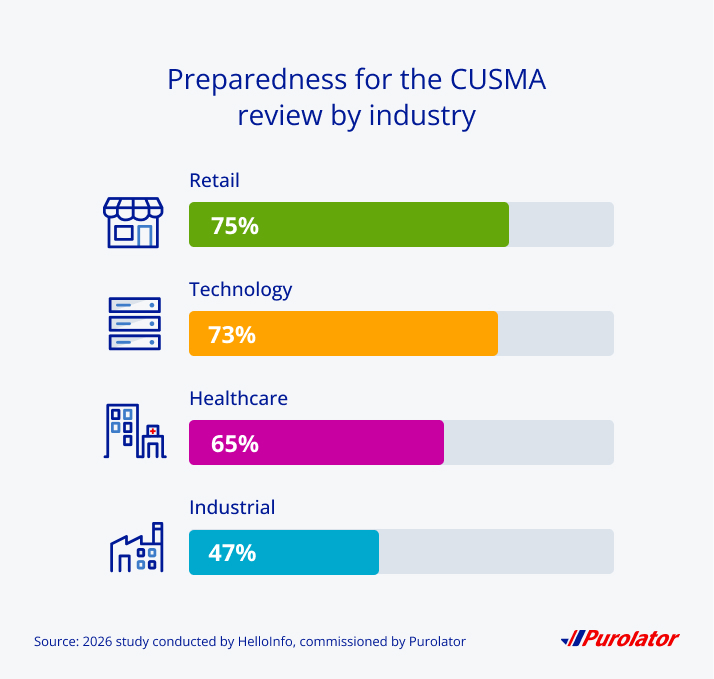
Canadian companies also lag on preparedness in every industry: Industrial companies are the least prepared for the review at 47%, while healthcare sits at 65%, technology at 73% and retail at 75%. The most common tactic among those who are aware of the review is to monitor news and hold off on making structural changes until the outcome is known. For a country where the review’s consequences will land harder and faster than south of the border, that “wait-and-see” approach could have a real cost.
For the companies that aren’t waiting for the outcome to act, they’re modeling best and worst-case scenarios with finance teams, making CUSMA/USMCA certificates of origin mandatory on all inbound shipments, building secondary supplier relationships outside the U.S. and engaging with industry associations for early intelligence on negotiating positions. These strategies will pay off regardless of what the review brings.
What shippers need from their Canadian logistics partners
Companies in both countries rely on cross-border logistics partners to support them through uncertainty. However, only 16% of Canadian respondents describe themselves as “very supported” by their U.S.-Canada shipping partners, compared to 30% of U.S. respondents. That gap is consistent across every sector.
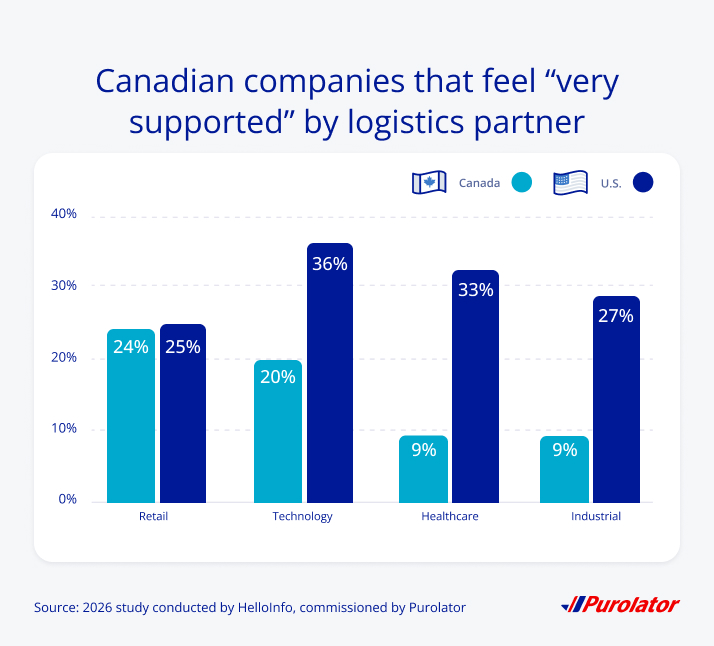
Canadian companies are operating under greater tariff pressure, making more operational changes and facing a higher-stakes review outcome. And yet, right when they need it most, they appear to be receiving less proactive support from their logistics partners than U.S. competitors.
The qualitative interviews reveal what’s been missing. Respondents overall said that during peak tariff volatility, carriers were slow to communicate, inconsistent across representatives and reactive when businesses needed proactive support. Combined with siloed internal teams, border delays and unexpected charges arriving weeks after a border hold, these friction points eroded trust.
What Canadian shippers want is consistent across all four sectors: proactive analysis of tariff exposure by shipment and SKU, practical CUSMA/USMCA certification guidance specific to their product mix, operational adjustment consulting that accounts for the two-front nature of their tariff burden and a single point of escalation when conditions change. Rather than generic policy updates, they need a partner that understands what it means to operate as a Canadian business right now and tailors the response accordingly.
What Canadian companies should do ahead of the CUSMA review
The upcoming CUSMA/USMCA review will dictate whether the agreement holds for another 16 years. Even a favourable outcome will kick off a period of interpretation and adjustment, while an unfavourable one will trigger a new wave of uncertainty. Either way, now’s the time for companies to prepare. Here’s how:
Between now and July, model your best- and worst-case scenarios. Canadian companies have more to lose from an unfavourable review outcome than U.S. counterparts, which makes financial modeling a necessity rather than a nice-to-have. If you’re already evaluating Mexico as a CUSMA-compliant routing alternative, accelerate that work. And if you haven’t, this is the time to start moving.
In the next 90 days, the highest-ROI move for most Canadian companies is a CUSMA/USMCA certification audit: Map your cross-border SKUs against current rules of origin requirements, identify gaps and make certificate of origin collection a mandatory supplier requirement. Alongside that, establish a single point of escalation with your Canadian shipping partner now before July creates the urgency to find one.
Beyond the review, the best way to set yourself up for any outcome is to invest in compliance infrastructure now, including HTS reclassification and free trade agreement optimization. It’s also the key time to build supplier relationships outside the U.S.
For the full 12-month action framework, including industry-specific guidance and benchmarks from 348 North American shippers, download the complete research report.
How Purolator supports Canadian shippers
Canadian companies are the most underserved by their logistics partners relative to the tariff pressure they’re under. As Canada’s largest integrated freight and courier network with over 65 years operating in Canada and over 25 years of cross-border experience, Purolator is positioned to deliver the proactive partnership that Canadian shippers are asking for across every sector and on both sides of the border. Whether you ship industrial goods, retail products, healthcare supplies or technology equipment, our cross-border expertise and trade compliance capabilities are built around the challenges this research surfaced.
For the full 12-month action framework, including industry-specific guidance and benchmarks from 348 North American shippers, download the complete research report.
For CUSMA/USMCA compliance and certification
Through our acquisition of Livingston International, Purolator provides Canadian shippers with access to 2,700+ Canada trade experts at over 52 border crossings, seaports, airports and other strategic locations in the U.S., Canada, Mexico, Europe and Asia. Livingston’s trade compliance specialists bring deep knowledge of CUSMA/USMCA rules of origin, HTS code classification and duty drawback programs, filling crucial support gaps for Canadian shippers. The Purolator Trade Assistant provides on-demand tariff classification codes, duty estimates and customs documentation requirements for Canadian teams auditing their certification coverage before July.
For tariff exposure analysis and Canada trade intelligence
Purolator and Livingston host tariff-focused webinars that translate a rapidly shifting regulatory environment into concrete operational guidance. For Canadian companies modeling CUSMA/USMCA scenarios, Livingston’s trade consulting services provide the specialized expertise that most internal teams don’t have internally.
For cross-border complexity and Mexico routing
Purolator’s integrated North American network covers Canada, the U.S. and Mexico with less-than-truckload (LTL) and truckload (TL) freight options, end-to-end customs support and bilingual trade compliance specialists who understand CUSMA documentation requirements at every border. For Canadian companies evaluating Mexico as a CUSMA-compliant buffer, Purolator supports both the Canadian logistics and the compliance requirements that come with a more complex routing strategy.
For network reach and single-source support
Purolator delivers to 100% of Canadian postal codes with Canada’s largest nationally integrated courier and freight network and 97% owned assets. Every Purolator customer is assigned a single point of contact who has full account visibility and the mandate to surface issues proactively, providing the streamlined support that Canadian shippers need amidst trade uncertainty.
Canadian companies are carrying more than their share of the current trade disruption and the July review will test that resilience further. Many have already made decisive operational changes but others are still playing catch up. For companies that want to build resiliency into their supply chains, preparation starts now. Download the full research report to understand how businesses across industries and both countries are navigating tariff uncertainty and how to prepare for July’s review.
*Purolator is Canada’s most reputable delivery brand in Canada, according to the 2026 Leger Reputation Study.
**This research was commissioned (paid for) by Purolator and conducted by HelloInfo, an independent research firm. Purolator was not identified as the sponsor during data collection.