
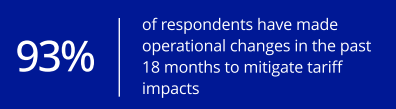
Purolator-sponsored research found 93% of businesses have taken action to manage fallout from the tariff uncertainty currently affecting Canada-U.S. trade. For most, this has meant a recalibration in their approach to international shipping, including a willingness to shakeup existing practices and implement new strategies. But businesses need help, with a majority looking to their logistics provider for guidance and support in finding ways to mitigate the effects of U.S. tariffs on Canadian goods, the end of the de minimis exemption, along with uncertainty about the future of the Canada-United States-Mexico Agreement (CUSMA/USMCA).
Businesses should know though, they are not alone in facing this uncertainty. Purolator, along with its subsidiary Livingston International, provide integrated solutions that help businesses mitigate risk and adapt to changing conditions. Purolator’s logistics capabilities, combined with Livingston’s customs/trade expertise, enable highly-effective solutions that address current trade and tariff issues while ensuring logistics optimization.
The Purolator-sponsored research included U.S. and Canadian supply chain decision-makers across the industrial, technology, healthcare, and retail verticals. The purpose of the research was to determine the extent to which Canada-U.S. trade has been affected by the tariffs, and to gauge how businesses were responding.
Turn global trade insights into smarter business decisions. Download the report
Among businesses on either side of the border, and across all industries, the findings might be described as “five alarm.” U.S. and Canadian businesses are reeling from the combined effects of tariff increases and uncertainty about what may lie ahead. A few more notable takeaways include:
- Tariff-related costs are the top concern among all businesses, with 45% of respondents putting the issue at the top of their list, and 85% having it in their top five.
- 61% of Canadian businesses and 44% of U.S. businesses have lost customers due to the tariffs.
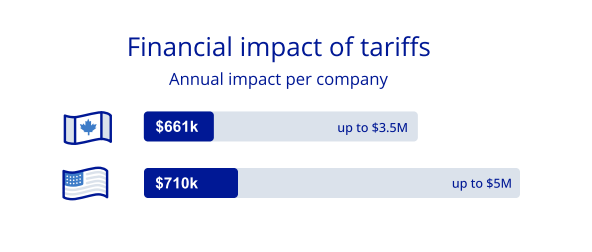
- Businesses have experienced revenue losses amounting to, on average, 23%. Among Canadian businesses, the “typical” revenue loss has been $661,000 and for U.S. businesses, the average loss has been $710,000. One U.S. business reported a revenue loss of more than $5 million.
Other top concerns include:
- Shipping cost increases – 83%
- Supply chain reliability – 75%
- General border delays – 66%
- Cross-border shipping compliance – 64%
- Decreasing margins – 59%.
Key takeaways
Managing the Fallout
With no resolution to the Canada-U.S. trade dispute in sight, Purolator’s research found a sense of urgency among businesses to find ways to manage the fallout. It seems that when it comes to preventing disruption, controlling costs, and maintaining customer relationships, all solutions are worthy of consideration.
This “whatever it takes” attitude is exemplified by the 93% of businesses that have implemented some degree of change within their operations.
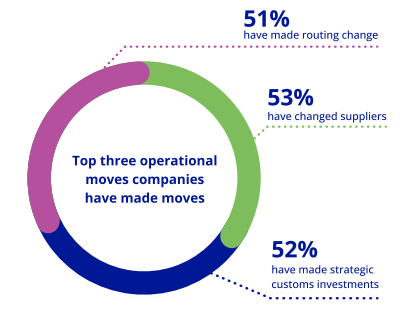
Roughly half of the survey participants have made changes that include:
- Switched to suppliers located in countries with lower tariffs.
- Implemented strategic customs practices.
- Changed routing/shipping of goods.
- Raised prices.
- Passed through additional fees to U.S. suppliers (Canadian companies).
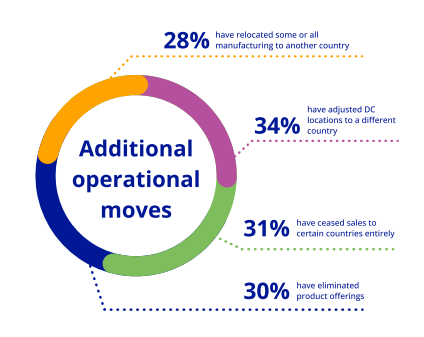
About one-third of respondents have done the following:
- Moved distribution centre locations to a different country.
- Stopped selling to certain countries.
- Eliminated product offerings.
Navigate trade volatility with confidence. Read the research report.
Logistics Excellence is a Must-Have
Implementing most of these mitigation strategies though, will require the strategic insight and capabilities of an experienced logistics partner. A business can’t simply uproot its established supply chain without having a plan in place to ensure reliable access to new suppliers who may be located thousands of miles and several oceans away. A business must have confidence that its logistics provider will have the resources and capacity required to ensure seamless product deliveries. This includes an understanding of all customs and regulatory requirements, insight about nuances of each marketplace, and access to an established distribution network.
The need to “feel supported” by their logistics provider rang through loud and clear in the Purolator research, with 81% of U.S. respondents and 75% of Canadian respondents saying they felt either “very supported” or “supported” by their provider. Businesses were especially grateful for providers that had a clear understanding of the current trade environment, and were able to offer proactive guidance. Most notably though, businesses want a single point of contact, someone to call who will have the answers, and be able to help when something goes awry.
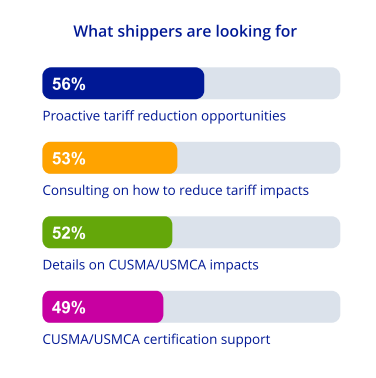
Too often though, businesses have been disappointed by their logistics provider’s inability to provide expertise and leadership. Survey respondents criticized providers for offering inconsistent, even inaccurate information, and for poor communication at a time when good communication is essential. Especially jarring were comments from some businesses that logistics providers seemed to be just as confused as they were by the changing trade environment.
For its part, Purolator has long prioritized customs/trade management and offers extensive consultative and compliance services. Purolator’s team of internal trade experts, including the highly experienced professionals at its subsidiary Livingston International, identify opportunities to manage duties and maximize customs efficiency wherever possible. In a recent series of webinars, for example, Livingston experts identified options including the use of foreign trade zones, customs bonded warehouses, and free trade agreements, and stressed the importance of proper tariff classification.
Learn how businesses can navigate current trade uncertainty. Download our white paper
Purolator’s customs and trade expertise complements its extensive logistics capabilities, which ensure comprehensive cross-border service between the U.S. and Canada. In addition, global network capabilities provide service to more than 220 countries worldwide. This means a company can rely on Purolator for end-to-end international trade management: Customs/trade expertise along with an innovative distribution solution that ensures guaranteed, on-time deliveries.
Industry-specific examples of Purolator and Livingston’s capabilities include:
Industrial Companies:
As manufacturers consider shifting production to different regions, including Mexico, Livingston trade experts help determine the financial viability of such a move. The team provides an initial tariff analysis, and identifies opportunities for efficiencies, including eligibility for duty-free status under the CUSMA/USMCA. Meanwhile, Purolator logistics professionals develop a customized solution for each business, using Purolator’s integrated freight network to accommodate any shift in supply chain operations.
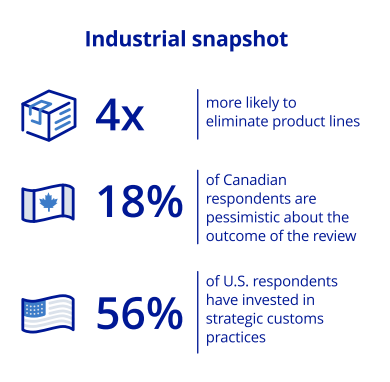
Learn more about the impact of tariffs on industrial companies
Retailers:
Retailers were hard hit when, in 2025, the United States terminated a favorable trade provision that allowed duty-free, express entry for shipments valued at less than USD$800. This provision, called the de minimis exemption, was especially lucrative for Canadian e-commerce retailers, who were able to sell duty-free to U.S. consumers.
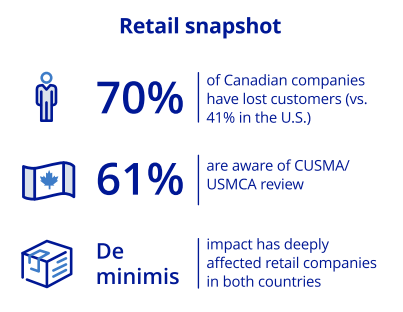
Purolator and Livingston trade and logistics professionals work with retailers to develop new e-commerce strategies for the post-de minimis environment. This includes ensuring the correct tariff classification code is assigned to each shipment, along with shipment consolidation strategies and U.S.-based fulfillment options that reduce border crossing frequency and improve transit times.
Learn more about the impact of tariffs on retail companies
Healthcare Companies:
The healthcare sector has been especially affected by current tariff uncertainty with pharmaceuticals, medical devices, med-tech, and life sciences targeted for tariff increases and other types of retaliatory actions.
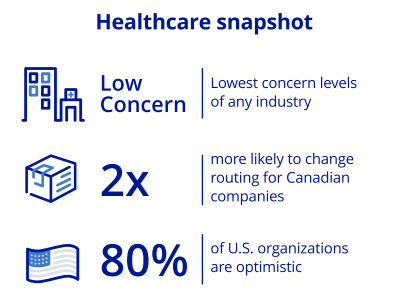
Livingston trade experts provide consultative services to help navigate the tariff uncertainty, and stress test tariff classification codes to ensure exemptions for pharmaceuticals not subject to the tariffs. And critically important, businesses have a proactive, single point of contact to ensure consistency and accountability as they navigate the period of uncertainty.
Learn more about the impact of tariffs on healthcare companies
Technology Companies:
With most technology companies heavily dependent on Asia-based production, businesses can rely on Livingston and Purolator for integrated solutions that address compliance as well as the need for logistics efficiency. Livingston’s trade experts focus on tariff classification accuracy along with country of origin and product valuation identifications. Failure to correctly list this information could result in excessive tariff assessments, as well as fines and penalties.
At the same time, Purolator’s logistics professionals develop distribution strategies that accommodate shipments originating in China and other Asian countries. Purolator builds solutions for seamlessly transporting Asian-based shipments, and ensuring fast, seamless deliveries throughout Canada, supported by a courier network that delivers to 100% of Canadian postal codes.
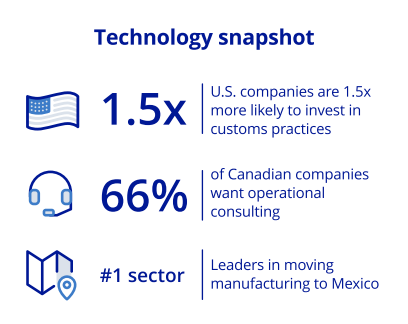
Learn more about the impact of tariffs on technology companies
The Uncertainty Continues: CUSMA/USMCA Review
As businesses react to the tariff increase fallout, they must also contend with the possibility of changes to the CUSMA/USMCA. The free trade agreement, which took effect in 2020, includes a provision for a mandatory six-year joint review. The deadline for that review was July 2026, at which time the United States declined to renew the agreement in its current form. According to Purolator subsidiary Livingston, that action triggered a period of negotiations that could extend until the agreement’s scheduled expiration in 2036. Or, any party to the agreement – the United States, Canada, or Mexico – could decide to withdraw from the agreement at any time, with six months’ notice.
For now though, the agreement remains in place and nothing changes. Or, as Livingston described the situation, continental trade across North America is now “in a state of purgatory, with no end in sight.”
For businesses, this means a period of uncertainty. Purolator’s research found nearly three-quarters of U.S. and Canadian businesses rely on CUSMA/USMCA provisions, especially duty-free entry, as the cornerstone of their U.S.-Canada trade strategy. And while most businesses – 70% — were aware that the agreement was set for review, more than four in five expect some level of disruption. This sense of pessimism was especially high among Canadian businesses, with 51% expecting significant disruption, compared with 21% of U.S. businesses.
Purolator suggests one very important thing businesses can do as they exist in this current holding pattern: Plan. Take stock of current supply chain operations, know where products are sourced, and plan for how those processes would be affected if products were no longer able to cross the border duty-free, or if the CUSMA/USMCA went away entirely.
Purolator used the takeaways from its research project to develop a framework for helping businesses navigate the current trade environment. While uncertainty will remain a constant, businesses can help minimize their risk by identifying vulnerabilities and shoring up weaknesses wherever possible.
The framework, which is explained in greater detail in Purolator’s accompanying white paper, features steps that include:
- Immediate Action (0-3 months)
- Audit your CUSMA/USMCA certification coverage.
- Map your tariff exposure by product and supplier origin.
- Establish a single point of escalation with your cross-border shipping partner.
- Near-term moves (3-6 months)
- Decide your “trigger points” (best-and-worst-case scenarios).
- Evaluate routing through Canada and Mexico.
- Begin supplier diversification conversations.
- Add tariff language to contracts set for renewal.
- Strategic Positioning (6-12 months)
- Invest in strategic customs infrastructure.
- Reduce single-geography dependency.
- Canadian companies:
- Evaluate your distribution footprint (in the post-de minimis environment).
- Engage with trade associations.
An in-depth planning session will allow greater visibility into a business’s many moving parts and identify areas of redundancy, as well as points of vulnerability. As Livingston points out, a business may realize it is overly-dependent on a particular market, or that changes in supply chain protocols are needed, or that the time is not right for an expansion plan.
At this point, only time will tell what, if any, changes will be made to the trade agreement. But by knowing their vulnerabilities, and planning ahead, businesses can head off any shock to their supply chains.
Amidst the Uncertainty – Businesses Can Count on Purolator and Livingston!
Many U.S. and Canadian businesses can’t remember a time when the two countries didn’t enjoy a free and open trade relationship. For decades, businesses have relied on the ability to seamlessly move goods across the border, often duty-free and with harmonized customs requirements. But all that has changed. At least for the foreseeable future, businesses must adapt to the current period of uncertainty in which all norms seem to be in flux, and all practices subject to change.
But as Purolator’s research makes clear, all is not lost. Businesses understand they have options, and that success in international shipping is possible. It’s essential though, to have a solid team on their side though – with partners like Purolator and Livingston International – that can help navigate the changing environment, and provide the resource and expertise vital to meet the moment.
Frequently Asked Questions (FAQs)
Is the CUSMA/USMCA still in effect?
Yes, the CUSMA/USMCA remains in effect, despite the July 1 decision by the U.S. government against renewing the agreement in its current form.
According to Livingston International, when the agreement was implemented in 2020, the three parties agreed it would be in place for 16 years, until 2036. However, it was also agreed that an interim review would take place every six years, at which time parties would have three options:
- Renew the agreement for another 16 year period (to July 1, 2042).
- Identify shortcomings and/or grievances and open up the agreement to annual reviews for the remainder of the current period (to July 1, 2036).
- Provide a six-month notice to exit the agreement altogether.
Per Livingston’s analysis, the U.S. has chosen the second option. This means the CUSMA/USMCA will remain in force, “under the same rules that have governed trade across the continent for the past 18 months.”
Click here for additional information.
Why didn’t the U.S. government renew the CUSMA/USMCA?
The United States identified issues with both Mexico and Canada, several of which, notes Livingston International, are “carryovers” from the original CUSMA/USMCA negotiations. A listing of U.S. concerns includes:
Mexico
- Lack of U.S. access to Mexico’s nationalized energy sector.
- Inadequate enforcement of CUSMA/USMCA labor provisions that require Mexican unions to provide more transparency and respond to worker complaints in a timely manner.
- Agricultural issues including an influx of certain Mexican produce into the U.S. that competes with U.S. producers. The U.S. is also concerned about Mexican restrictions on genetically-modified crops from the U.S.
- Consistent with original CUSMA/USMCA negotiations, the U.S. continues to demand greater automotive content be produced in the U.S.
- Concerns over the transshipment of Chinese-made products into the U.S. via Mexico.
- Concerns over Mexico’s rapidly growing trade deficit with the U.S.
Canada
- Greater access to Canada’s supply-managed dairy market.
- Concerns over the transshipment of Chinese-made goods entering the U.S. via Canada. The U.S. is particularly concerned about electric vehicles.
- The proposed implementation of a digital services tax in Canada, which would tax U.S. tech companies headquartered outside the country, but that generate profits within Canada.
- Tariffs on steel and aluminum.
Please click here for additional information.
When will the CUSMA/USMCA renegotiation be settled?
There is no set timetable.
According to Livingston International, discussions are ongoing between the United States and Mexico about terms of trade across America’s southern border. Similar discussions between the U.S. and Canada have yet to be scheduled.
Click here for more information.
Are CUSMA/USMCA-eligible goods exempt from U.S. tariffs announced in August 2026?
No. Unlike previous tariffs, those that took effect in August 2026 specifically do NOT exempt goods that would otherwise qualify for preferential treatment under the CUSMA/USMCA. The August 2026 tariffs affect certain products in the alcoholic beverage, dairy, and motor vehicle categories.
However, according to Livingston International, CUSMA/USMCA-qualifying products still benefit from Most Favoured Nation (MFN) tariff treatment, as found in the Harmonized Tariff Schedule of the United States (HTS).
Click here for more information.
What goods are affected by the latest round of tariff increases?
The latest series of tariff increases affect both U.S. and Canadian goods, as detailed below:
United States
Effective August 22, 2026, the United States has imposed additional 50% tariff increases on products in the dairy, alcoholic beverage, and motor vehicle industries.
- Proc. 11046: Imposing Additional Duties to Offset Canadian Discrimination Against the Commerce of the United States With Respect to Alcoholic Beverages (July 20,2026)
- Proc. 11047: Imposing Additional Duties to Offset Canadian Discrimination Against the Commerce of the United States With Respect to Dairy (July 20, 2026)
- Proc. 11048: Imposing Additional Duties to Offset Canadian Discrimination Against the Commerce of the United States With Respect to Motor Vehicles (July 20, 2026)
Canada
In response to the U.S. action, Canadian Prime Minister Mark Carney announced a series of retaliatory tariffs. Effective September 8, 2026, Canada has imposed counter-tariffs on a range of U.S. products including steel and aluminum, dairy, appliance, agricultural equipment, pulp and paper, plastics, and electronics.
Click here for a complete listing of U.S. products subject to Canadian counter tariffs.
How do I know if my goods are affected?
A product’s tariff rate is determined by its tariff classification code, which is the identifying number assigned to each product during the customs compliance process.
- For products entering the United States, tariff classification codes are found in the Harmonized Tariff Schedule of the United States (HTS).
- For products entering Canada, tariff classification codes are found in the Customs Tariff schedule.
Identifying the correct code can be complicated. A shipper must determine the exact code that matches the precise nuances of each product, including not only its purpose and core components, but its manufacturing process and any “special” treatments.
But, since tariff classification determines tariff rates – including eligibility for free trade agreement benefits – it’s important to get it right!
Help is available to assist in identifying the correct code. Options include:
Livingston trade specialists. Businesses can rely on Livingston International trade experts to identify the correct tariff classification code and ensure comprehensive customs compliance management. In addition, trade specialists can identify customs efficiency opportunities, and offer strategic insight about international supply chain management.
Purolator Trade Assistant. An online lookup tool allows shippers to quickly identify a product’s tariff classification code.
Advanced Rulings. Shippers may contact either the Canada Border Services Administration (CBSA) or U.S. Customs and Border Protection (CBP) and ask for an advanced ruling, which effectively eliminates any doubt about a product’s classification code. Customs officials review detailed information about a particular product and determine its correct code. However, advanced rulings are binding, meaning a business must accept the agency’s determination, even if another classification code seems more appropriate.
Alternatively, the two agencies maintain libraries of previous advance rulings. A shipper can review previous decisions to gain insight about how its products might be treated. Reliance on a prior ruling is non-binding.
Are there viable options for minimizing tariffs?
Purolator and Livingston trade specialists have identified several possible options for helping businesses manage fallout from the tariff increases. That list includes:
- CUSMA/USMCA eligibility. Although the August 2026 tariffs did not make an exception for CUSMA/USMCA-qualified products, previous rounds of tariffs did. Businesses should check – and recheck – to determine if products qualify for preferential treatment and are therefore able to enter the United States duty-free.
- Foreign Trade Zones/Customs Bonded Warehouses. In general, FTZs and customs bonded warehouses allow goods to enter a country duty-free, as long as they are stored in a designated facility. Although there are distinctions between FTZs and customs bonded warehouses, they allow businesses to avoid paying tariffs until goods are released into the U.S. market, or subsequently exported or destroyed.
- Consolidation. A good way to reduce cross-border costs is to reduce the number of times shipments cross the border. Purolator works with businesses to combine smaller shipments into single, larger shipments. The larger unit qualifies for reduced shipping rates, and also helps save customs/administrative fees.
- Alternate sourcing options. Many businesses are opting to enlist secondary suppliers located in countries with less trade uncertainty. Livingston’s trade specialists are experts in helping businesses identify potential new supplier/production sources, while Purolator’s global logistics capabilities ensure seamless service – and guaranteed deliveries and pickups – to more than 220 countries worldwide. One example: Purolator can seamlessly transport goods between Mexico and Canada, ensuring goods pass through the United States duty-free and with a minimal number of stops.
Click here for more information.
How can Cross-Border Logistics Efficiency Help?
Logistics efficiency is no longer a “nice to have” for businesses that ship regularly between the United States and Canada. In today’s environment, it is essential.
The combined capabilities of Livingston and Purolator help businesses navigate the current challenges, and identify new strategies for success. Benefits of a highly-efficient cross- border logistics strategy include:
- Customs Efficiency – An understanding of all customs requirements, and the expertise to ensure all documentation is completed accurately and thoroughly.
- Customs Experience – Familiarity with all border clearance procedures, so that shipments clear the border with minimal delays. This includes membership in all U.S. and Canadian “trusted trader” programs that allow expedited clearance to program participants.
- Global Insight – Expertise into global markets, and an understanding of each country’s strengths/weaknesses with regard to international business opportunities. Once a business decides to expand beyond North America, Purolator’s global logistics capabilities ensure reliable service from more than 220 countries.
- Comprehensive U.S. and Canadian Transportation/Service Options – Now more than ever, businesses need flexibility and innovation in managing their cross-border supply chains. Purolator prioritizes cross-border shipping with an integrated platform that addresses comprehensive cross-border needs. No need to enlist multiple service providers. Businesses have access to a broad range of services and capabilities, all managed within the Purolator network. This includes courier, freight and air services, along with customs expertise, trade consulting, supply chain security, and special services. One network for comprehensive cross-border services.
Shippers are also adjusting to the loss of de minimis. What can be done to offset the loss of this important benefit?
The August 2025 end of the de minimis exemption was especially impactful for e-commerce retailers and other businesses engaged in low-value shipping. Through the de minimis exemption, shipments valued at less than USD$800 were able to enter the United States duty-free, and with minimal customs documentation. Going forward, shipments are now subject to applicable tariffs and customs entry requirements.
There may be opportunities though, for mitigating the fallout. Trade professionals from Purolator and its Livingston International subsidiary have identified options that, depending on a business’s circumstances, could help. Those options include:
- Determine CUSMA/USMCA eligibility. Products that qualify for preferential treatment under the CUSMA/USMCA may be able to avoid tariff payments.
- Use of Foreign Trade Zones/Customs Bonded Warehouses. Businesses are able to store inventory in these U.S.-based facilities, but avoid paying duties/tariffs on goods until they enter the U.S. market.
- Contract Reviews. Businesses are advised to review all existing contracts and supplier agreements to identify opportunities for savings. Many times, businesses agree to shipping terms that become outdated by the time products are ready to ship. A contract executed while de minimis was still in effect would be a good example of an agreement that will need to be revised.
- Logistics Optimization. Purolator’s logistics professionals work with each business to identify new opportunities for adding efficiency. Purolator takes a “clean slate” approach with each customer, meaning all options are on the table and “because we’ve always done it this way” is not an appropriate justification for a shipping strategy.
Once Purolator has completely identified a shipper’s cross-border needs, logistics professionals develop an ideal strategy that draws from Purolator’s extensive capabilities to ensure fast, consistent, and efficient services. Businesses are often amazed at how inefficient their logistics strategies had become, and grateful for the opportunity to “start fresh” with a technology-based, innovative approach.
Click here for more information.
How can businesses expand supplier bases beyond the U.S. and Canada?
Purolator and Livingston are powerful partners in helping businesses expand their supply chains beyond North America.
Purolator’s logistics capabilities extend throughout the world, to more than 220 countries. Businesses can rely on Purolator to develop highly-efficient transportation solutions, regardless of where a shipment originates.
Livingston International trade experts offer extensive knowledge about global markets, and help businesses determine the viability of operating in a particular market. Once a business identifies a new market opportunity, Livingston ensures compliance with all customs mandates and, where possible, offers recommendations for customs efficiencies. This may include, for example, opportunities to take advantage of free trade agreements, or special trade incentives.